


The military and political situation of the Russian state in the second half of the 16th century was complex.
While the situation on the eastern borders had somewhat stabilized, with the exploration of the Urals and Yermak's expedition to Siberia in 1581, protecting the southern lands from Crimean raids required the construction of fortresses and the organization of patrol services. In the west, however, Ivan the Terrible had to persistently fight for access to the Baltic Sea to restore cultural and trade ties with Western Europe. The early stages of the Livonian War (1558–1583, encompassing several campaigns in the Baltics) were quite successful for the Russian army. It captured several enemy fortresses. One of them, Fellin, a stronghold of the Livonian Order, ceased resistance only after Russian gunners bombarded it with "fire" (incendiary) cannonballs. As a result of several such victories, the Livonian Order, which had oppressed the peoples of the Baltics for centuries, disintegrated.
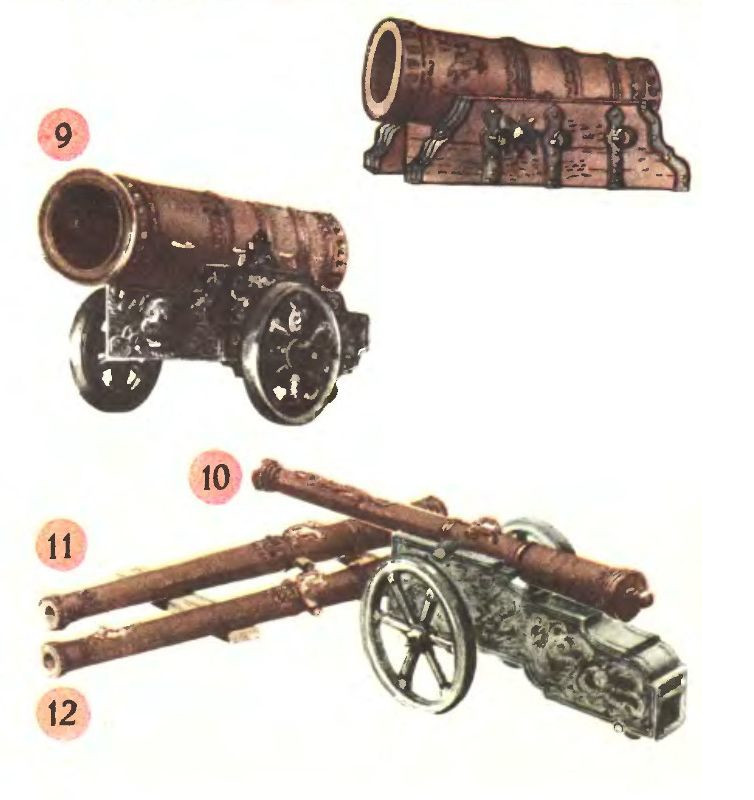 |
| 9. This is how the Tsar Cannon is commonly seen on the grounds of the Moscow Kremlin. Top right — the Tsar Cannon on a 16th-century carriage. 10. A. Chokhov's "Aspid" arquebus, stored in the Moscow Kremlin. 11. One of the siege arquebuses cast by Chokhov for the Russian army. 12. The battering arquebus "Lion." |
Russian artillery played a crucial role in the successful conclusion of this campaign. By then, the production of various artillery systems, gunpowder, and ammunition was centralized in a single institution — the Cannon Department, which oversaw workshops in Moscow and other cities.
The production of artillery and ammunition was strictly regulated. For example, in 1555, Ivan the Terrible wrote to the Novgorod clerks: "When the gunners arrive, you must immediately order the Novgorod blacksmiths to make 600 iron cannonballs according to the calibers sent with the gunners. The cannonballs must be round and smooth, as directed by the gunners." However, the master gunsmiths not only perfected existing types of artillery but also developed new samples of artillery technology. From that period, a bronze stone-thrower with a vertical aiming mechanism has survived. Interestingly, its barrel was not round, as was customary, but square, with sides of 18 cm, ending in a pyramidal loading chamber.
The Cannon Department gathered many excellent gunsmiths, experts in artillery. Among them was Andrey Chokhov (approximately 1545–1628). This remarkable man, a talented self-taught master, worked in the Cannon Department for about 60 years, creating over two dozen original cannons, a dozen of which have survived to this day.
In modern terms, Chokhov was a versatile designer. He created small cannons for regimental use, battering arquebuses, and mortars. His arquebuses "Wolf," "Lion," "Skoropeya," and "Yesup" have become legendary in the history of world artillery. But Chokhov's legacy goes beyond weapons. In 1621, at an advanced age, he cast four magnificent bells, whose chimes became a source of pride for the city's residents.
Nevertheless, providing the Russian army with heavy firearms remained Chokhov's primary focus. His apprentices, including Master Andrey and others, refined the shape of cannons, standardized their designs, and improved barrel casting techniques. These advancements accelerated the production of cannons for field armies and fortresses.
In 1577, during the height of the Livonian War, Chokhov crafted the colossal siege arquebus "Inrog," whose barrel reached a length of 5 meters. Unfortunately, during one of the battles, despite the valiant resistance of Russian gunners, the "Inrog" was captured. It wasn't until 1703 that Peter the Great secured the return of this remarkable weapon from the Swedes.
Nine years later, Chokhov cast the unprecedented Tsar Cannon for the Kremlin garrison. It weighed an astounding 40 tons, measured 5.34 meters in length, and had a caliber of 890 mm. The barrel's thickness ranged from 15 cm at the muzzle to 40 cm at the breech. This cannon remains in the Moscow Kremlin to this day. It is worth noting that the ornate carriage and the oversized cannonballs were created much later. As a mortar by design, the Tsar Cannon was intended to fire grapeshot — iron or stone shrapnel — at enemy forces. At that time, no other army in the world had such an artillery system.
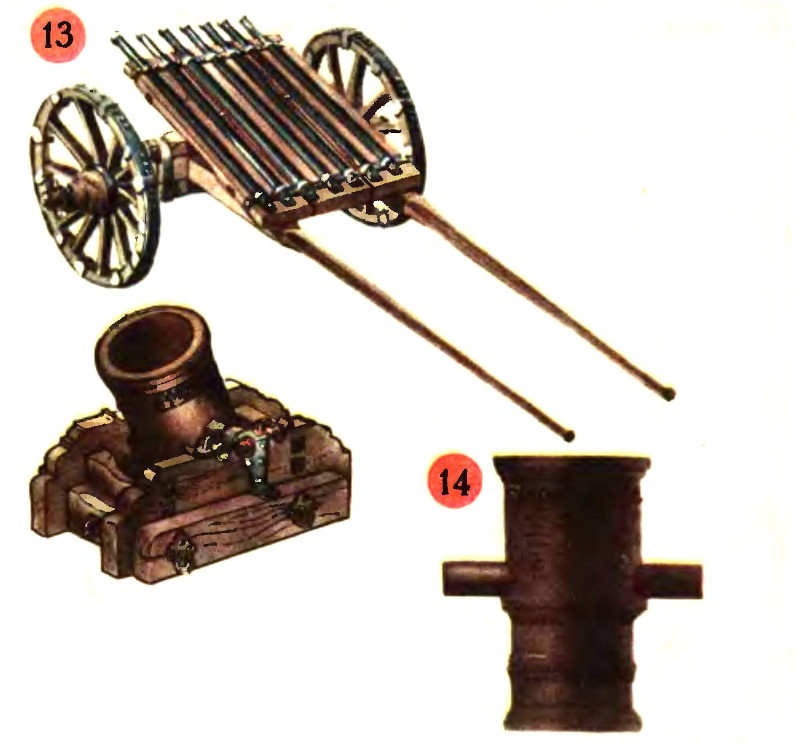 |
| 13. "Soroka" — a seven-barrel cannon used by Yermak Timofeyevich's expeditionary force. 14. A large-caliber short-barreled siege mortar crafted by Chokhov's apprentice, Master Prony Fedorov. Left — Fedorov's mortar mounted on a 16th-century carriage. |
The great achievement of Chokhov lies not only in his significant contributions to the development of artillery but also in fostering a generation of skilled gunsmiths, some of whom rivaled their renowned mentor.
In 1582, tackling the issue of increasing rate of fire, the gunsmiths crafted a hundred-barrel cannon. The following year, Ivan Fedorov developed a multi-barrel installation with interchangeable barrels. It is worth noting that such weapons had been produced in Russia earlier. For example, the "Soroka," a seven-barrel cannon reportedly used by Yermak Timofeyevich's expeditionary forces, is preserved in the Military-Historical Museum of Artillery, Engineer, and Signal Troops in St. Petersburg.
In 1605, one of Chokhov's apprentices, Master Prony Fedorov, cast a short-barreled, large-caliber (535 mm) siege mortar. It served Russian artillery units for many years before being placed in storage at the Moscow Arsenal when more advanced weaponry emerged. A century later, during his inspection of outdated weapons for remelting, Peter the Great discovered Fedorov's mortar. Admiring its craftsmanship, the Tsar ordered its preservation, inscribing on the barrel a directive: "By the sovereign's decree, this mortar is not to be remelted. 1703."
The endeavors of Andrey Chokhov, his colleagues, and students marked the culmination of the formative period of Russian artillery. By the late 17th century, their efforts had established the production of standardized cast weapons of various types and calibers, along with the necessary ammunition. Artillery systems began incorporating wheeled carriages, allowing gunners to participate in fortress defenses, sieges, and accompany troops on the march, facilitating swift repositioning during battles.
During this era, Russian artillery science also began to take shape. In 1621, clerk Onisim Mikhailov completed a fourteen-year project titled "Regulation on Military, Artillery, and Other Matters Pertaining to Warfare." This comprehensive work summarized knowledge on artillery design, operational use, siege warfare, and fortification construction. That same year, Mikhailov's "Regulation" was printed at the Moscow press, becoming one of the first textbooks for artillerymen and military engineers.
A century later, Peter the Great fundamentally reformed the Russian army, including its artillery. Notably, his sweeping reforms successfully integrated the best achievements of his predecessors with the demands of his era. Until then, Moscow's gunners would endure numerous trials and contribute significantly to the artillery's evolution through remarkable accomplishments in battles for the nation's independence.
On the header: Casting cannon barrels in a 16th-century workshop.