


In the work of the Arab writer Shams al-Din Muhammad, "A Collection of Information on Various Branches of Art," dated to the late 13th – early 14th century, two examples of the madfa are described—an unusual weapon for the early Middle Ages.
The first, the simplest and apparently the earliest version, resembled a short wooden tube of small diameter, mounted on a "stock." It was loaded with gunpowder and a "bunduq" (nut, pellet). The other, an improved version of the madfa, was an iron tube with a closed end. It could fire spherical bullets and arrows. The gunpowder was ignited by a heated rod through a priming hole located in the "breech" of the weapon. These are the first reliable records of the emergence of firearms abroad.
Possessing relatively advanced science and technology, the Arabs quickly mastered the new weapon and used it in the defense of the city of Alicante and later in the protection of their fortresses. From the Arabs, firearms made their way to Europe. In 1326, the first examples appeared in Italy; two years later, in France; and then they were adopted by the English (who successfully used them in the Battle of Crécy), the Swedes, and the Hungarians. It is worth noting that the first Western European "artillery systems" were practically no different from the Arab madfa of the 13th century.
 |
|
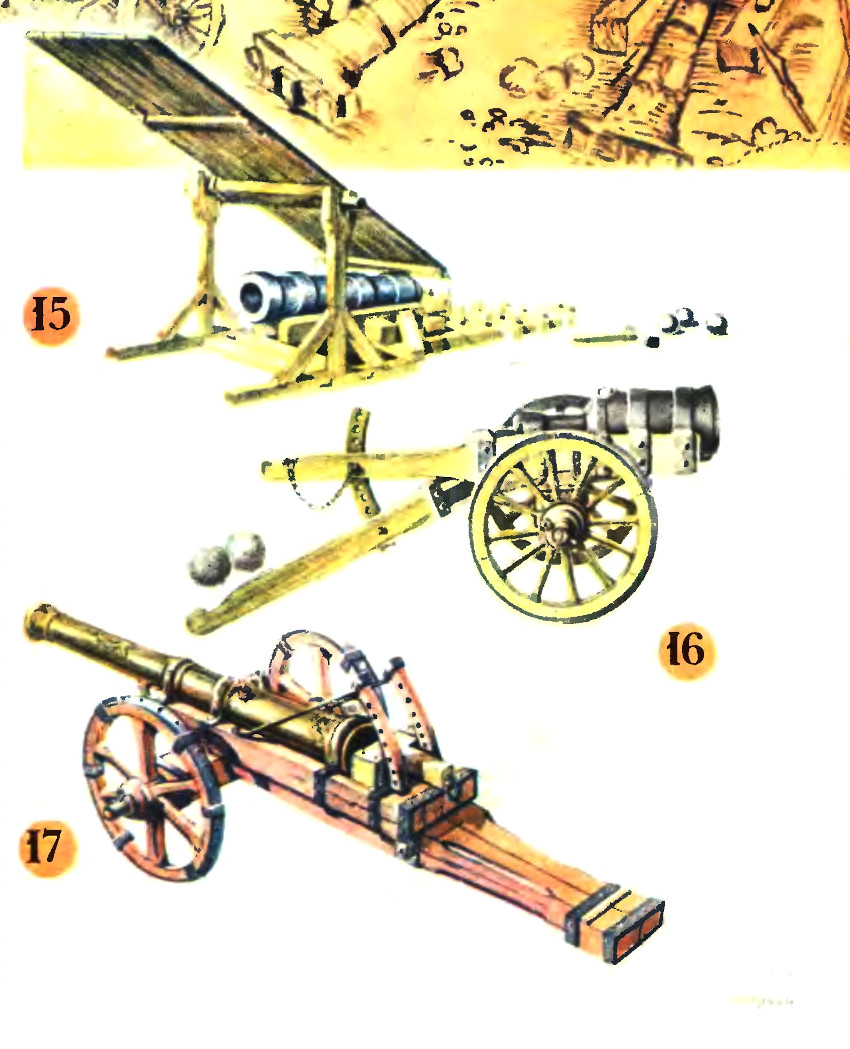
15. German cannon of the 15th century. 16. Spanish bombard on a wheeled carriage, 1470. 17. Western European culverin on a bronze carriage, 15th century. |
At first, European artillery developed rather slowly. Throwing machines were widely used because firearms were complex and expensive. Moreover, they were primitive and unreliable, and the technology of that time, along with the difficulties of cannon manufacturing, prevented gunsmiths from quickly improving their design.
Usually, cannons were made by handcrafting methods. Each master independently determined their design, size, and materials. He also typically supplied buyers with ammunition—stone, iron, or lead projectiles. This resulted in the inevitable "diversity" of medieval artillery systems.
When preparing for a campaign, suzerains usually ordered their vassals to supply the army with soldiers, provisions, equipment, and weapons, including artillery. However, the technical shortcomings of early cannons, particularly their bulkiness, low mobility, and slow rate of fire, led to their initial adoption primarily by fortress garrisons and armies that often besieged these fortresses for months.
Only with the strengthening of absolutism and the development of productive forces did artillery begin to improve and play a greater role in battles. By the late 15th – early 16th century, Western European gunsmiths transitioned to casting cannons with trunnions from copper and bronze, as well as producing cast-iron cannonballs. Wooden gun carriages, including wheeled ones, appeared, and artillery itself became the property of kings, symbolizing centralized states.
In the first half of the 16th century, the West saw the emergence of the first works on artillery. In 1537, the famous Italian mathematician Niccolò Tartaglia published his study "On the New Science," followed eleven years later by the book "Various Questions and Inventions." In these works, Tartaglia formulated the law of projectile trajectory curvature and proved that the maximum range of a cannonball is achieved when the barrel is elevated to 45°. Additionally, Tartaglia invented a precursor to modern rangefinders—the quadrant.
At the same time, the concept of artillery caliber was being formed. Initially, it was determined by the weight of the cannonball (hence the term "three-pounder cannon"). Only much later did caliber come to be defined by the diameter of the projectile and the bore of the barrel.
Although the quality of cannons improved significantly over the years, a unified system for firearm production in the West did not exist until the early 18th century. In France, an attempt was made to standardize the casting of only twelve specific calibers (matching the number of peers), while in the German principalities, a similar number of artillery systems were named after the twelve apostles. However, these measures did not yield significant results. Gunsmiths continued to disregard prescribed calibers, and "standardized" cannons were used alongside older models in the armies.
In 1494, the French army effectively used artillery in field combat for the first time. By then, the French had acquired lightweight cannons mounted on wheeled carriages, allowing them to move easily across the battlefield while firing cast-iron cannonballs. The Italian artillery, on the other hand, was outdated, featuring bulky cannons without carriages. As a result, Italian gunners could not change positions during battle and fired ineffective stone cannonballs. It is no surprise that the French quickly silenced the enemy's batteries, securing victory for their cavalry and infantry.
 |
|
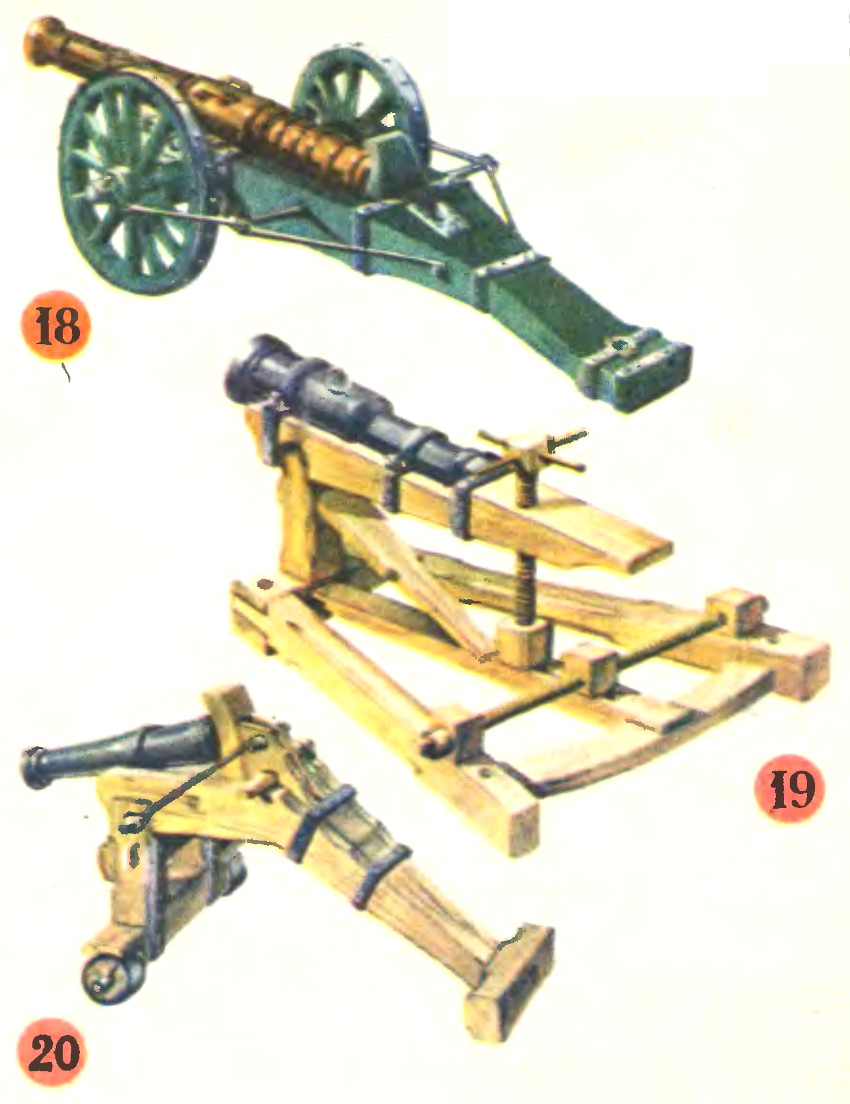
18. Culverin on a wooden carriage. 19. Fortress cannon of the 15th century. 20. German fortress cannon of the 15th century. |
The success of French gunners prompted gunsmiths and military leaders from other countries to hastily improve their artillery. For example, in the first quarter of the 17th century, Swedish King Gustavus Adolphus established regimental artillery.
Swedish light regimental artillery was equipped with "leather cannons," consisting of a relatively thin bronze barrel wrapped with tarred ropes, over which resin was poured before being covered with leather. While these cannons were lightweight, they were also insufficiently durable, often bursting upon firing and causing more harm to their own crews than to the enemy. As a result, they were typically used to fire grapeshot at short range to avoid overstraining the barrels. "Leather cannons" had a short service life and were soon replaced by four-pound cast-iron cannons.
Other Swedish innovations included a lifting mechanism and guide rails on the gun carriage, as well as packaging gunpowder charges in cartridges, which increased the rate of fire.
The development of artillery in Sweden undoubtedly contributed to the successful operations of its army during the Thirty Years' War (1618–1648) and spurred the advancement of firearms in Western Europe.
In particular, many countries exhibited a tendency to increase the firepower of cannons, even at the expense of their mobility. However, despite notable progress, Western European artillery remained inconsistent in caliber until the late 17th century. Furthermore, military commanders had yet to develop clear principles for its battlefield use.
Frontispiece: Artillery during a fortress siege (fragment of an engraving by A. Dürer, 1520).