


It is commonly believed that only the emergence of rifled guns in the second half of the 19th century became the impetus that brought fundamental changes to artillery in all countries of the world.
This opinion is quite natural, since even the best smoothbore cannons were inferior to rifled ones in range, accuracy, and ammunition effectiveness. All of this is true. But it would be a mistake to think that the very first rifled breech-loading guns were created only in the 1850s–1860s.
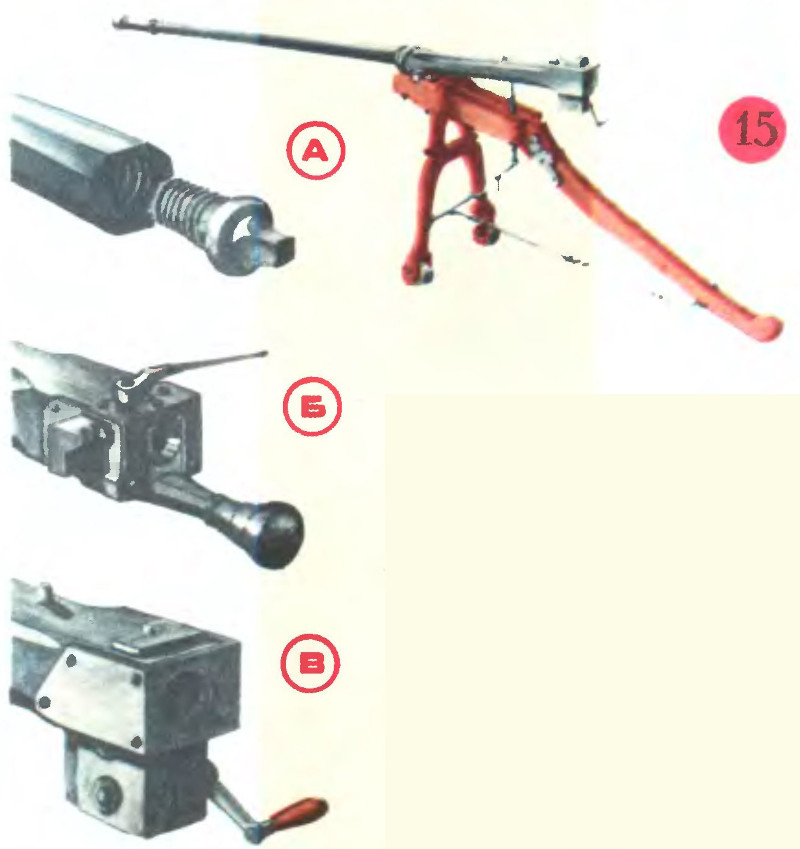 |
| 15. Russian breech-loading musket of the 17th century with a vertical wedge breech. Barrel caliber — 25 mm, barrel length — 665 mm. Examples of the first artillery breeches made by Russian gunsmiths in the 16th–17th centuries: A. Vingrad — prototype of the piston breech. B. Prototype of the horizontal wedge breech. |
Artillery historians know that already at the end of the 16th century Russian gunsmiths made an iron musket of 1.7-inch caliber — one of the first weapons of this type. Its barrel channel had rifling, and on the barrel itself, above the muzzle, there was a device for fixing the front sight. This remarkable weapon also had an unusual mechanism for all times, allowing it to be loaded from the breech. And this was by no means the only example of rifled artillery systems created by Russian masters.
In the Leningrad Military-Historical Museum of Artillery, Engineer Troops, and Signal Troops, one can see a bronze musket with ten spiral grooves inside the barrel. This weapon, cast in 1615, was also breech-loaded with a wedge breech. Incidentally, the German “cannon king” Krupp patented a similar breech only in the 19th century!
Thus, Russian gunners long before their Western European counterparts managed to create simple and reliable devices — forerunners of modern piston and wedge breeches. In particular, a piston breech (or, in the terminology of the time, a vingrad) was fitted to the 16th-century iron musket “Granovitaya,” which owed its unusual name to the characteristic polygonal shape of its barrel.
At the same time, Russian gunsmiths continued to work on increasing the rate of fire of guns. In the 16th–17th centuries, this problem could be solved in only one way — by increasing the number of guns in regiments. However, in this case, the batteries would be oversaturated with equipment, which would negatively affect their maneuverability, and controlling several dozen guns would be difficult. Russian masters found an original solution to this problem by creating multi-barrel guns called “sorokas” (recall the old expression “sorok sorokov,” meaning a great multitude!). Incidentally, at the same time, rifles with mechanisms for “repeated firing” were made, somewhat resembling the magazine rifles and revolvers of the 19th century.
One of the first to work on multi-barrel systems was the remarkable Russian gunsmith Andrey Chokhov. He created the aforementioned one-hundred-barrel cannon, which for a long time defended the Moskvoretsky Gate of Kitai-gorod. Later, the hundred-barrel gun, weighing 5.2 tons, was moved to the Cannon Yard, where it remained until the beginning of the 18th century. Chokhov’s weapon was designed to fire cannonballs the size of a goose egg, weighing about 200 grams.
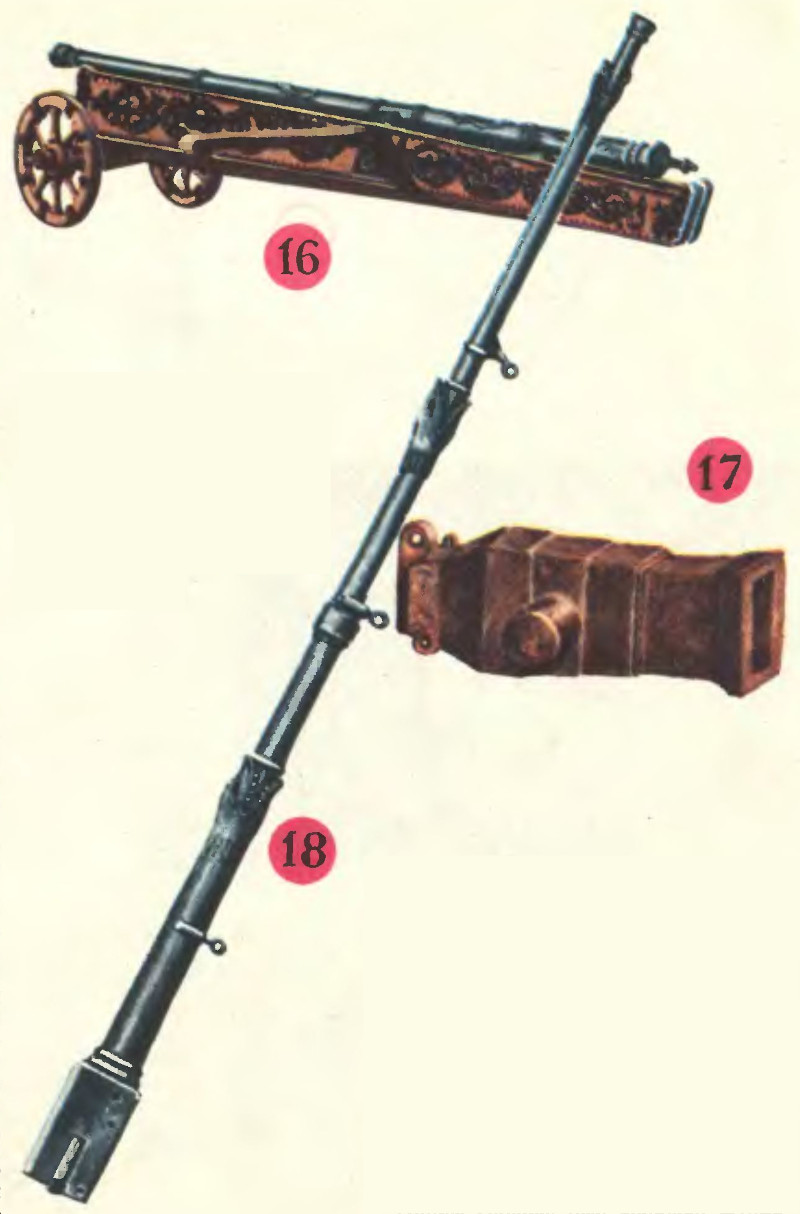 |
16. Musket with piston breech, in service with the garrison of the Trinity-Sergius Monastery. 17. Along with rifled weapons, stone-throwers were used in the Russian army. 18. Breech-loading musket “Three Aspids,” equipped with a vertical wedge breech. Barrel length — 4 m. |
Forty years later, Russian masters cast a more modest — “only” three-barrel gun weighing 952 kilograms, but firing 800-gram cannonballs. Also noteworthy is the 17th-century “mini-battery,” consisting of three-inch mortars arranged in three rows of eight barrels each. The charge chambers of each row were connected by a common trough, allowing salvo fire. This weapon was mounted on a two-wheeled carriage equipped with a device that allowed vertical aiming of each row of mortars.
Another artillery system of similar purpose included two dozen cast-iron mortars, mounted on a four-wheeled carriage in two separate groups — three rows in each.
It should be noted that multi-barrel “sorokas” were not exceptional in Russian artillery. In the 17th century, they formed the backbone of fortress artillery. For example, according to the 1637 inventory, Suzdal had “two copper forty-barrel muskets, with 37 iron cannonballs, each weighing half a grivna.” In Kaluga — “forty-barrel copper musket on a wheeled carriage, with 25 iron balls.” In addition, “forty-barrel” muskets were in service with the fortress garrisons of Borovsk, Mozhaysk, Tver, Putivl, Kolomna, Pereyaslavl, Tula, and others.
Russian gunsmiths achieved such remarkable successes in the development of artillery because the secrets of production were not the private knowledge of a single master. On the contrary, they were regularly compiled into manuscripts, and new generations of gunsmiths began work having mastered the experience of their predecessors. To this day, the manuscript “Orders of the Artillery Affairs,” dated 1680, and “The Affairs of the Moscow Artillery Order from November 30, 1681 to January 1, 1685” have survived, containing extensive material on the development of artillery in the Moscow state. In particular, they contain detailed information on the production of weapons of various systems and their combat use.
The handwritten work “Military Architecture,” from the same period, set out the rules for besieging and defending fortresses, provided recipes for making gunpowder, described the design features of various weapons and ammunition, and summarized the methods of deploying weapons in positions. This collection also contained recommendations for gunners on how to achieve effective firing.
Significant attention was also paid in the Moscow state to the practical training of artillerymen. Documents survive indicating that since the time of Ivan the Terrible, annual firing drills were held with guns of different calibers and types. This practice continued during the reigns of Mikhail Fyodorovich and Alexei Mikhailovich Romanov, and later firing drills became traditional for the Russian army. It should be added that such competitions were used to test new weapons, and the best of them were then adopted for service. At the same time, “training grounds” were used to develop effective methods of firing at various targets.
…The 17th century was ending, bringing many severe trials to our country. In a number of wars, the Moscow army managed to protect the state’s borders, and the soldiers of the Regimental Detachment played a significant role in this.
For gunsmiths, the 17th century marked the end of the formative period of domestic artillery, during which the types of firearms and the organization of artillery affairs were perfected. In short, the foundation was laid on which the reforms of the “first bombardier of the Moscow army” — Peter I — were based.
On the cover: Defense of Smolensk in 1633. Fragment of a German engraving of the 17th century.