Polemizing with critics of industrial art of the 1920s, V. Mayakovsky wrote:
Comrades,
have you seen a Royce?
A Royce,
merged with the wind?
And when it stands still —
a whale...
Engineer H. Royce and aristocrat C. Rolls set themselves the goal of creating a car that would be as reliable and comfortable as possible. At the beginning of the century this was considered a fantasy. However, the persistent work of the partners led to the creation of the “Silver Ghost” model. The car proved so perfect that for the next twenty years it required no major modifications. It owed its name to its silent operation and to the fact that many of its visible elements were silver-plated.
“Rolls-Royce” was probably the first of the cars that today are called “classics” (not to be confused with cars of a “classic layout”!). They were produced until the 1930s at factories that seemed to stand somewhat aside from the rivalry of major competing firms. The market for “classics” was guaranteed in advance. Buyers—bankers, aristocrats, sports and film stars—were willing to pay as much as possible for a car so that everyone could see how wealthy they were. For designers, working for such a client was a special challenge and pleasure. One could, without regard for cost, realize any technical and stylistic concepts—creating a kind of work of technical art. Design became art for art’s sake.
From the “classics,” many useful solutions found their way into mass-produced cars: for example, the electric starter, turn signals, and synchronizers in the gearbox. First used in the “Cadillac,” the starter ushered in a new era: previously, starting the engine was hard and dangerous work; now it became simple and accessible to everyone. It is true, however, that in terms of overall parameters the “class” car lagged behind ordinary vehicles, whose designers had to show ingenuity—lightening the car, improving layout, reducing production costs. In the design of “classics,” the greatest interest was focused mainly on bodies and engines.
For the Italian artist-designer E. Bugatti, working in France, the luxury of the “Silver Ghost” seemed insufficient.
In “Bugatti” cars, innovative engineering solutions were astonishingly combined with archaic ones—rigid suspension, brakes without friction linings. The designer devoted the greatest attention to the plastic, sculptural beauty of the mechanism. For example, he considered the joint between the cylinder head and the engine block unaesthetic. Therefore, the head was made integral. And the front axle! It was made from a thick steel rod, hollowed from the inside, forged into the required shape, and then spring packs were passed through it. All parts were chrome-plated. The result was a slender construction. But if it bent under a strong impact, for example against a stone, restoring its original shape was almost impossible. The spokes of the wheels of some “Bugatti” models were a web of… piano wire. Beautiful! But how to keep them intact, how to clean them of mud! In most “Bugattis,” however, cast aluminum wheels were installed—also beautiful, light, and convenient in use.
And now recall the words from a popular romance: “You are rocked in a soft swing by the blue ‘Hispano-Suiza.’” Does everyone know that this splendid name belongs to a car? Poems and even novels were dedicated to it. For what merits?
“Hispano-Suiza” translated means “Spanish-Swiss.” The designer M. Birkigt was born in Switzerland and began his activity in Barcelona. Having moved to Paris in 1914 and founded a new company there, he retained in its name a memory of his homeland and of Spain. Later, a figurine of a flying stork appeared on the radiator cap of the “Hispano-Suiza”—in honor of the famous World War I pilot Guynemer. He commanded a fighter squadron whose aircraft bore the image of a stork on their fuselages.
The great length gave the car a dynamic appearance, although its height exceeded that of a person. One could enter the interior without bending. A powerful engine provided high speed, rapid acceleration, and silent travel. The engine block was painstakingly finished by the hands of experienced craftsmen and, like a precious vase, coated with durable enamel. Each “Hispano-Suiza” was built slowly, like a house, and cost 30–40 times more than an ordinary car. Over a quarter century of the company’s existence, fewer cars with the silver stork were produced than “Moskviches” are made today in a single day.
Once, “classics” paraded along the Champs-Élysées and the avenues of the Bois de Boulogne in Paris, demonstrating the wealth of their owners. Today these brands have been supplanted by the mass-produced car, and the “classics” stand in museums, sometimes taking part in vintage car rallies. This is what it looks like.
Something unusual and large enters the roaring stream of cars. The hood and the attached wheel discs are covered with the sheen of polished aluminum, and the enormous headlights shine with silver. The interior of the body is upholstered in velvet, and the roof— in the spirit of old carriages— is covered with glossy leather. The steering wheel and window frames are made of mahogany; the instrument panel has a “frosted” texture. In the rays of the sun, mirrored windows and crystal lamps sparkle. Above the radiator, the legendary stork rushes forward. Behind the “Hispano-Suiza” follow a “Voisin,” a “Royce.” Slowly and majestically, these cars enter a fenced square, roll ceremoniously along a narrow corridor formed by the crowd. They maneuver awkwardly (they are very long!), their brakes creak, they line up in a herringbone pattern. Ladies and gentlemen step out, dressed according to the fashion of the 1920s—helmet-shaped hats, checkered flat caps, colorful long scarves, lace-up shoes, and knickerbocker trousers. Spectators peer under the hoods, click the shutters of cameras. And beneath the cars, puddles of oil soon appear.
What can one do—old age!
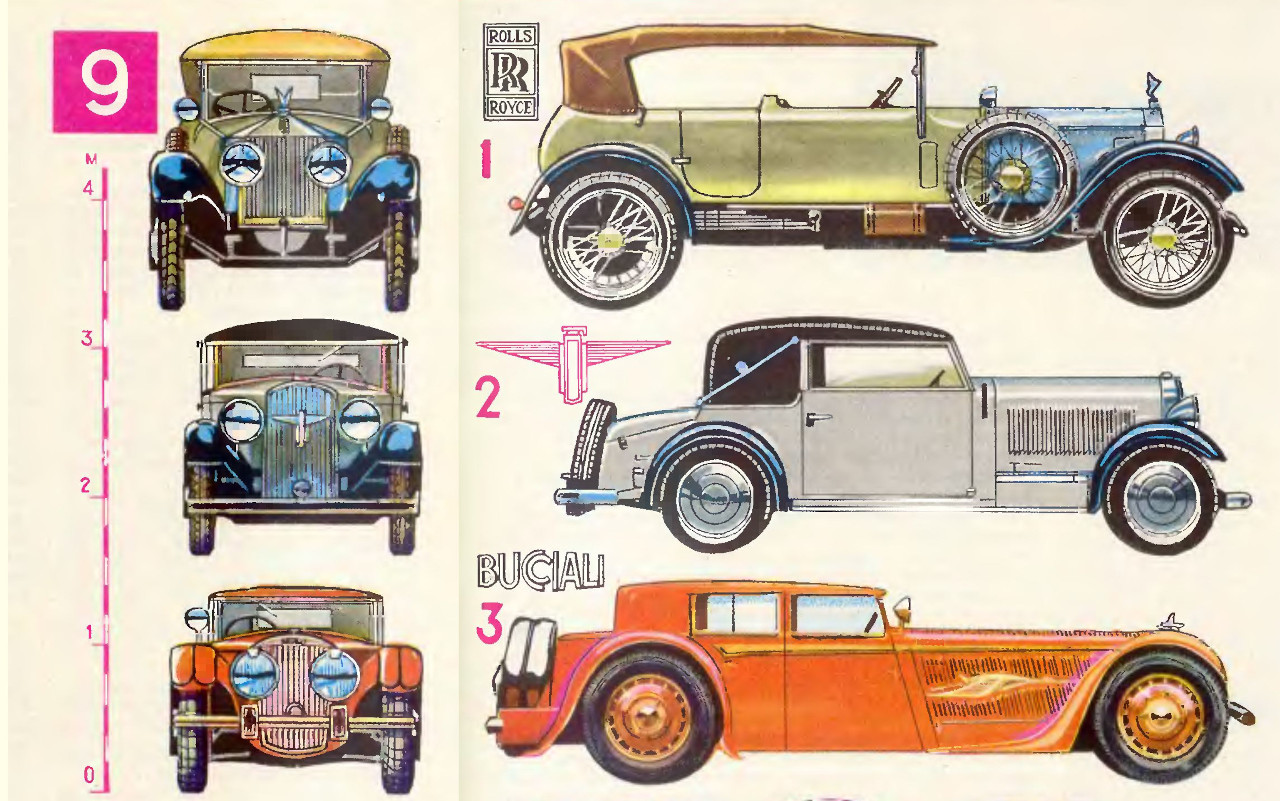
1. “Rolls-Royce,” model “Silver Ghost” (England, 1907–1926). Body — 6-seat double phaeton. 6-cylinder engine, about 50 hp. Speed up to 130 km/h.
2. “Adler,” model “Standard-8” (Germany, 1929–1933). Body — 4-seat convertible designed by the famous architect W. Gropius in the Bauhaus style. 8-cylinder engine, 70 hp. Speed 100 km/h.
3. “Bucciali,” model TAV-30 (France, 1930–1932). Body — 4-seat sedan. 16-cylinder engine, 155 hp. Speed 150 km/h.
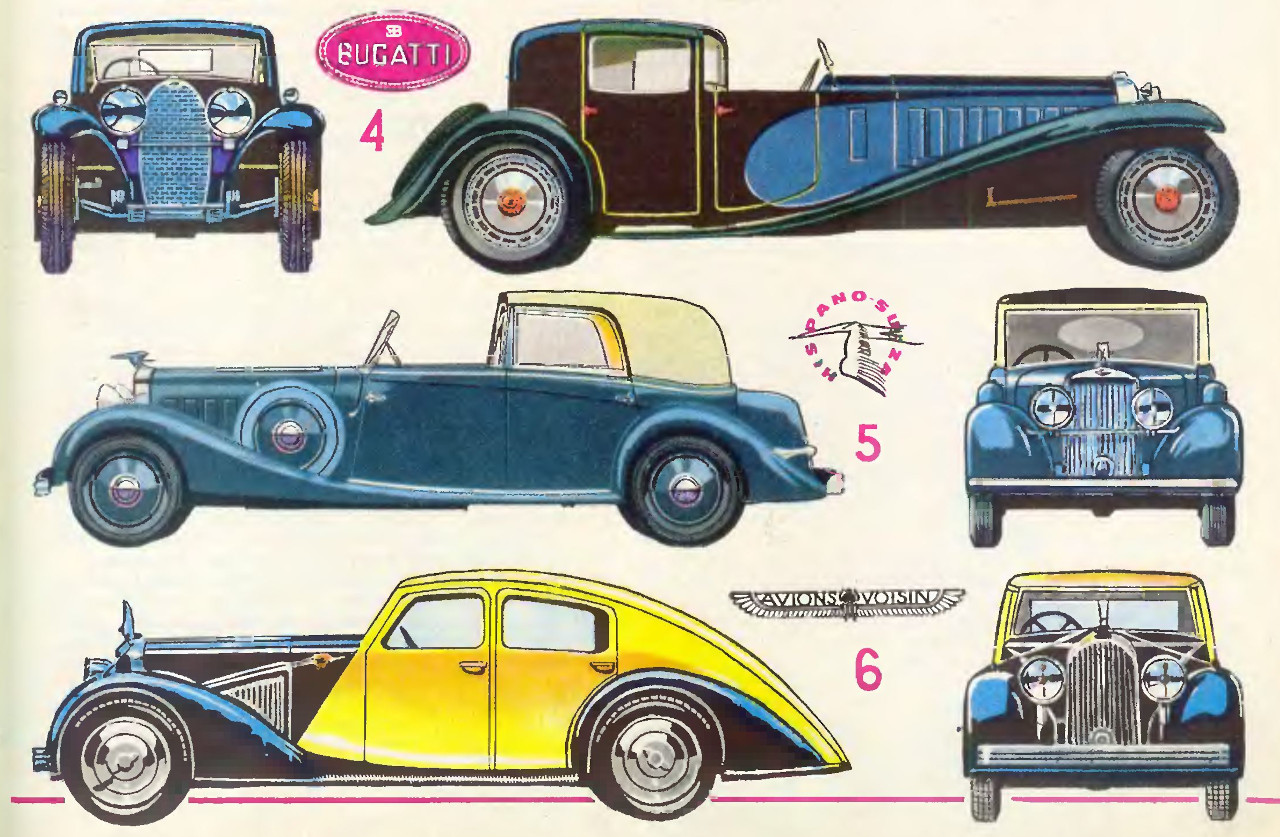
4. “Bugatti,” model 41 “Royale” (royal). Body — 4-seat sedan de ville (town coupé). 8-cylinder engine, 250–300 hp. Speed about 200 km/h.
5. “Hispano-Suiza,” model K6 (France, 1928–1933). Body — 4-seat convertible-limousine. 6-cylinder engine, 120 hp. Speed 150 km/h.
6. “Voisin,” model “Aérodynamique” (France, 1935). Body — 6-seat sedan. 6-cylinder engine, 150 hp. Speed over 150 km/h.