


The Latin word “omnibus” translated means: for all, universal. It became a transport term about two hundred years ago, when carriages for public use appeared.
They were called omnibus carriages, and later—briefly—simply omnibuses. The name underwent another transformation with the appearance of multi-seat passenger automobiles—omnibuses. Later the two words merged, producing “bus.” In many countries people say (and write!) simply “bus,” although such a combination of sounds means nothing by itself.
But taxis are also intended for everyone, yet they are not called buses! A bus is generally considered a vehicle with more than seven to nine passenger seats. It also differs in that passengers travel along strictly defined routes and get off wherever it is convenient for them.
The first buses of private companies differed little from horse-drawn tramcars—they looked similar and did not run any faster. They were “shod” with solid, molded rubber bands: the vehicles were truck chassis with bodies of carriage construction.
Municipal city buses appeared in our country only after the revolution. At first it was necessary to make do with vehicles of foreign brands, but soon the Yaroslavl Automobile Plant began producing bus chassis, and the Moscow Body Plant began producing bodies for them, modeled after English “Leylands.” Wood was widely used in the body construction: for the frame, interior lining (black, white, and yellow polished slats, the so-called paneling), side lattice false boards, steps, and door and window frames. The upper windows were made of colored ribbed glass. Above the roof rose a light box with the route number. The sides of the body were decorated with the coat of arms of the Moscow Soviet. Illuminated from within, such buses gave stops a festive appearance.
The basis of the later ZIS-8 and ZIS-16 buses was again the lengthened chassis of the ZIS-5 truck (see TM, 1972, No. 1). The ZIS-16 was distinguished by a streamlined body shape fashionable at the time, though hardly suitable for a city vehicle, and by a pointed chrome radiator grille.
It is easy to understand the surprise of city dwellers accustomed to buses with a traditional engine protruding forward when vehicles of the wagon type appeared on the streets. Experimental models were then undergoing operational tests. Many mistook them for trolleybuses (which had already appeared in Moscow by that time). Only by taking a closer look at the NIIGT (model of the Institute of Urban Transport) and NAMI-A could one notice radiator grilles and exhaust pipes.
What is a wagon-type bus? Imagine that it is necessary to accommodate in a vehicle as many passengers as their weight corresponds to the payload of the base model (ZIS-5—3 tons). In that case the length of the vehicle would have to be increased to 11 m (people cannot be packed like cargo). It would become unwieldy, heavy, and would take up a lot of space on the street. Therefore, the ZIS-8 had only 21 seats, and the ZIS-16—26 instead of the possible forty! In a wagon-type bus the engine is installed next to the driver’s seat, and sometimes in the rear of the vehicle. This makes it possible to increase the passenger compartment and eliminate the mismatch between capacity and payload. Carrying one passenger in a wagon-type bus costs one and a half times less than in one built on a truck chassis. An example is the NIIGT bus.
The layout with a transversely mounted rear engine was adopted for the first serial wagon-type bus in the USSR—the ZIS-154; only instead of a gasoline engine a diesel was installed, and the mechanical transmission was replaced by an electric one. A distinctive feature of the vehicle was a load-bearing body instead of a heavy chassis frame.
So little remained in common between buses and trucks that now “omnibuses” are produced at specialized plants—such as, for example, the Lviv or Likino plants. Modern vehicles are built with front- or rear-engine layouts. This essentially ends their similarity to veteran buses. Rigid metal leaf springs gave way to rubber air bags with compressed air, which provide a smooth ride and prevent the body from sagging regardless of the load. A bus driver works in even better conditions than his colleague in a passenger car—the seat is adjustable in height and tilt and is installed at the very front of the body, from where the road is clearly visible.
Moreover, there is no need to spend effort or attention on shifting gears—the transmission is automatic; there is neither a gear lever nor a clutch pedal. The result is a high average speed and traffic safety.
These improvements would not hurt any automobile. And a bus cannot do without them (despite the complexity and cost of some devices), because it is a public vehicle.
In large cities, vehicles of ever greater capacity are required. And they have appeared. Articulated buses capable of carrying 200 people. The Hungarian factory “Ikarus,” producing such super-buses, is known throughout the world.
It is not difficult to imagine that in the future, when the number of buses, private cars, and taxis increases, and when other modes of transport improve, one will not see standing passengers on city buses. The height of these vehicles will decrease; they will become like large passenger cars. It is possible that the need for drivers will disappear. After all, buses run on defined routes, and their movement lends itself to programming.
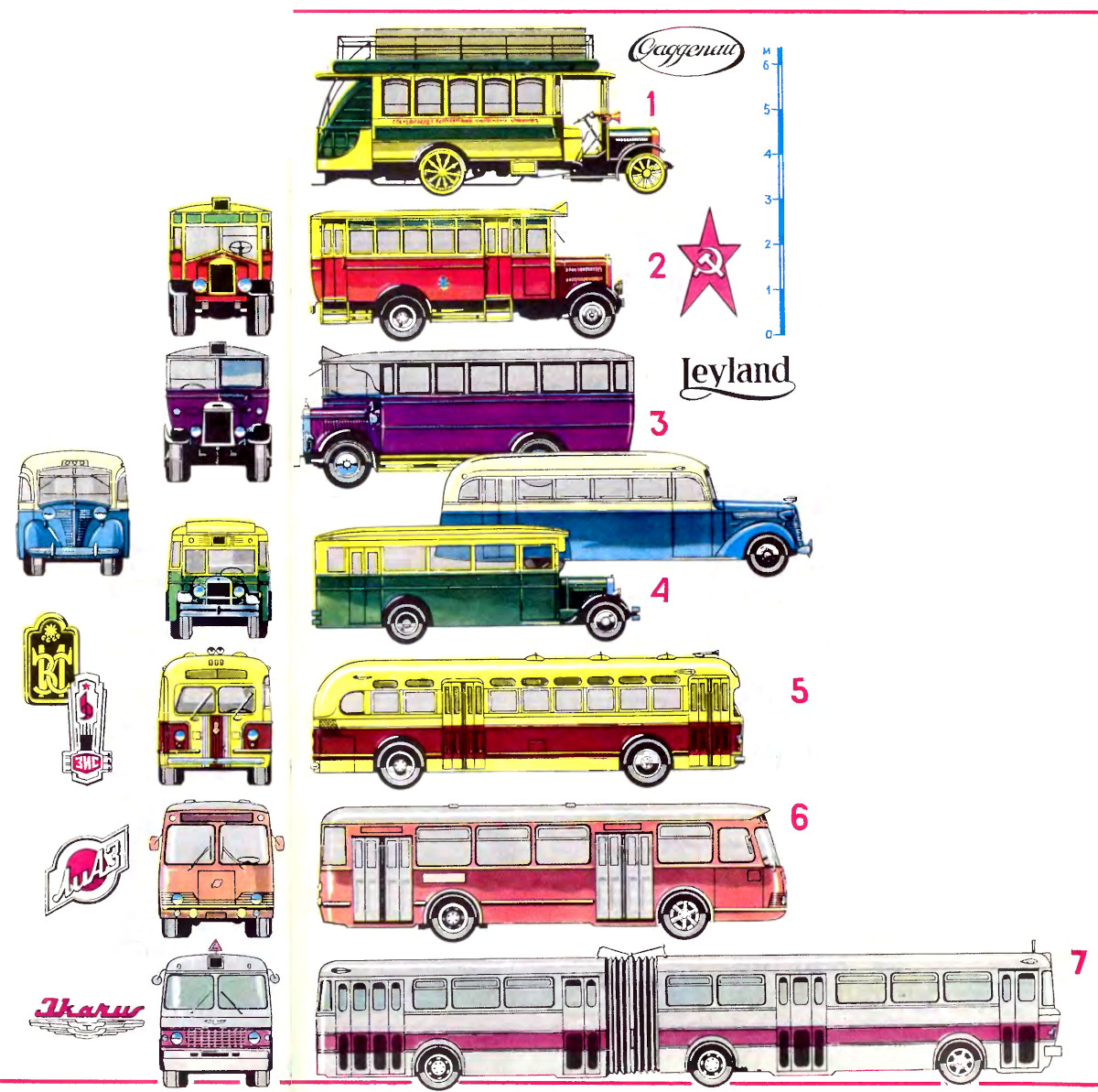
1. Early bus by Benz “Gaggenau” (Germany, 1911). Number of seats—20 in the body, 12 on the imperial deck; total (including standing passengers) 40. Engine: 4-cylinder, 32 hp. Speed: 26 km/h.
2. Ya-6 bus of the Yaroslavl Automobile Plant (USSR, 1928–1932). Number of seats 27, total 36. Engine: 6-cylinder, 73 hp. Speed: 40 km/h.
3. Semi-wagon bus “Leyland” (England, 1930–1933). Number of seats 32, total 40. Engine: 6-cylinder, 62 hp. Speed: 60 km/h.
4. ZIS-8 and ZIS-16 buses (USSR, 1934–1938 and 1938–1942). Engine: 6-cylinder, 73 and 85 hp. Speed: 60 and 65 km/h.
5. Wagon-type bus ZIS-154 (USSR, 1947–1950). Number of seats 36, total 62. Engine: 4-cylinder diesel, 110 hp. Speed: 65 km/h.
6. LiAZ-677 bus (USSR, 1967–1972). Number of seats 25, total 80. Engine: 8-cylinder, V-type, 180 hp. Speed: 70 km/h.
7. Articulated bus “Ikarus,” model 180 (Hungary, 1970–1972). Number of seats 40. Engine: 6-cylinder, 170–200 hp. Speed up to 80 km/h.