


The Lenin Year — the year of the 35th anniversary of the Great Victory, when the Komsomol of the entire country is carrying out the “Tree of Memory” campaign, is also an anniversary year for Soviet forestry.
60 years ago, on April 29, 1920, V. I. Lenin signed the decree “On Combating Drought,” which stated:
a) to reinforce ravines and sands by means of tree plantations;
b) to arrange snow-collecting strips and fences;
c) to afforest clear-cut areas, burned lands and other treeless spaces in arid regions, as well as in the upper reaches and along the banks of rivers...”
V. V. Dokuchaev and other Russian scientists had experimentally proven as early as at the end of the previous century the prospects of using shelterbelts to overcome the harmful influence of dry winds on crops, to improve the water regime and prevent soil erosion. But under the conditions of bourgeois–landlord Russia, their discoveries were not widely implemented in practice. Only after the Revolution did Lenin’s decree give forest-reclamation work aimed at transforming the nature of the country’s steppe zone truly nationwide scale.
During the concluding five-year plan alone, the area of protective forest belts in the RSFSR will increase by 255 thousand hectares. But whereas earlier any forest planting was considered a benefit, and the more that were planted the more optimism they inspired, the situation is changing now. The modern integrated scientific approach requires, without forgetting quantity, that primary attention be paid to quality, which is determined by the achievement of the final result. For forest belts, such a criterion of efficiency must be the increase in crop yields on the fields they protect, and not the number of plantings.
And one more thing. As noted in the central press, “many agronomists, team leaders and farm managers are now thinking: is it worth taking rich flat chernozem land for forests?” There are also some direct opponents of using shelterbelts. This means that not everything is going smoothly in this matter. That is why the editorial board decided to return to this topic.
Protective forestry has always received great attention in our country. It was associated with hopes not only for a substantial increase in field productivity, but also for a general improvement of the climate in steppe regions, for eliminating dry winds and dust storms. And although in most cases shelterbelts did indeed contribute to increased yields, the anticipated radical transformation of nature did not occur. Often, the grown, fully strong forest belts that seemed to form an impenetrable wall against the wind ceased to perform their role — to protect the fields from wind erosion. This became especially evident in 1969, when dense multi-row belts themselves perished from dust deposits.
It cannot be said that foresters did not draw any conclusions from this. On the contrary, the instructions and rules on forest planting were revised twice. Instead of 7–8 rows, it was first recommended to limit plantings to 4–5, and then to 3–4 rows. But this did not bring significant improvement. After all, in appearance the belts remained the same — dense and poorly ventilated. Foresters persistently try to plant the maximum number of rows permitted by the instructions, and in each row — the maximum permissible number of seedlings. On the one hand, this is financially beneficial for them, and on the other — common sense suggests that the denser the belt, the more reliable a barrier it will be against the wind. And indeed, who among us does not know that dense shrubs and trees protect much better from wind? But in this case common sense misleads us, and science has not opposed it with anything, having failed to answer:
how does a forest belt work?
Without an answer to this seemingly elementary question, without a clear understanding of the physical nature of the process by which wind speed decreases behind a wall of trees, the search for an optimal design of a forest belt cannot be effective.
 |
It cannot be said that agricultural science does not attempt to provide such an answer. On the contrary, modern literature offers a multitude of ideas on this matter, but all of them rely on the same common-sense assumptions.
Here is one of the most popular explanations: the air stream, overcoming the forest belt, loses part of its energy, which causes it to slow down. Yes, energy losses do occur, but they are too small to noticeably affect the wind speed.
Some specialists believe that the entire issue lies in the flexibility of branches, which, springing back, absorb wind gusts. But this explanation is incorrect if only because the best shelterbelts consist of mighty oaks, whose branches, as is known, are not flexible at all.
Since 1963, A. Ya. Smalko’s theory has become widespread, claiming that “a belt of any construction is a powerful generator of vortices.” In his monograph he repeatedly returns to this idea, trying once again — theoretically — to show that it is the formation of a vortex that leads to a decrease in wind speed. But this conclusion cannot be accepted either. In fact, the denser the belt and the more powerful a vortex generator it is, the worse it protects the field. After dust storms one often sees the following picture: behind dense plantings the wind has deposited a substantial heap of fine soil, clearly showing that a vortex was raging at that spot. There was a vortex, but, as practice shows, there was no protection for the field.
In A. V. Albensky’s monograph, published in 1971, an even “bold hypothesis” is proposed — that the air stream compresses before the forest belt and therefore warms up slightly. But anyone familiar with aerodynamics knows that air compressibility in a free stream flowing around an obstacle manifests itself only at speeds approaching the speed of sound — beginning at approximately 250 m/s. Such winds, fortunately, do not occur at ground level.
The last example is more likely a misprint than an error. It cannot be used for practical recommendations and will not cause harm. Far worse cases do occur. But first, let us see,
what aerodynamics shows
In engineering, special flaps or throttles are used to reduce the power of a flow. And to smooth it (laminarize it), grids and meshes of appropriate design are used.
Keeping this in mind, let us try to determine what changes take place in the air stream when it encounters a forest belt. Its model can be a flat grid (fence, panel with openings) with 50% porosity. Let us conditionally assume that the air speed in the openings does not increase or decrease (which is sufficiently accurate for our purposes). Then only half of the volume of the incoming stream will pass through the grid. Thus, the shelterbelt acts as a throttle flap: it lets through only part of the stream.
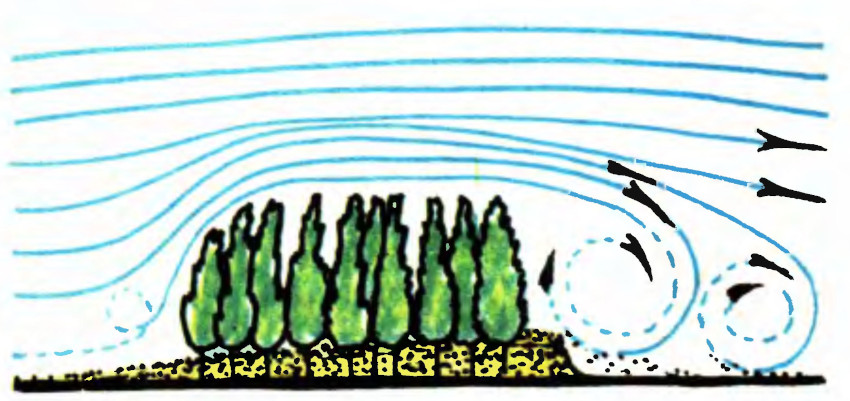
After overcoming the obstacle, the stream expands and, according to the continuity equation (in steady flow the speed of a jet is inversely proportional to the area of its cross-section), reduces its speed by half. And this slowdown manifests itself in the near-ground layer, whose height is approximately equal to the height of the belt. The remaining part of the air stream (the second half) rises and flows over the obstacle from above. At the same time, its speed above the belt increases. This increase is observed up to heights two to three times higher than the height of the trees. The shelterbelt has not reduced wind energy; it has not extinguished it. (Hydraulic losses undoubtedly exist but can practically be neglected.) It merely changed the distribution of velocities of the incoming stream: reducing them in the lower layer and increasing them in the upper one.
The weakening of the wind behind the forest belt will persist over some distance, and then, due to turbulent mixing of the air, the ground-level layer will regain the speeds it had before meeting the obstacle. And this will occur farther from the belt the more smoothed and less vortex-filled the flow is.
Openwork, wind-permeable forest belts, having acted as a throttle, simultaneously function as laminarizing grids — smoothing the flow and thereby preventing active mixing of the lower layer with the upper one. Skillfully created belts reduce wind speed at distances exceeding their height by 20–25 times or more, prevent the formation of deposits, and ensure uniform snow distribution over the protected area.
Unfortunately, most existing belts do not possess these qualities. Dense, poorly permeable, they let only a tiny part of the flow pass through them, that is, they function exclusively as throttles. The noticeable difference between the speeds of the lower and the upper streams leads to the formation of a strong vortex. Such a forest belt, which becomes itself a source of flow turbulence, begins to do harm instead of good. The ramp-shaped deposits that form behind it are clear evidence and physical proof that nothing good can be expected from it.
Misconceptions that must be overcome
The aerodynamic explanation of shelterbelt function presented above is so obvious that one involuntarily wonders: why did foresters not arrive at it immediately? The reason apparently lies in the fact that the authors of scientific works on shelterbelts are biologists — competent in botanical and ecological matters, but very far from mechanics. And we have already seen that analyzing the design of shelterbelts within the framework of biological sciences alone, without involving aerodynamics, is extremely difficult.
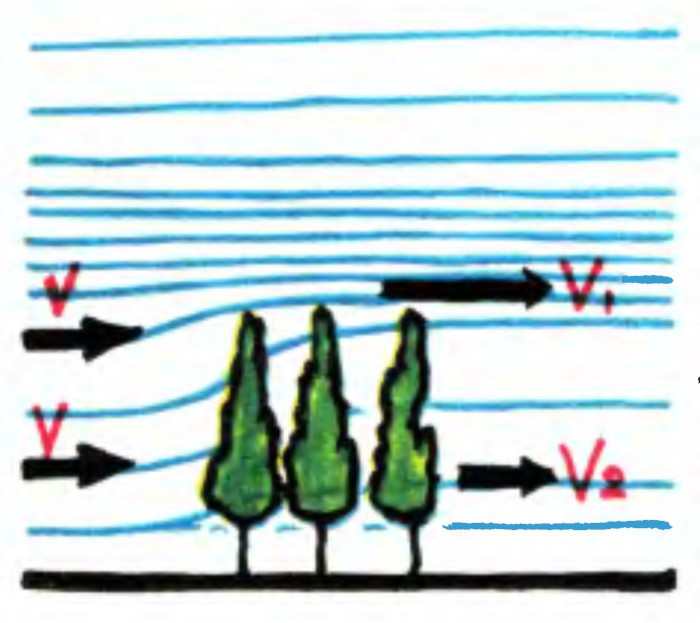 |
| Wind flow around a dense (left) and a sparse (right) forest belt. An impermeable dense belt functions only as a flap. The airflow with speed V, rising (to heights 2H, 3H, where H is the height of the trees), accelerates and acquires vortex motion behind it. These vortices intensify soil erosion and lead to the formation of ramp-shaped deposits. Sparse plantings, acting both as a flap and as a grid, prevent the occurrence of such harmful phenomena. The lower part of the flow passing through the belt weakens (to speed V2) and reliably isolates the field from the upper flow with increased speed (V1). |
Thus, two well-known foresters, Doctors of Agricultural Sciences A. Debely and V. Vekshegonov, as a result of many years of research in completely different regions of the country, nevertheless identified the advantages of sparse belts and accumulated extensive experience in cultivating them. However, this valuable experience has not received widespread dissemination, because it is believed that it is valid only under the specific conditions of the areas where it was obtained. And the fact that abroad in recent years mostly 1–2-row forest belts are planted is also explained not by their advantages but by the claim that arable land there is scarce. But how can one agree with the skeptics when the facts show the opposite? For example, Americans annually allocate 10 thousand hectares of arable land for new shelterbelts. Hardly an attempt to save land... Apparently, they have had the opportunity to see the advantages of well-ventilated belts.
What such reasoning leads to — when, without understanding the causes of a harmful phenomenon, people begin fighting its consequences — is shown by the following example. As we have already said, behind a dense belt, due to its vortex-producing action, ramp-shaped deposits occur that reach 2–3 m in height with a width of 10 m or more. Their removal requires great labor and cost. And so F. S. Baryshman, in his article published in the “Proceedings of the Kuban Agricultural Institute,” recommends: to prevent these deposits, make the belts even denser and thicker. Then, in his opinion, the vortices behind the belt will become more powerful and will carry away all the fine soil.
This is far from a harmless recommendation!
The author has forgotten the very purpose of a shelterbelt and, carried away by fighting the deposits, gives it a soil-destroying function. The resulting vortex, acting like a rotary excavator, will carry away not only the deposit but will scalp the field — and over a greater area the stronger the wind and the denser the belt.
So, let us summarize. As the experience of leading foresters shows and as aerodynamic studies confirm, it is possible to create well-ventilated forest belts that work reliably even under the most difficult conditions.
Of course, growing a narrow, openwork belt is more difficult. It will require more attention. But later, when the seedlings grow stronger, it will almost not require expensive thinning cuts. And on existing plantations such cuts are necessary, but most often foresters do not have time for them, and non-ventilated dense plantings turn into real “jungles,” even harming the fields. Attempts to resolve such contradictions from narrow departmental positions can only discredit the ideas of protective forestry. This will not happen if we create forest belts on the basis of comprehensive studies corresponding to the modern level of development of both biological and technical sciences.
PAVEL LUKYASHKO, inventor, Bykovo, Moscow Region