


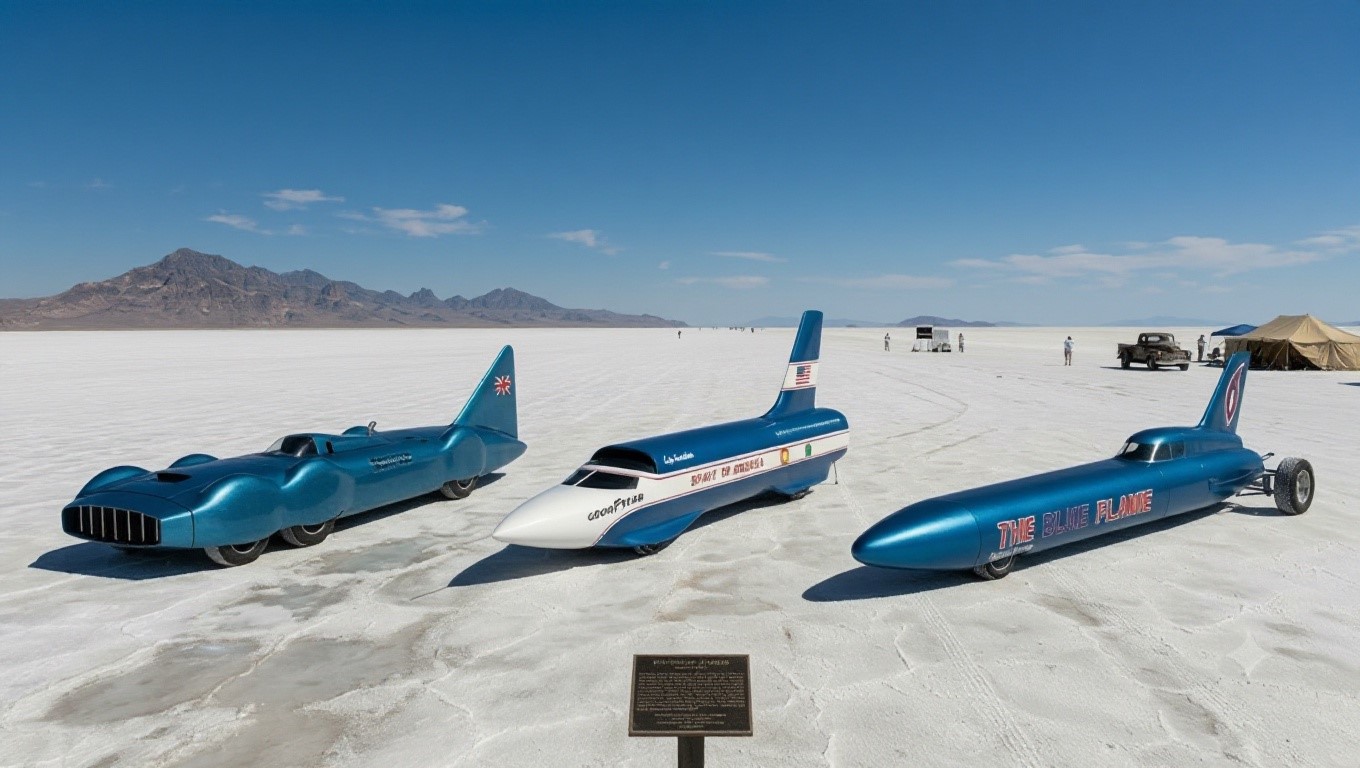
The automobile was created precisely to speed up human movement on land. Each new step in speed was achieved with difficulty and always caused concern, sometimes not without reason.
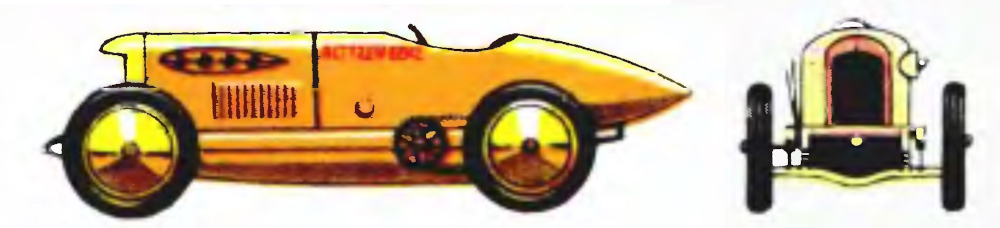 |
| The "Lightning" "Benz" (Germany). Engine: 4-cylinder, 200 hp. Speed — 202–211 km/h (record years — 1909–1910). Pilots: Emery and Oldfield. |
The speed of automobiles is constantly restricted on streets and roads, and even at competitions. In the latter case, restrictions are provided for by the vehicle's design itself, as are its speed capabilities. However, there is a category of automotive engineering where such restrictions do not exist. These are the machines on which the absolute world land speed record is set.
As early as the end of the 19th century, the first official record was recorded — 63 km/h, and by 1910 — the 200 km/h mark. The increase in record speed averages over a hundred kilometers per hour per decade; today the four-digit mark has already been surpassed (see TM, No. 10, 1971).
 |
| Sunbeam (England). Two 12-cylinder engines of 500 hp each. Speed — 326.5 km/h (1927). Pilot: Segrave. |
Already at the turn of the century, the record speed was twice the normal (maximum) speed of an average passenger car and ten times the speed limit allowed by traffic regulations, and now this gap has increased to 12–15 times. The development of record cars, like racing cars (see TM, No. 3, 1972), had a considerable influence on the progress of automotive technology. What was first used on speed cars became the property of all vehicles within 3–5 years. Later this period increased to 10–15 years. As for the record cars of recent times, they are unlikely to become prototypes for mass-production cars of the future. It is difficult to imagine an ordinary car, for example, with a braking system in the form of a deployable parachute.
 |
| Blue Bird (England). Napier engine, 12-cylinder, 1450 hp (later 2500 hp). Speed — 396–485 km/h (1931–1935). Pilot: Campbell. |
Moreover, traveling on land at speeds exceeding 200–250 km/h is not economically justified — too much energy is expended overcoming tire rolling resistance. In addition, the average driver is not capable of reacting to external information as quickly as is required for very fast driving. It should be noted that record runs are conducted on wide, perfectly flat beaches and dry lake beds.
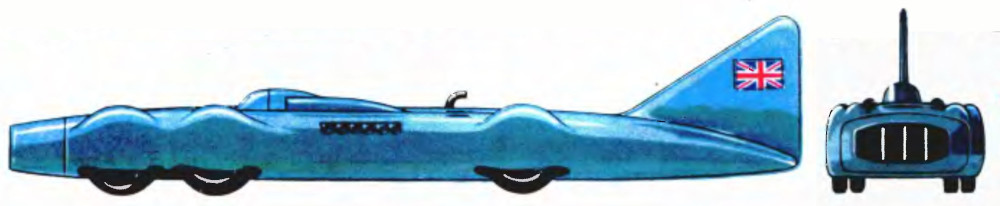 |
| Thunderbolt (England). Two 12-cylinder Rolls-Royce engines, 4700 hp. Speed — 502–575 km/h (1937–1938). Pilot: Eyston. |
The paths of record cars and production cars diverged in 1910. The "Lightning" — as the Benz car was called — still resembled the company's main products in many ways. Starting from the 1920s, record-breaking cars were built specially, as single copies, with funding from several firms.
 |
| Railton (England). Two 12-cylinder Napier engines, 2500 hp. Drive to front and rear wheels. Speed — 563–634 km/h (1939–1947). Pilot: Cobb. |
The mission of the pilot-designer is not an easy one. He cannot do without technical ingenuity, courage, dexterity, willpower, and the ability to interest major firms in his idea. Few possess such qualities. Therefore, the same names remain on the record tables for long periods. In the 1920s–30s, the list of world record holders was firmly occupied by the Englishmen Segrave, Campbell, Eyston, and then Cobb. After a lull — during which the record speed increased by only 30 km/h from 1947 to 1964 — the Americans came to the forefront. With their arrival, the era of turbojet record cars began. Over the course of six years, Arfons and Breedlove alternately broke records. They came close to the thousand-kilometer mark, but it was a newcomer — Gary Gabelich — who crossed it (see TM, No. 10, 1971).
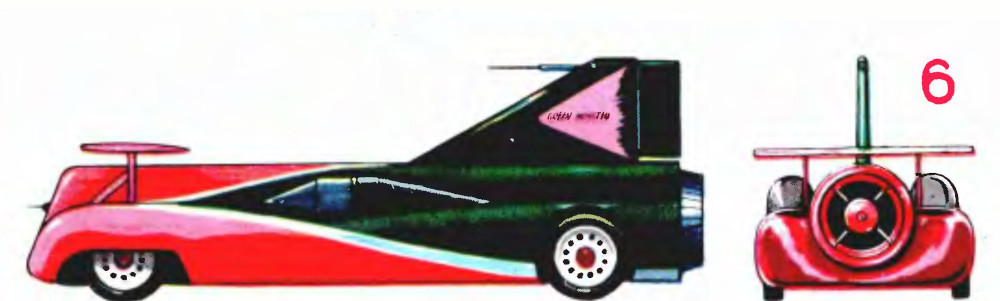 |
| Green Monster (USA). Turbojet engine, General Electric J-79, 17,000 hp. Speed — 699–928 km/h (1964–1965). Pilot: Arfons. |
No matter how well prepared the pilot is, his success is almost entirely predetermined by the merits of the record car itself. On one hand, the machine must have sufficient engine power to overcome the colossal rolling resistance of the tires (which is greater the heavier the car) and especially air resistance. On the other hand, reliable tire grip on the track surface is required. This grip is proportional to the weight of the vehicle (meaning it is advantageous to make it heavier).
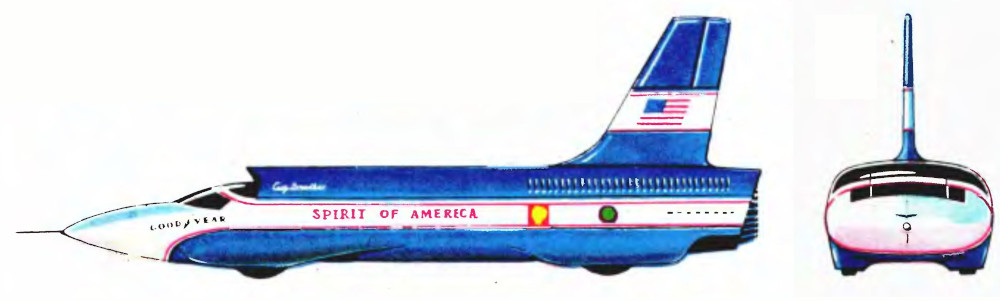 |
| Spirit of America (USA). Same engine. Speed — 657–966 km/h (1963–1965). Pilot: Breedlove. The illustration shows the final, four-wheel version of the car. |
In principle, the design features of speed cars come down to the following: as much horsepower as possible, minimal frontal area, streamlined body shape, and high-strength tires. Some record cars lacked a differential, since they travel in a perfectly straight line. Nevertheless, exceptionally high demands are placed on the materials from which the mechanisms are made and on the brakes — since the length of the record run is limited. No less attention is paid to the body shape. It is important to prevent the occurrence of lift, ensure wheel grip on the road, and provide aerodynamic stability. These contradictions are resolved in various ways.
 |
| Blue Flame (USA). Turbojet engine, Reaction Dynamics, runs on natural gas, power 53,000 hp. Speed — 1001.5 km/h (1970). Pilot: Gabelich. |
As early as 1927, Segrave was not satisfied with a special body shape that pressed the car to the ground through aerodynamic forces, and instead loaded the rear of the car with ballast. Campbell and Eyston, and later the Americans, installed huge fin stabilizers above the body. However, the Railton without a stabilizer successfully and for a long time broke Campbell's and Eyston's records, and the excellent shape of this car made it possible to get by with an engine half as powerful as that of its predecessors. The entire mass of the Railton "worked" on tire grip thanks to all-wheel drive. However, a moment came when any mechanical drive could no longer resolve the contradiction between engine torque and wheel traction. This is why record cars became jet-powered. Now they are almost airplanes without wings.
Interestingly, the rules in effect at the time, which did not always reflect the progress of record cars, led to curious situations. The record of 657 km/h set by Breedlove in 1963 was not ratified by the federation, because according to the regulations, a car must have at least four wheels, with at least two of them driven. Breedlove's first model of the Spirit of America — jet-powered and three-wheeled — thus fell outside the rules. Later, jet cars were "legalized," and Breedlove switched to a four-wheel vehicle.
Some generally successful record attempts were not ratified because the regulations require the previous record to be exceeded by no less than one percent. For example, in 1963, Thompson, who reached 639 km/h in a car with four 8-cylinder engines, fell just 1.7 km/h short!