


For the third year, our magazine has been publishing materials on the history of technology.
Following the aviation series, TM released tank and artillery series. Those with a hobby in naval history were introduced to the illustrated collection "Sailboats of the World." Now it's the turn for cars. It is these ubiquitous machines in the modern world that the new section "TM CAR MUSEUM" is dedicated to.
Under the high, time-darkened dome of the Paris "Warehouse of Arts and Crafts" stand the veterans of automotive transport. Among them is the very first self-propelled carriage in the world - Cugnot's steam wagon.
Cugnot did not invent the engine (the wagon was equipped with an engine reminiscent of Polzunov's famous machine), but he focused on the main thing - to design a self-propelled carriage using all the achievements of the technology of that time.
Steering. The inventor had only one model before him - a horse-drawn carriage, where the front axle turns on a pivot. Cugnot replaced two wheels with one: turning it on the spot is easier. The wagon became three-wheeled. Then Cugnot added a chain drive from the control handle to the wheel.
Thinking about the transfer of power from the engine to the wheels, Cugnot again turned to carriage practice: the horse is in front and pulls the front axle. So, the engine should be placed in the front part of the wagon. But the piston rod of the steam engine must move in a plane parallel to the plane of the wheel! And Cugnot mounted the entire engine on the wheel, and the engine, like a horse in a harness, deviated when turning left and right.
Test trips with a load of up to three tons began. It didn't matter that any pedestrian could overtake the wagon and it had to stop every fifteen minutes to add fuel. Parisians were horrified and delighted. Cugnot and his assistant stoker turned the control handle in the sweat of their faces. Once, when they didn't manage to turn the wheel, the wagon crashed into the arsenal wall and broke it like a battering ram; the boiler fell off the subframe, fell, and exploded "with a bang across all of Paris" (as the newspapers wrote).
In the first quarter of the last century, the era of English steam omnibuses began, even more cumbersome than Cugnot's wagon but workable. They competed with horse-drawn carriages. The engine was located at the rear or below and rotated the rear wheels and also moved the "legs," which, according to the designers' idea, were supposed to help the wheels. A special third axle on a turning lever served for control, like a boat rudder. Alarmed by the competition, the owners of the carriages managed to get the parliament to pass the "Road Locomotive Act." The law stated that a man with a red flag should walk in front of each steam engine to warn pedestrians and drivers of the impending danger. This nullified the main trump card of the omnibuses - speed. They disappeared from English roads but were revived in France. Their engines were equipped with kerosene burners. The need for a coal supply and heating was eliminated. The cars became lighter and more powerful.
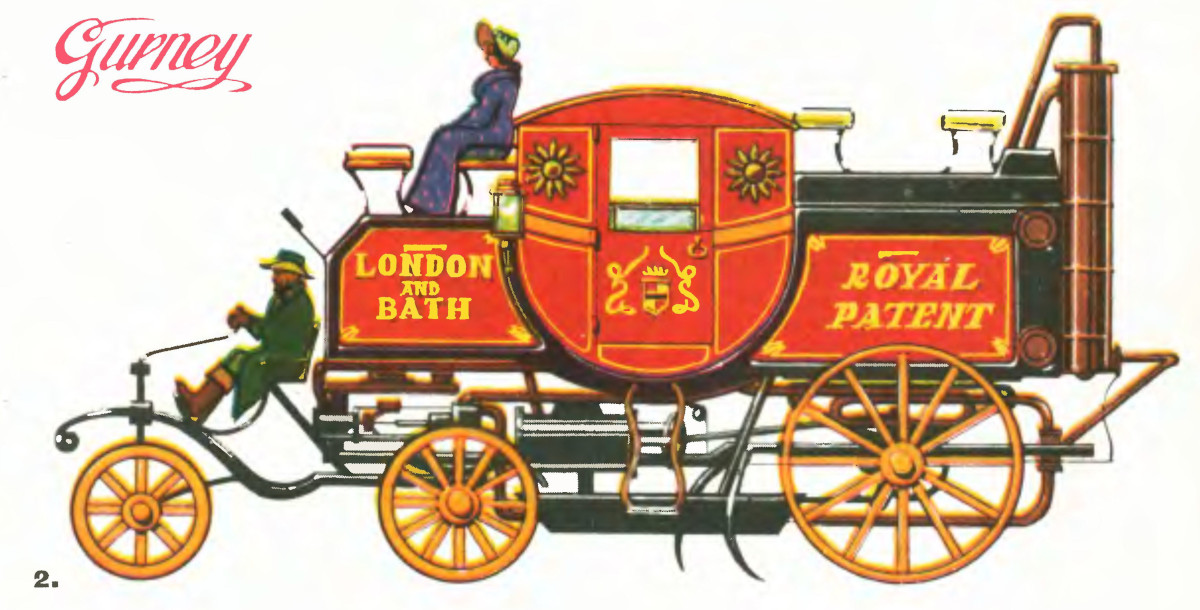 |
| 1. Cugnot's steam wagon. France, 1769. Load capacity 3 tons, 2 cylinders, 2 hp, 4 km/h. 2. Gurney's steam omnibus. England, 1824. 16 seats, 1 cylinder, about 10 hp, 12 km/h. |
French engineer Léon Serpollet designed a coil boiler. The water reserve was reduced, the coil quickly heated up, continuously producing the small amount of steam necessary for the machine's operation; there was no accumulation, which led to the explosions of the boilers of the previous wagons. On one of his cars, Serpollet won the Rothschild Cup three times in Nice, set a world speed record of 120 km/h in 1902, and a year later - 144 km/h (in 1905, the American Marriott exceeded 200 km/h, again in a steam car).
In the 1880s, cars with internal combustion engines appeared. Their main advantages were low weight and quick start. They immediately became the winners of races and rallies.
But the improvement of steam cars continued, and not without success. The latest models of steam cars are amazingly quiet, durable, easy to operate, start quickly, do not pollute the air (see TM, 1968, No. 4). They lag far behind gasoline cars in only one aspect, and this gap is widening. Their unit power is twice to three times heavier. It's no coincidence that steam locomotives have retreated before diesel and electric locomotives.
The steam engine played an important role in automotive technology. It proved the very possibility of mechanical movement. The mechanisms of the future car - the steering trapezoid, differential, brakes - were tested and improved on steam cars. Competition with steam cars contributed to the rapid development of gasoline cars. There is also a trace left from steam cars: the word "chauffeur" in French means "stoker," and drivers are still called that to this day, although cars have long had no stokehold. But steam cars have no serious prospects for now. They only have some chances to compete with diesel and gas turbine heavy trucks.
 |
3. De Dion-Bouton steam car, one of the winners in the Paris-Rouen race. France, 1894, 4 seats (with semi-trailer), 2 cylinders, 4 hp, 24 km/h. 4. Serpollet's record steam car, France, 1902, 4 cylinders, 40 hp, 120 km/h. 5. Stanley's record steam car. USA, 1960, 2 cylinders, 250 hp, 204 km/h. 6. Williams brothers' steam car. USA, 2 seats, 4 cylinders, 43 hp, 130 km/h. Like other modern steam cars, the machine differs externally from conventional ones only in that steam, not gases, comes out of the exhaust pipe, and its engine compartment and trunk are filled with steam power unit components. |
```