


In 1885, a loving husband gave Mrs. Daimler a brand-new, straight-from-the-store, phaeton.
If it weren't for this fact, perhaps one of the world's first two cars wouldn't have been four-wheeled. Because a year later, Gottlieb Daimler installed an internal combustion gasoline engine on the phaeton he had designed. Another German inventor, Karl Benz, spent seven years building motor vehicles specifically with three wheels! His wife might have also influenced his taste. In 1888, she made the first long (180 km!) car journey, proving the three-wheeled vehicle's reliability.
If we're talking about history, it's worth mentioning that Ivan Kulibin also made his pedal "self-propelled cart" three-wheeled. Steam vehicle builders did the same: one front wheel made it easier to control a heavy and cumbersome carriage. Kulibin's and Benz's vehicles were similar in other ways too: for example, they had large horizontally mounted flywheels. Benz believed that a "lying" flywheel was a guarantee against the vehicle overturning.
Three-wheeled cars are still being built today. But they are built only because the owners of "motor tricycles" are usually exempt from paying taxes. There are no other reasons. A three-wheeled car is unstable and handles uneven roads poorly (it has three tracks instead of two, like a traditional car).
Daimler and Benz are recognized as the most deserving among 400 (!) contenders for the title of car inventor. They worked in the same years in neighboring cities, but they never saw each other. The companies they founded merged after three decades of fierce competition, forming the Daimler-Benz company that still exists today.
There were inventors of a slightly different kind as well. For example, American George Selden didn't create a car, but he managed to get a patent for a general vehicle design as early as 1879. One day, he filed a lawsuit against car manufacturers in the USA. The court made a "Solomon-like decision": to confirm Selden's rights by building a car according to his design. To the dismay of the defendants, the car turned out to be functional!
And Siegfried Marcus wasn't after profits. Austria, like other countries, simply wanted to have "its own" car inventor. And when Marcus (in 1875) proposed a horseless carriage design, a legend was created about its remarkable qualities. You can still see the carriage today with the label "Ready for action" in the Technical Museum in Vienna, although it has been indisputably proven that it never drove without a horse because it wasn't capable of it.
At first, inventors installed the engine under the body or behind it and as close as possible to the driving axle—either rear or front. However, after 5–10 years, almost all designers adopted a layout that became classic for a long time: engine in front, rear driving wheels. This was forced by the increased size and weight of the engine and the need to cool the radiator with a strong headwind.
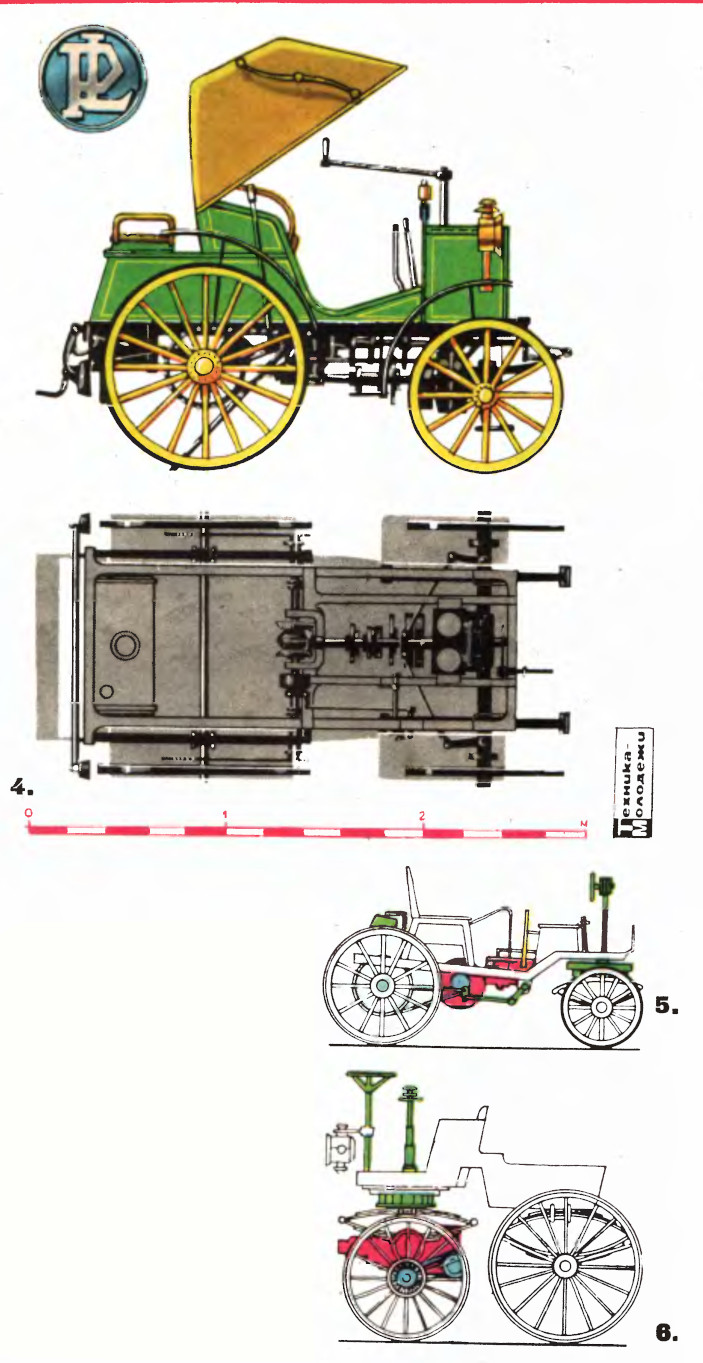 |
The first company to apply the classic layout was the French firm "Panhard-Levassor." They used Daimler's patents but supplemented them with a Jeantaud steering trapezoid, a sliding-gear transmission, a differential, and a chain (instead of belt) drive. The trapezoid allowed the front wheels to turn at coordinated angles without turning the entire axle, as was done with carriages and early cars. The transmission was without... a box (case or housing), with shafts and gears left exposed. A whole battery of oilers on the front panel of the body was used for lubrication. The car lacked only a driveshaft, which first appeared on a Renault in 1898. The "Panhard-Levassor" had three (!) brakes, each with a separate lever.
The classic layout was established, but they couldn't agree on a unified name for the new vehicle. It was called a horseless carriage, a motor carriage, a motor, and a self-mover. Eventually, the French term "voiture automobile," meaning self-moving carriage (from the Greek word "autos"—self and the Latin "mobilis"—moving), stuck. "Voiture" was dropped for brevity, leaving "automobile." Today, a car is simply called a carriage—voiture (French), wagen (German), car (English)—because horse-drawn carriages have become rare, and everyone understands that it's not about them. The carriage of our century is the car.
1. Diagram of Kulibin's three-wheeled pedal cart (late 18th century). The arrow points to the horizontal flywheel.
2. "Benz" car, 1886. Designed for two seats. Single-cylinder engine with 0.9 HP. Speed—15 km/h.
3. Diagram of the first four-wheeled "Daimler" car, 1887. Four-seater. Single-cylinder engine with 1.5 HP. Speed—12 km/h.
4. "Panhard-Levassor" car, 1891–1894. Capacity 2+2. Two-cylinder engine with 4 HP. Speed—25 km/h.
5. Diagram of Selden's carriage (1879) with a rotating and driving front axle.
6. Marcus's carriage (1875), which turned out to be non-functional.