


Having emerged into the world in the form of a truck (think of Cugnot’s or Selden’s machines), the automobile earned recognition as a “mechanical toy for adults” — a passenger car. In this form, it evolved from an exotic “self-propelled carriage” into a reliable autonomous means of transportation. In the 1890s, the truck experienced a second birth.
At first, in terms of appearance and performance, it differed little from a horse-drawn wagon: wheels with iron or solid rubber tires (cargo bands); an engine beneath the platform; only the front axle had springs, if any; the rear wheels were larger than the front ones. Speed did not exceed 10–15 km/h. The driver sat on a bench, sometimes under a primitive canopy. One of the first such trucks was the “Nesselsdorfer,” with the engine located at the rear of the vehicle. This layout proved successful: almost the entire body area was used for its intended purpose — carrying cargo. The vehicle was compact, relatively light, and maneuverable.
The army, agriculture, and industry demanded more powerful cargo vehicles. Simply increasing the size of the trucks would hardly have been a wise response. The engine no longer fit under the platform, overloaded the rear wheels, and required additional cooling devices. The engine was moved to the front, on the vehicle’s frame, and the driver's seat was placed between the engine and the platform. This redesign was also aided by the unification of many truck models with passenger cars, which had already adopted the “classic layout” (see TM No. 11, 1971).
But what about the tires? Surely, carrying two different spare tires in case of a puncture wasn’t practical! After all, the rear wheels of a truck bear up to two-thirds of its total weight. And so, the dual rear wheels we still see today appeared.
Many other features of trucks still reminded one that the automobile was a 19th-century invention. Until 1923, White trucks were produced in our country without a cabin or windshield, with chain drives and cargo bands. Engines were manufactured by the AMO plant (now ZIL), and other mechanisms were sourced from out-of-service vehicles.
A true revolution in truck design came with the advent of pneumatic tires, drive shafts, cabins, and electrical systems. All of these were included in the first Soviet-produced vehicle, the AMO-F15. Despite difficult conditions, our engineers and workers managed to create a reliable machine. Less than a year after production began, AMO-F15s participated in an international rally from Leningrad to Tbilisi to Moscow, completing the entire journey without breakdowns and finishing first. AMO-F15s were produced until 1930, and some units have survived to this day. One of them is housed in the factory museum.
Based on a Fiat model, Soviet designers modified the vehicle’s original appearance, increased the engine’s power by 20%, improved the cooling system, and reduced the flywheel diameter. Looking closely at the AMO-F15, you’ll notice there are no vents on the sides of the hood. The flywheel, with blades cast into its body, served as the fan; it drew air through the radiator’s honeycombs and under the hood down to the road surface. Above the driver fluttered a canopy on folding bows. In later production models, this was replaced with a hard roof, but the sides of the cab remained open, and only in winter were fabric side panels with celluloid windows installed on the single left-hand door.
The “classic” truck finally took shape by the late 1930s. Trucks now had brakes on all wheels with hydraulic or pneumatic drive, shock absorbers, and enclosed cabins. The ZIS-5 was produced without major design changes for a quarter of a century and was once the most common vehicle in our country. During the Great Patriotic War, it was simplified at the Ural factory: the cab was made of wood, the fenders were welded, and only one headlight with a blackout shield was installed. The result was a cheap, easy-to-produce vehicle. Thousands of these three-ton trucks served successfully on the front lines and in the rear. Their heroic service on the Road of Life, which connected besieged Leningrad with the mainland, will never be forgotten.
Even today, the ZIS-5 can still be found on the roads. But it is time to preserve a few of them, for soon they will vanish, just like the “classic layout” trucks as a whole. They are being replaced by vehicles that — much like before, but in new and more efficient ways — make better use of space.
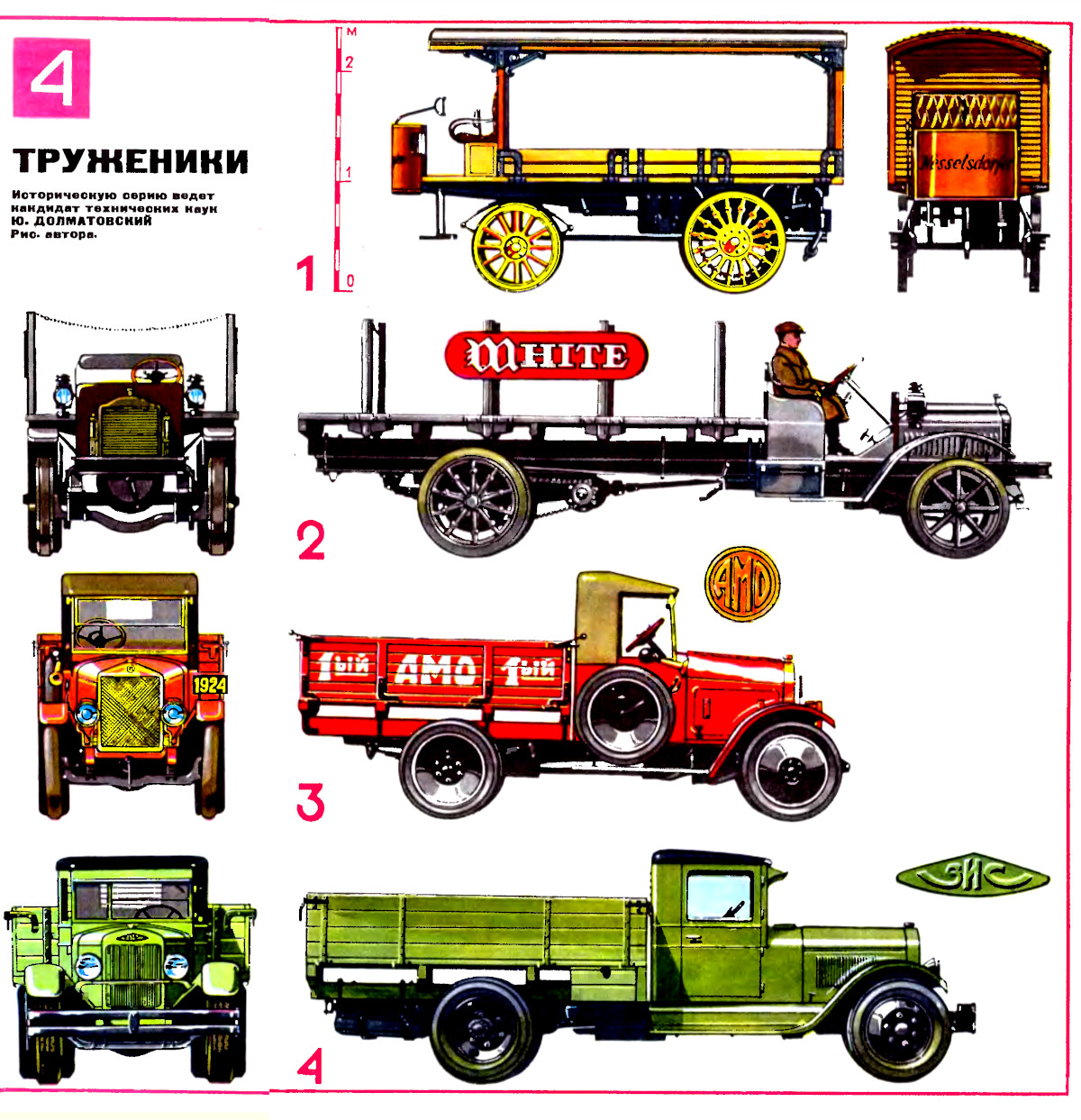
1. “Nesselsdorfer” (Austria-Hungary, 1899). 3 tons, 12 hp, 10 km/h.
2. “White” (USA, 1918–1923). 3 tons, 22.8 hp, 20 km/h.
3. AMO-F15 (USSR, 1924–1930). 1.8 tons, 35 hp, 60 km/h.
4. ZIS-5 (USSR, 1934–1948). 3 tons, 73–86 hp, 60–70 km/h.
Shown here is a prewar export version.