


The history of world helicopter engineering – like technology in general – knows no beaten paths.
In the late 1930s and early 1940s, there was no shortage of ideas in the aviation world regarding rotary-wing aircraft. Numerous experimental helicopter prototypes were built in many countries. Thus, in Germany, whose industry was being rapidly restructured for war, helicopter development was undertaken not only by German firms "Focke-Achgelis," "Flettner," and "Doblhoff," but also by the Austrian "Nägler" and "Holz," and the French "Breguet," which had fallen into Nazi hands.
During these same years in the USA, the firms of Sikorsky, Piasecki, Bell, Kellett, Hiller, and a number of others were working on helicopter design. True, later many of them, unable to withstand competition, left the stage. But for now, everyone steadily, step by step, probed and searched for the most rational configurations of rotary-wing aircraft.
Helicopters began to be conventionally classified according to the arrangement of the air rotors relative to the structural axes (longitudinal, transverse, and vertical) and by the number of these rotors.
Naturally, the question could not help but arise among designers: "Which configuration is better?" Or, figuratively speaking, how to arrange the main rotors: longitudinally or transversely? It should be said that the problem contained fundamental significance with far-reaching consequences.
In our country, in January 1940, an Experimental Design Bureau was organized at the Moscow Aviation Institute (MAI), first headed by Professor B. N. Yuryev, and then by I. P. Bratukhin, who came there from TsAGI.
I. P. Bratukhin went down in the history of Soviet aviation as an outstanding scientist-innovator, theoretician, and brilliant master of experiment.
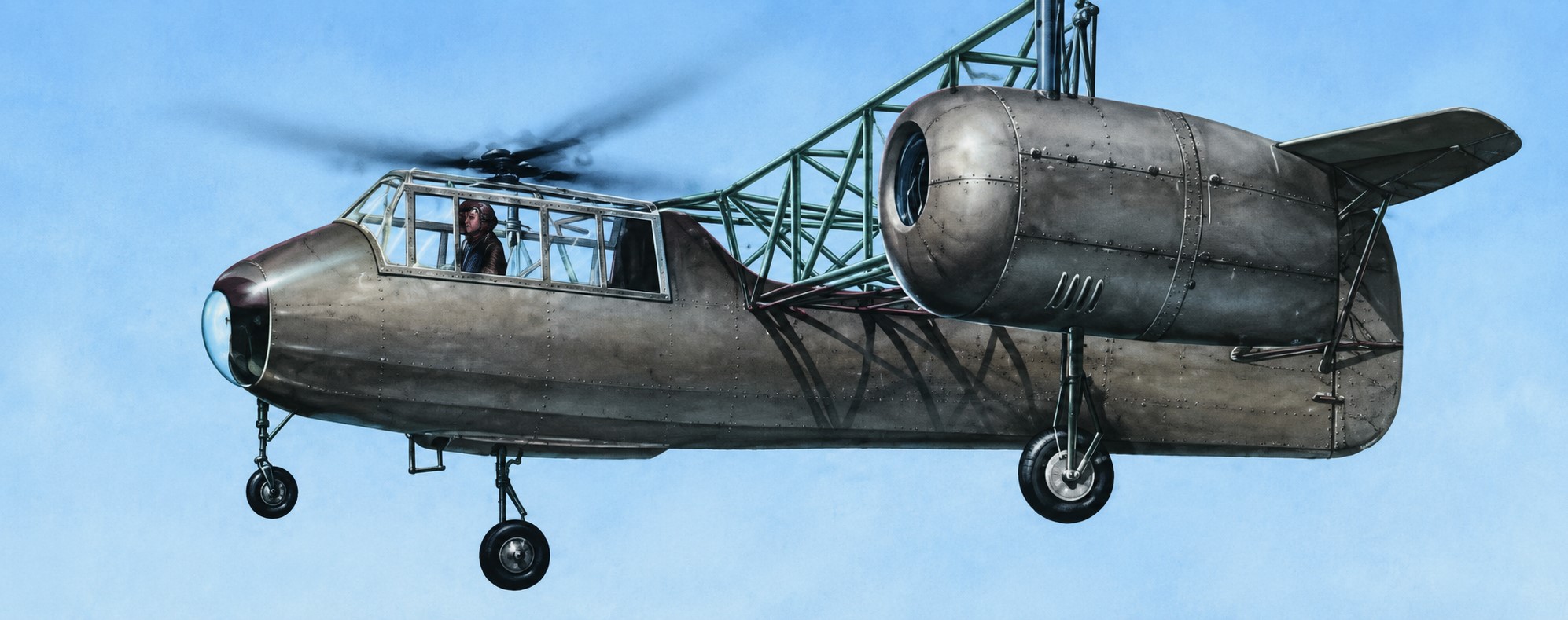
Starting work on a helicopter, Bratukhin gave preference to the transverse configuration and soon after the final approval of the preliminary design, he began building the "Omega" helicopter with two air-cooled engines (Fig. 1). On the title page. However, Bratukhin's work was started in 1939-1940 as part of the "Omega" project. The Design Bureau had to be evacuated, and work resumed only in the summer of 1943.
  Click to toggle image Click to toggle image
|
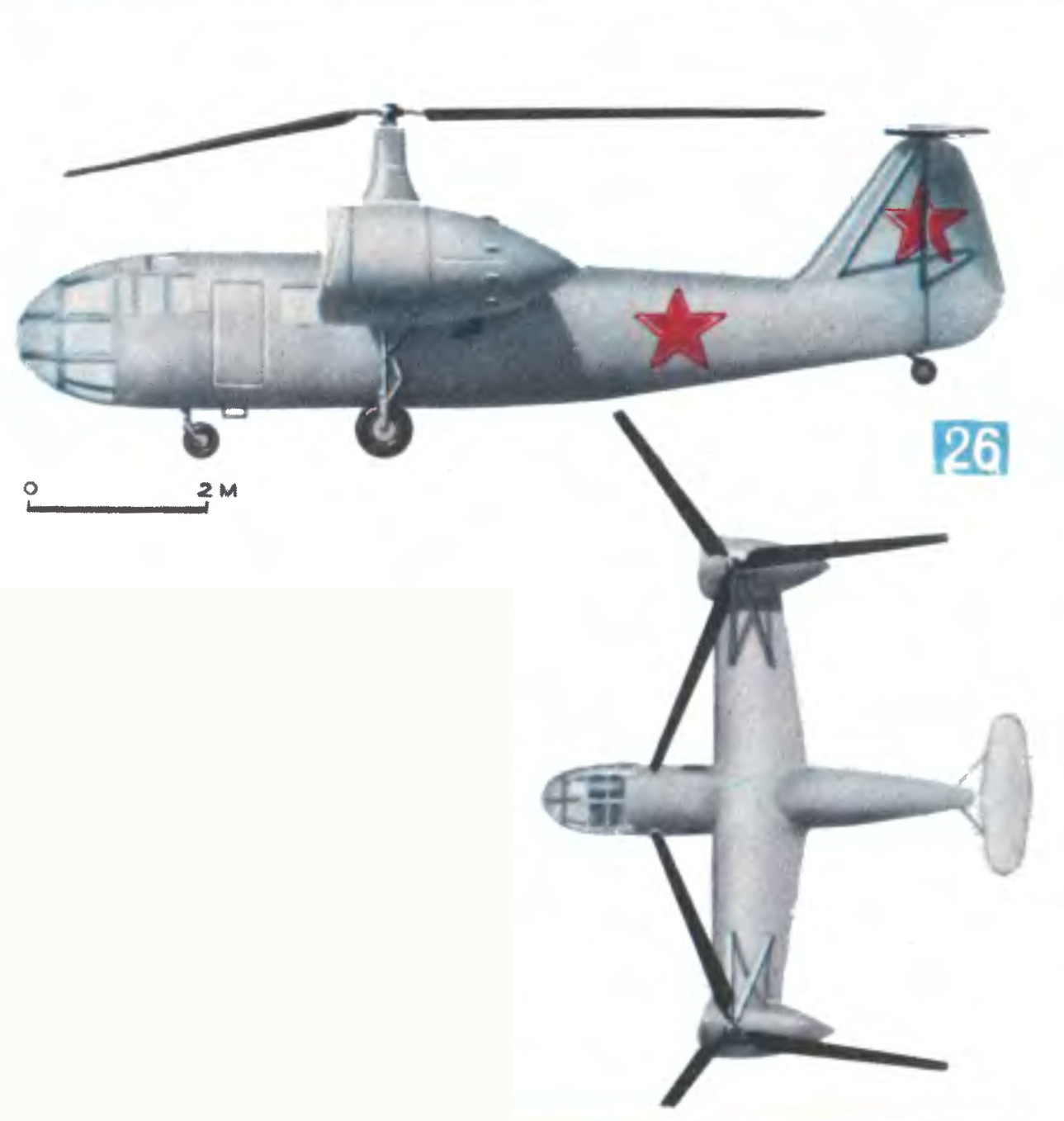
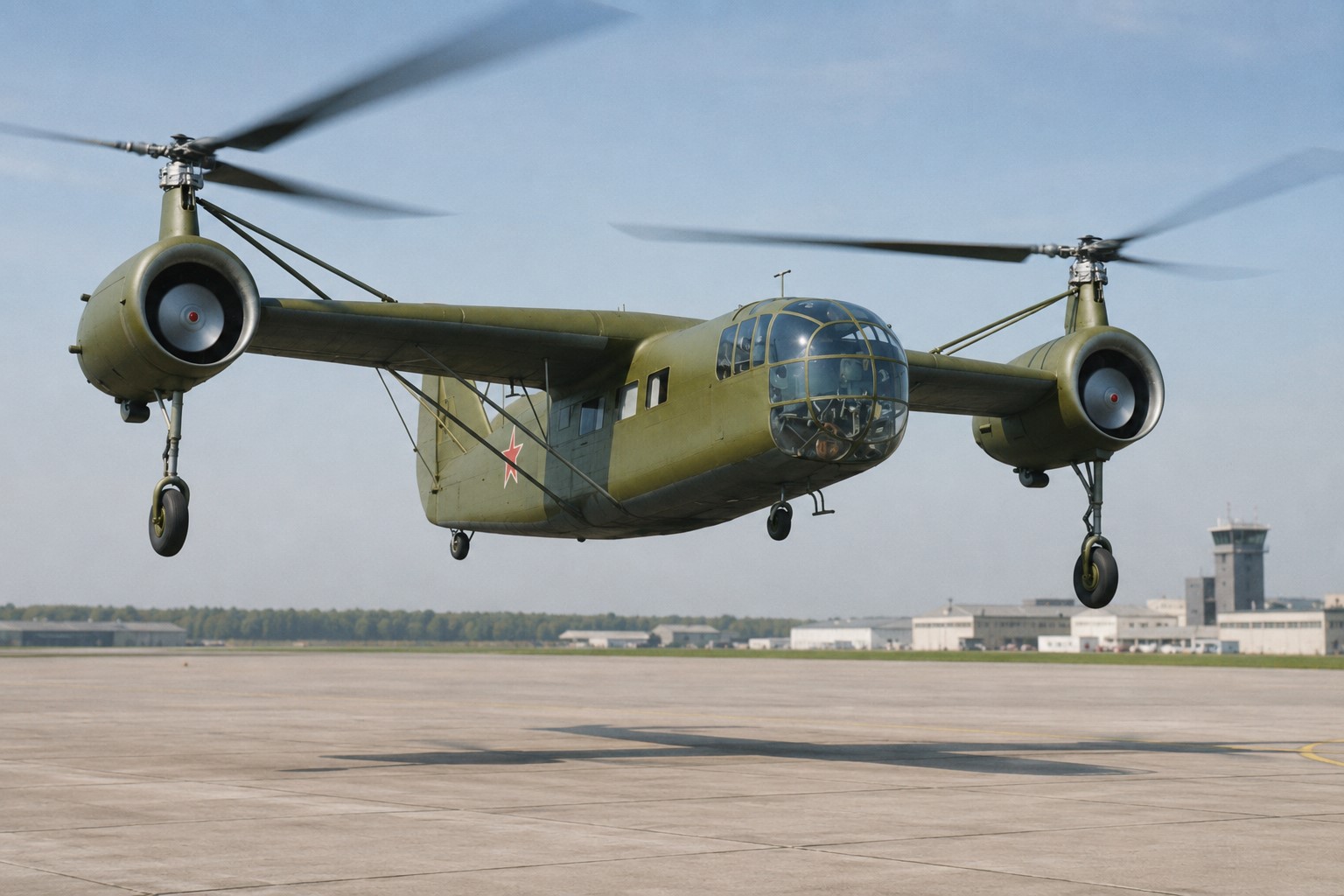
| 26. Helicopter B-11 by I. P. Bratukhin (USSR, 1948), two-seat, twin-rotor, transverse configuration. Engines AI-26 GRF, 550 hp. Main rotor diameter — 10 m. Gross weight — 4150 kg. Empty weight — 3398 kg. Maximum speed — 155 km/h. Service ceiling — 2550 m. Range — 328 km.
|
|
|
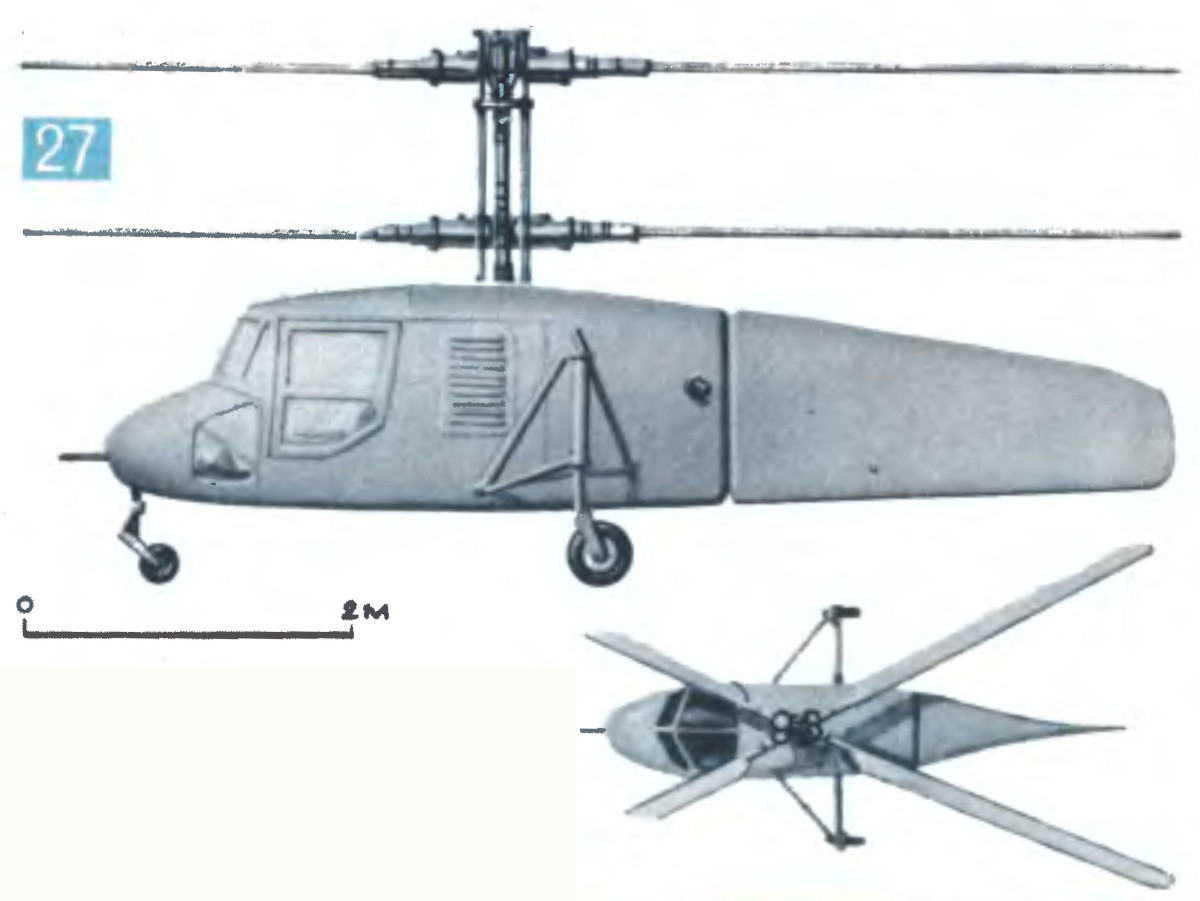
| 27. Experimental helicopter by A. S. Yakovlev (USSR, 1947), two-seat, twin-rotor, coaxial configuration. Engine M-11FR-1, 140 hp. Main rotor diameter — 10 m. Gross weight — 1020 kg. Empty weight — 878 kg. Hover ceiling — 150 m. Service ceiling — 1500 m. Range — 235 km. During testing, stabilizers and fin washers were removed to measure center of gravity.
|
The "Omega" was tested in two stages. First, pilot K. I. Ponomarev lifted the "Omega" held by cables to conduct tests gradually, without unnecessary risk. Remember, much was done for the first time then, including training the pilot in the specifics of piloting techniques.
Despite some whims of the machine, the first flights yielded very satisfactory results. The chosen configuration fully justified itself. Moreover, after necessary modifications, as noted in the state commission's report, the "Omega" could be used both for military and civilian needs.
In 1944, Bratukhin's Design Bureau built the machine, and soon tests of the "Omega-1" began at the factory airfield. This helicopter was fitted with new, more powerful engines, resulting in a total thrust increase of the main rotors of 300 kgf.
The "Omega" became the progenitor of a whole family of rotary-wing aircraft. Following it, the all-metal G-3, G-4, and the six-passenger B-5 emerged from Bratukhin's Design Bureau.
It should be noted that on this machine, the trusses connecting the fuselage with the engine nacelles were replaced with a wing of calculated profile, which at maximum speed gave a 25% increase in lift and simultaneously unloaded the main rotor blades.
In 1946, the "Omega-1" and the silver G-3 and G-4 took part for the first time in a parade held on Aviation Day.
In 1946–1948, Bratukhin designed several more machines, including the B-9 ambulance helicopter, the B-10, and the B-11 communications helicopter (Fig. 26). The latter, repeating the configuration of its predecessors and also possessing good stability and controllability in all flight modes, was more refined and thoroughly tested.
At the very end of 1944, the design team of A. S. Yakovlev joined the work on helicopters.
Already in 1945, tests began on a coaxial-rotor helicopter, which was never given any official designation (Fig. 27).
  Click to toggle image Click to toggle image
|
|
|
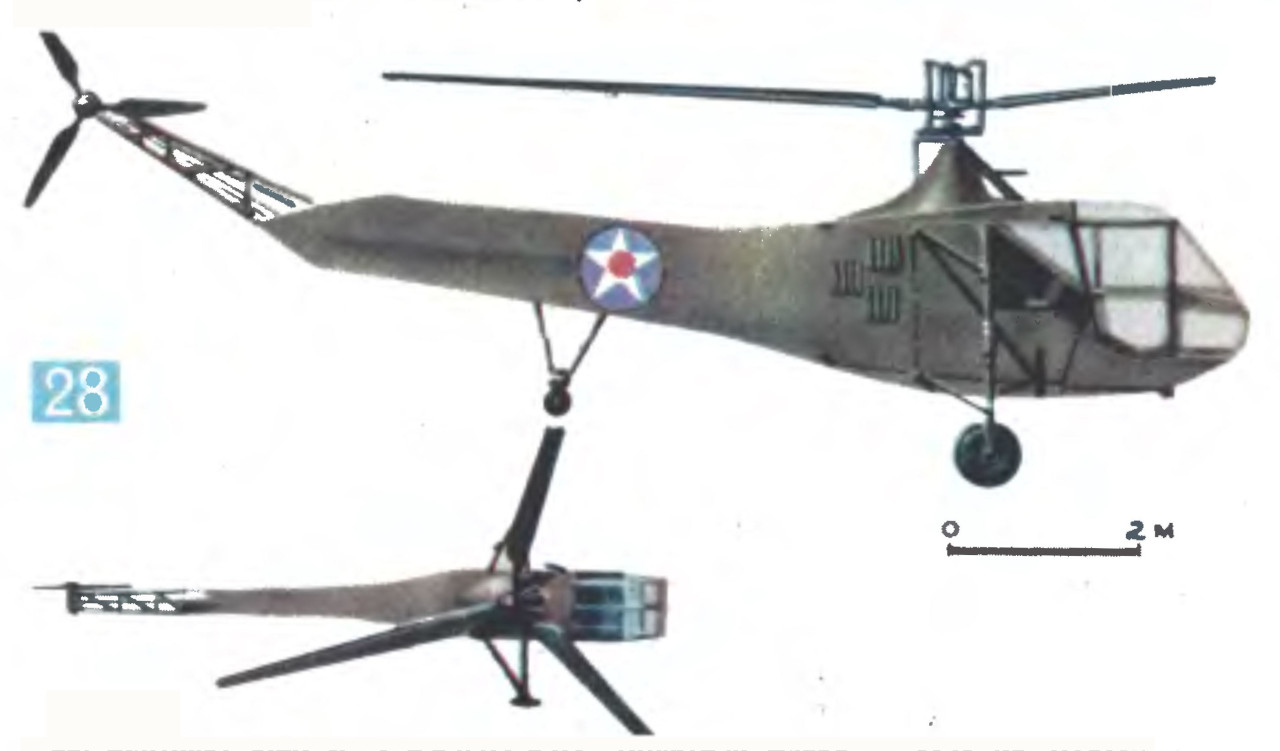
| 28. Helicopter R-48 by I. Sikorsky (USA, 1943), two-seat, single-rotor. Engine R-550-1, 200 hp. Main rotor diameter — 11.58 m. Tail rotor diameter — 2.34 m. Gross weight — 1175 kg. Payload — 238 kg. Empty weight — 912 kg. Maximum speed — 145 km/h. Service ceiling — 1450 m. Range — 104 km.
|
This experimental two-seat machine had two main rotors rotating synchronously in opposite directions. Special restraints prevented the blades from striking each other.
Flight tests conducted by pilot V. V. Tezavrovsky provided the design team with valuable practical experience, which was later useful when working on other examples.
However, the greatest success in designing coaxial-rotor helicopters was destined for our respected designer N. I. Kamov, whose work we will discuss in more detail and depth later.
Abroad, the greatest attention to helicopters was paid by US aircraft designers. There, as early as the pre-war years, a number of companies produced experimental models of machines of almost all configurations known at that time. True, only a few proved viable. For instance, in 1939-1940, I. Sikorsky, who had become head of the "Vought-Sikorsky" firm and technical director of one of the largest corporations, built the VS-300 experimental helicopter.
It must be said that despite his experience and capabilities, Sikorsky did not seek to immediately create an aircraft suitable for practical use. He worked out the helicopter's design elements sequentially, gradually increasing the scale and parameters. The first version of the VS-300 was equipped with a mere 75 hp engine, then it was replaced with a 90 hp "Franklin," and only after all stages of flight tests were completed did the Americans build an autogyro-configuration helicopter, the R-4 (Fig. 28). After this, the company received a large government order to supply the army and navy with R-4 and R-48 helicopters.
However, during the operation of the new equipment, deficiencies related to stability and controllability emerged. They caused a number of accidents and crashes. Nevertheless, the advantages of machines that did not require airfields were appreciated.
Title page: "Omega" (2MG) helicopter by I. P. Bratukhin (USSR, 1941), two-seat, twin-rotor, transverse configuration. Engines IV-6, 220 hp. Main rotor diameter — 7 m. Gross weight — 2050 kg. Empty weight — 1760 kg. Maximum design speed — 186 km/h. Hover ceiling — 290 m. Service ceiling — 6000 m. Range — 250 km.