


There are things too incredible to believe.
But nothing is so incredible that it cannot happen.
Thomas HARDY
The history of seafaring holds many dramatic incidents: ships run aground, sink due to collisions, are lost to fires, and so on. According to statistics, about fifteen ships go missing every year.
The shadow of the “Flying Dutchman,” wandering the seas for centuries, sometimes amidst the harsh Arctic ice, sometimes on the serene waters of the southern seas, occasionally appears before astonished sailors...
The “Flying Dutchman”! Of course, it is just a legend. But are there not too many doubles of the mythical ship?
“Seabird”
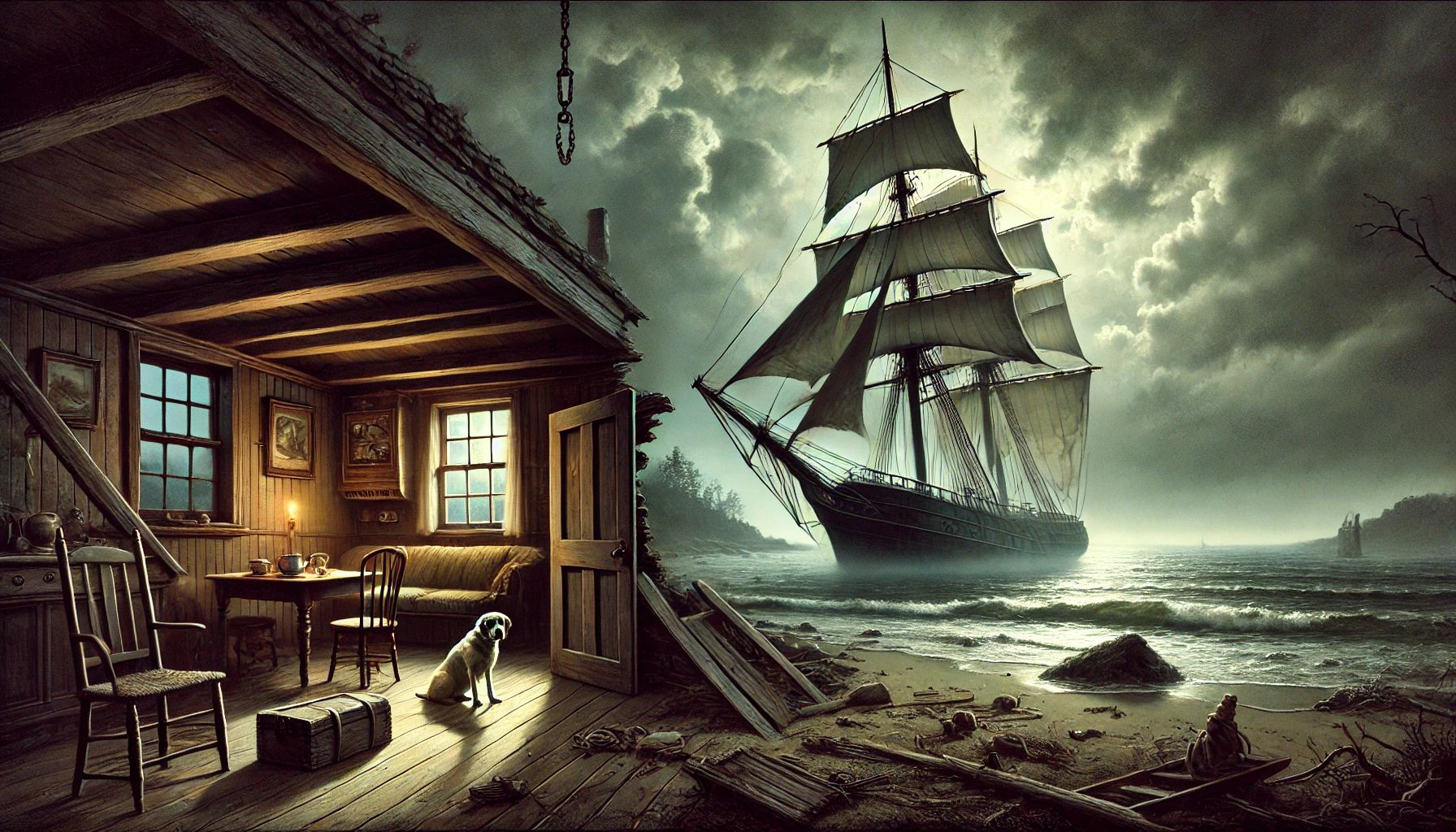 On a July morning in 1850, the residents of Easton’s Beach, on the coast of Rhode Island, were astonished to see a sailing vessel approaching the shore under full sail. It stopped in shallow water. When people boarded, they discovered coffee boiling on the galley stove and plates set on the table in the salon. Yet the only living being on board was a terrified dog cowering in the corner of one of the cabins. There was not a single person aboard.
The cargo, navigational instruments, charts, sailing directions, and ship documents were all intact. The last entry in the logbook read: “Passed the Brenton Reef” (this reef is located just a few miles from Easton’s Beach).
It was known that the “Seabird” had been on a voyage carrying a cargo of timber and coffee from the island of Honduras. However, even the most thorough investigation conducted by the Americans failed to uncover the reason for the crew’s disappearance from the sailing ship.
Where did the people go? Where?..
“Mary Celeste”
At noon on December 4, 1872, the English brig *Dei Gratia*, located 600 miles west of Gibraltar, spotted the sailing vessel *Mary Celeste*. The ship was alternately luffing into the wind and falling off, tracing erratic zigzags. To the experienced eye, it was clear that no one was at the helm.
Shortly after, sailors from the *Dei Gratia* boarded the brigantine. Not a soul was on deck. The wind howled through the torn rigging of the foremast, and tattered sails flapped noisily against the mast and yards. The lifeboat on the keel blocks was missing.
On the table in the captain’s cabin lay charts, sailing directions, and books. A brief entry in the logbook stated that the ship had safely reached almost the exact location where it was spotted by the *Dei Gratia*.
It was soon discovered that the chronometer, sextant, and sun declination table were missing, while the ship’s compass lay broken in a corner of the cabin. In a desk drawer, a significant amount of money was found, along with a box of women’s jewelry. A woman had evidently been aboard the brigantine: in a nearby cabin, there was a sewing machine with an unfinished child’s shirt draped over it.
Inspection of the sailors’ quarters added to the mystery. The bunks were neatly made, all storage lockers intact, and on the table lay... unfinished pipes!
In the galley, there was a large supply of fresh water, flour, salted meat, potatoes, vegetables, and even freshly baked bread.
In the hold, the sailors found neatly stacked rows of wooden barrels—1,700 in total. The barrels contained alcohol.
What could have happened to the crew? The commission assigned to investigate proposed many theories, including some highly fanciful ones. For example, it was suggested that the brigantine’s crew fell victim to giant octopuses. The idea of a mutiny, with the captain and his family murdered, also seemed unlikely. Most likely, the commission concluded, the vessel was abandoned by its crew for some unknown reason, who later either perished at sea or were rescued by another ship. However, months passed, and the *Mary Celeste* crew did not turn up in any port worldwide. The commission admitted it was unable to offer a satisfactory explanation for the mystery. And once again, the question remains unanswered: what happened to the people of the *Mary Celeste*?
“E.B.S. Hart”
In September 1894, the German steamer *Pikkuben* spotted the three-masted bark *E.B.S. Hart* in the Indian Ocean. A distress signal was fluttering on its mast. When the German sailors boarded the sailing ship, they found all 38 crew members dead, and the captain had lost his sanity.
“Freya”
On October 3, 1902, the German four-masted bark *Freya* departed from the Mexican port of Manzanillo. Seventeen days later, it was found partially submerged and heavily listing to port. The ship's masts were broken, and the crew was missing. There were no reported storms off the west coast of Mexico at the time. The disappearance of the crew remains a mystery.
“Carroll A. Deering”
 At 8:10 AM on January 31, 1921, the lighthouse keeper at Cape Hatteras spotted a large five-masted schooner. It was grounded on the outer edge of Diamond Shoals. All its sails had been furled, and the lifeboats were missing. When a rescue party boarded the *Carroll A. Deering*, they found no one aboard. The cargo, crew's belongings, and provisions were intact, but the ship’s logbook, chronometer, and sextants were missing. The ship's compass and some navigational instruments were smashed, and the steering gear was disabled. The fate of the captain and nine sailors remains unexplained. The only living creature found on the schooner was the ship's cat.
“Ourang Medan”
In February 1948, merchant ships navigating the Malacca Strait near Sumatra received a distress signal via radio: “SOS. This is the *Ourang Medan*. The ship continues to follow its course. Perhaps all crew members are already dead.” The message was followed by a series of incoherent dots and dashes, ending with a chilling, “I am dying.”
Shortly afterward, the Dutch freighter *Ourang Medan* was located by English sailors. They discovered that the entire crew was dead, with expressions of terror frozen on their faces. The rescuers planned to tow the ship to the nearest port, but a sudden fire broke out in the freighter’s hold.
Moments later, a massive explosion shook the Indian Ocean. The *Ourang Medan*, split in half and engulfed in thick smoke, disappeared beneath the waves.
“Holchu”
On February 8, 1953, the English vessel *Rainey*, while 200 miles off the Nicobar Islands, spotted a small cargo steamer named *Holchu*. The ship showed signs of damage from rough weather, and its mast was broken. However, the lifeboats were intact, and the ship’s holds contained a full cargo of rice, along with ample supplies of fuel and water. Yet, the five crew members were nowhere to be found. The fate of the *Holchu’s* crew remains an unsolved mystery.
A hundred years have passed since the investigation into the *Mary Celeste* began. Twenty years separate us from the mysterious events aboard the *Holchu*. And how many more ghost ships still roam the ocean waves! Will we ever uncover the causes of these tragedies?
Probably not. Time and the ocean know how to guard their secrets...