The aspiration to explore new spaces that had previously been inaccessible has always been inherent to Russian people, and after the Revolution it became one of the characteristic features of the Soviet nation.
It was therefore no coincidence that in the 1930s the most beloved heroes were polar explorers and stratonauts, and that the campaign “Assault on the Stratosphere,” initiated by GIRD and continued by the stratospheric committees of Osoaviakhim and the aviation section of the All-Union Scientific and Technical Society (AviaVNITO), literally encompassed the entire country and provided substantial funds for the construction of stratostats and high-altitude rockets. Part of these funds was allocated in 1935 to the AviaVNITO cell, which brought together specialists from RNII, for the construction of a stratospheric rocket.
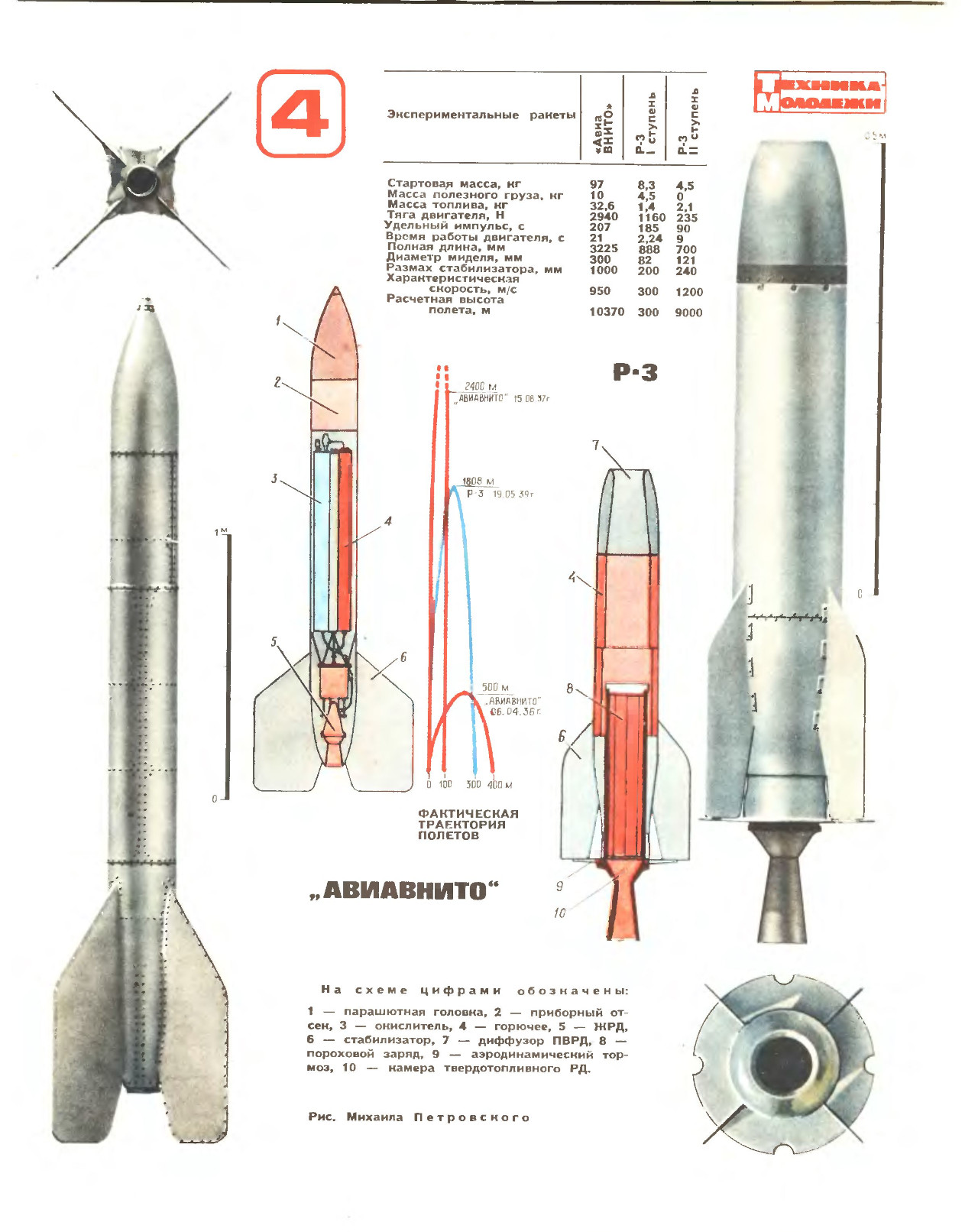
The basis of the project for this vehicle, which was accordingly named “AviaVNITO,” was the finished body of the largest of GIRD’s rockets—the 05 design by M. K. Tikhonravov. It was fitted with the most powerful of the liquid oxygen–alcohol rocket engines created at that time—the 12k designed by L. S. Dushkin. The propellant was stored in four long cylindrical tanks, similar to those of the first rocket, the 09, and, as in that case, was fed into the engine chamber under the pressure of liquid oxygen vapors. In cross-section, the body itself did not have a circular shape but rather a cruciform figure formed by arcs of circles described around the tanks. This was done to increase its rigidity and reduce the frontal area. Whereas on the first rockets the launch valves were opened by a cord pulled from a bunker, here they were replaced by pyrotechnic valves with rupture membranes actuated by an electrical signal. The tail stabilizer was also modified—it became much lighter and more refined in shape. A parachute was placed in the nose section of the rocket; it was to deploy on a signal from a gyro instrument when a certain angle of deviation of the rocket’s longitudinal axis from the vertical was reached. In the instrument compartment, a device for measuring flight altitude was installed, developed by S. A. Pivovarov on the basis of a barograph.
The first launch of “AviaVNITO” took place in 1936 from the launch frame of the 07 rocket with short guide rails. The rocket left the frame without gaining much speed and flew while turning into the wind. As a result, the parachute opened even before the engine had finished operating and prevented the rocket from climbing to a great height.
This flight was reported in the newspaper Pravda in an article entitled “The Rocket Takes to the Air.”
For the second launch, in order to ensure a strictly vertical flight, a special launch frame was constructed, mounted on a wooden mast 48 meters high—the tallest ever used. Launched from it in 1937, the rocket successfully took off and disappeared into the zenith. This time the parachute was ejected with a significant delay, when the rocket was already in free fall and had managed to gain such speed that the suspension lines could not withstand the air удар and broke. The altitude-recording instrument found in the wrecked rocket registered only a single point—2,400 meters. The commission concluded that this corresponded only to the moment of parachute deployment, since it was visually observed that the rocket had climbed well above 3,000 meters.
The rocket group of the Stratospheric Committee of Osoaviakhim also made its contribution to the development of the stratospheric rocket. The most interesting of its creations was the world’s first two-stage rocket designed by I. A. Merkulov, with a ramjet (PVRD) on the second stage. As the first stage, which accelerated the rocket to the speed necessary for the ramjet to begin operating, a solid-propellant rocket engine designed by A. I. Polyarny was used.
The solution of the problem of creating a ramjet engine on the basis of B. S. Stechkin’s theory, begun at GIRD, was continued at RNII as well. In 1935, responding to a question from the writer Ya. I. Perelman about the prospects of rocket technology, S. P. Korolev wrote: “I attach very great importance to air-breathing rocket engines, on which Yu. A. Pobedonostsev is working (here at RNII).” However, it turned out that the principal success in this field was achieved not by Pobedonostsev, but by his student together with a group of very young enthusiasts.
The project of Merkulov’s rocket, designated R-3, was approved by such prominent specialists as Professors V. P. Vetchinkin, K. A. Putilov, and K. L. Baev, and was accepted for implementation by the department of special constructions of one of the aircraft plants. As fuel for the ramjet, fuel blocks of two types were used, developed and manufactured by chemists from Moscow State University and the Moscow Institute of Chemical Technology. They consisted mainly of a mixture of aluminum and magnesium powders and differed in filler composition and pressing technology. Two ring-shaped blocks with the same outer diameter but different inner diameters were loaded into the engine, thereby providing the required profile of the channel through which the air necessary for their combustion flowed from the diffuser.
Ignition of the ramjet fuel was carried out by means of a fuse cord that ignited at the moment the solid-propellant booster finished operating. The booster was separated from the rocket by the oncoming airflow with the aid of an “aerodynamic brake.”
A total of 16 R-3 rockets were manufactured. Their flight tests, which began in February 1939 at the Planernaya station near Moscow, were conducted along a vertical trajectory. After the successful working-out of the rocket launch, stage separation, ramjet ignition, and clear recording of the increase in speed due to its operation, official tests were undertaken. These took place on May 19, 1939, in the presence of members of a commission from the People’s Commissariat of the Aviation Industry. To determine the parameters of the trajectory, a team of astronomers equipped with instruments used for tracking meteors was invited for the first time. The tests were successful, confirming the promise of using ramjet engines in aviation and rocket technology.
At the end of the 1930s, several more projects of stratospheric rockets designed to reach altitudes of 50 and 100 km were being developed in our country, but these efforts were interrupted by the war.
YURIY BIRYUKOV,
engineer