


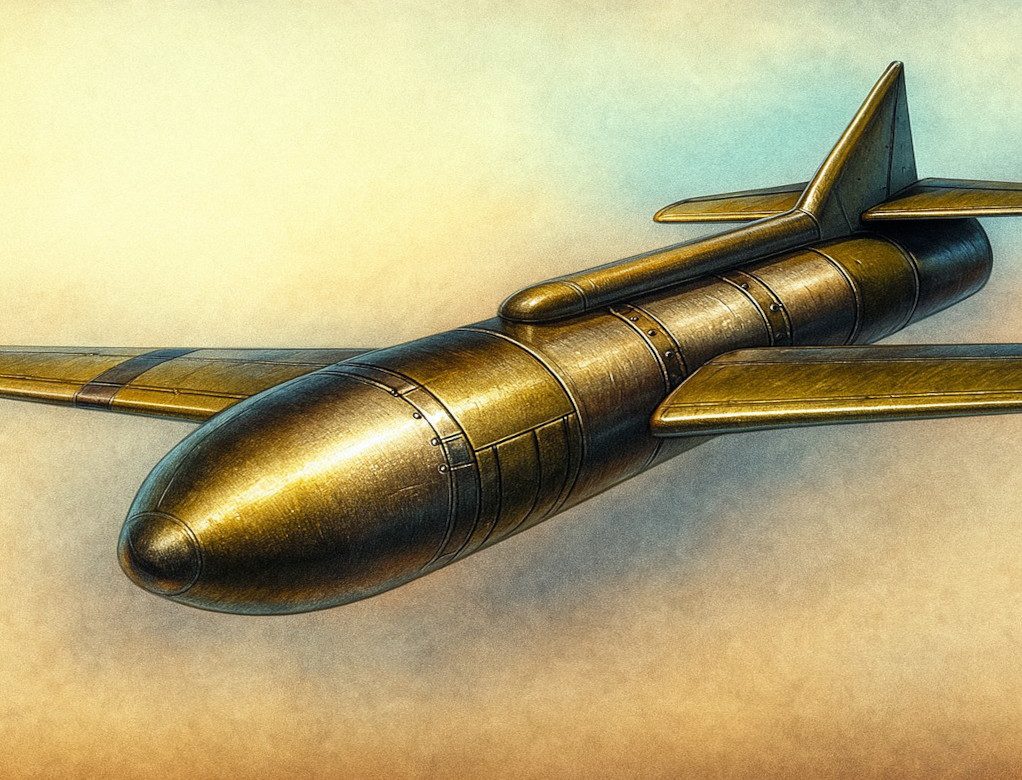
One of the main problems faced by the designers of the first rocket-powered aircraft (RPA) was ensuring the stability of their flight along a given trajectory. Stabilization using a tail assembly, which provided gunpowder rocket projectiles with not very high but acceptable accuracy, turned out to be almost ineffective here.
Therefore, K. E. Tsiolkovsky already spoke about the need to create automatic control systems for rockets. Fully understanding the importance of solving this problem, S. P. Korolev, even before GIRD, paid much attention to studying the newly emerging autopilots at that time.
At first, when the pioneers of rocket technology were confident that rocket planes would be created first, they focused all their efforts on developing rocket engines, leaving the issues of automatic control for the future. But the difficulties in creating engines led to the fact that they had to start with small unmanned rockets. Their first launches showed that the problem of control in rocketry was no less relevant than the creation of reliable, lightweight, and economical jet engines. True, the rocket engineers had to develop engines themselves, while automatic control systems were already being worked on by existing specialized organizations, which the GIRD members turned to. However, specialists in aviation instrument making, having studied the technical specifications for the development of a gyroscopic automaton for the rocket, categorically stated that it was impossible to create the required device in such small dimensions—and most likely impossible at all. Korolev realized that the problem had to be solved by themselves. When attempts to bring in an experienced instrument engineer failed, he sent the young engineer S. A. Pivovarov, who had just joined GIRD, for training at an instrument research institute. He was destined soon to become the designer of the first Soviet rocket control instruments.
The creation of guided rockets took place in RNII with the active participation of engineers E. S. Shchetinkov, B. V. Rauschenbach, M. P. Dryazgov, and others. Based on GIRD’s winged rocket 06, a 06/II rocket with a gyro-automaton stabilizing flight in one plane was developed. It flew successfully, performing Nesterov loops, sometimes several in a single flight. Then, a short-range winged rocket 216 with a liquid oxygen–alcohol LRE 02 designed by Tsander–Dushkin was built, which made four flights in 1936–1937. Its automaton stabilized flight already in two planes. Next came the long-range winged rocket 212 with a nitric acid–kerosene LRE ORM-65 designed by V. P. Glushko. This machine can be considered the first typical example of modern rocket technology since it had all the main systems inherent to guided RPAs, was stabilized along all three planes, and was designed to cover a distance an order of magnitude greater than that of all unguided rocket projectiles being developed at that time. The rocket was built according to a conventional aircraft layout. In its instrument compartment was a gyroscopic stabilization automaton GPS-3 designed by Pivovarov, consisting of two gyroscopes, air boxes, an aneroid speed device, a spool system, an arrester, control servos, and a feedback system. The fuel tanks were located in the wings, and compressed air cylinders for the fuel feed system and control system were placed in the rear fuselage in front of the engine. The rocket was launched with the help of rocket sleds accelerated along a rail track by a powerful gunpowder engine. Thus, rocket 212 is remarkable in that for the first time it combined achievements of different directions of Soviet rocketry, which had originated in GIRD and GDL.
A major achievement of GDL was the creation of solid-propellant rocket engines using highly efficient smokeless powder. While somewhat inferior to liquid rocket engines in specific impulse, they remained extremely simple and thus attractive to designers. With their help, RNII decided to conduct extensive research to select the aerodynamic configuration of RPAs, for which a series of small winged solid-propellant rockets—the “object 48”—was developed. These unguided rockets, before being forced by structural and technological tricks to fly with sufficient accuracy, performed in flight the most diverse and often unexpected maneuvers.
Korolev had the ability to turn every property, even an obviously harmful one revealed during tests of new equipment, to advantage. In the erratic maneuvers of unguided rockets, he saw the opportunity to create an “air torpedo” for air defense, capable of easily catching up with any aircraft. Such a machine was developed in 1936 in two versions: 217/I—an aircraft layout, and 217/II—a symmetrical four-wing layout typical of today’s anti-aircraft guided missiles. The successes of the RNII instrument sector, headed by Pivovarov, led to the fact that instrument organizations also joined in solving the problem: for the 217 rocket, a control system using a searchlight beam illuminating the target was being developed by the Institute of Telemechanics.
The experience of developing the first guided rockets led to new projects: the guided ballistic rocket 609/II and the air torpedo 301 with a radio control system designed by Professor A. F. Shorin, launched from an aircraft against ground and air targets.
Thus, in the pre-war years, within the walls of RNII, at the level of experimental prototypes, a coherent system of rocket armaments was developed, including machines of all the main types that in the 1950s took a permanent place in the armies of developed states. Moreover, all the RPAs included in this system had been tested on stands, and rockets 212 and 217 made several flights in 1939. But with the war approaching, these works, which required enormous efforts and resources, were suspended. The experience gained showed that the general level of technology worldwide still did not allow guided rockets to become an effective weapon for widespread use. And although there was information that Germany was continuing similar work, in the USSR it was decided to concentrate all rocket specialists’ efforts on creating piloted interceptors and multiple launch systems for massive firing of unguided rocket projectiles. This decision led to the timely appearance at the front of the famous “Katyushas.”
