


The initial program for GIRD was set by K. E. Tsiolkovsky. Upon receiving a letter on September 23, 1931, from enthusiasts who had initiated a new rocket organization in Moscow, he replied the same day with a detailed letter:
"...I will send you everything I have on jet devices. The conquest of outer space must be preceded by the conquest of the rarefied layers of the atmosphere. We should begin with something simpler. Flights into the stratosphere can be initiated with purely jet-powered devices or with modified and improved airplanes. The former is simpler, the latter more complex and limited, but closer to real life." Naturally, for the head of GIRD, S. P. Korolev, and his team leaders—F. A. Tsander, Yu. A. Pobedenostsev, and M. K. Tikhonravov—all of whom came from the aviation industry, the idea of building a rocket plane also seemed more feasible.
Knowing these basic premises, it is interesting to follow how GIRD’s work plan was formed. The first design topics included in the plan, listed as "Objects 02 and 03," were developments of rocket planes: RP-1 with Tsander’s liquid-propellant engine—Object 02 with pressure-feed fuel supply, and RP-2 with Tikhonravov’s engine—Object 03 with a pump-feed system. In parallel, GIRD also began scientific research. The first research project was "Object 01"—developing the most effective methods of burning metal fuel in the OR-1 rocket engine.
The second research project—"Object 04"—planned the creation of the country's first gas-dynamic test facility IU-1—a supersonic wind tunnel designed by Pobedenostsev.
In March 1932, at a meeting with the head of armaments of the Red Army, M. N. Tukhachevsky, GIRD members met Leningrad rocket scientist B. S. Petropavlovsky and learned that his Gas Dynamics Laboratory had tested several experimental rocket engines on nitric acid and kerosene and was completing the ORM-47 engine, designed by V. P. Glushko, suitable for use in rockets. As a result, another item appeared in GIRD’s plan—"Object 05"—a wingless (ballistic) rocket with an engine developed by GDL.
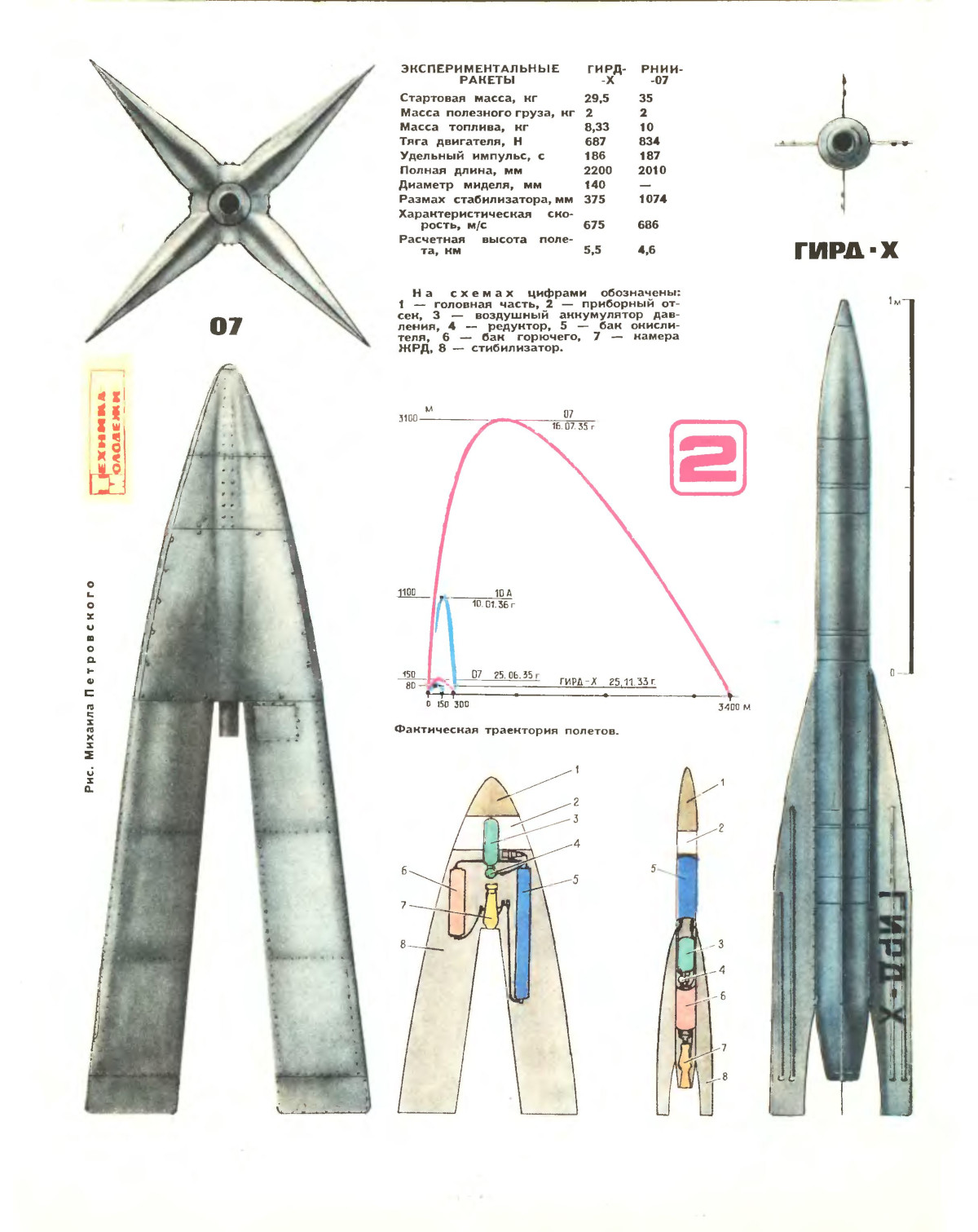
In the summer of 1932, when initial design calculations for the projects were completed, it became clear that a rocket-powered aircraft could achieve maximum flight speed if its engine thrust approximately equaled the machine's launch weight. Since the engines being developed at that time had about 100 kg of thrust, and the rocket planes weighed no less than 470 kg, Korolev decided to develop a small unmanned winged rocket—Object 06—to test the entire flight dynamics under nearly optimal conditions. Further calculations showed that winged rockets had a significant range advantage over wingless ones and were therefore of interest not only as models of rocket planes but also as a means of quickly delivering cargo over long distances. The idea immediately arose to create a combined-configuration rocket that would launch steeply like a ballistic missile and then glide to the target like a winged one. Thus, the "Object 07" project was born.
Theoretical calculations also gave rise to another original project. According to the theory of air-breathing engines developed in 1928 by B. S. Stechkin, the simplest structure of such engines was the ramjet (RJ), but it could only operate at high supersonic speeds. The only realistic method at the time to accelerate a ramjet to the required speed was to fire it from a gun. Thus, the rocket project 08 was conceived, representing an artillery shell housing a ramjet using white phosphorus as fuel.
Looking at this series of projects, we see that the later ones were simpler. GIRD engineers were progressively gaining a deeper understanding of the specifics of the new technology and increasingly convinced of the wisdom in Tsiolkovsky’s advice to start with the simplest designs. And indeed, they achieved their first success when Tikhonravov’s team created rocket 09 of the simplest construction (see the previous issue of “TM”). Tsander’s team also had to follow the path of simplification.
In January 1933, F. A. Tsander began developing his wingless rocket project—Object 10, or GIRD-X, with a liquid-propellant engine using metallic fuel. However hard the engineers tried, and however many methods and devices they tested to feed metal into the engine, none worked. The idea clearly outpaced the available technology. Korolev then ordered rocket 10 to be developed with a conventional liquid engine using liquid oxygen and gasoline. The engine design, with a pear-shaped combustion chamber, was proposed by Tsander himself, but the rocket’s construction was carried out after his death by L. S. Dushkin, L. K. Korneev, and A. I. Polyarny. During the testing of engines 02 and 10—which often burned through or exploded—GIRD engineers had to retreat again: kerosene was replaced with a less calorific fuel—ethyl alcohol—which finally made the engines reliably operational.
On November 25, 1933, the rocket successfully launched from the Nakhabino test range and rose to a height of 80 m. Although the success was incomplete (the engine mount failed during flight, causing the rocket to veer and fall 150 m from the launch site), this did not diminish the creators’ joy—another step in mastering rocket technology had been taken.
The development of all GIRD rockets continued successfully at the Jet Propulsion Research Institute. In May 1934, flight tests began for Korolev’s rocket 06, which used a hybrid propulsion system from rocket 13. And in the summer of 1935, Tikhonravov’s rocket 07, designed as a “flying wing,” was launched and reached a then-record altitude of 3,000 m with engine 02. In January 1936, rocket 10a (RBD-01) also successfully flew with the same engine. New winged and wingless rockets with various types of liquid, air-breathing, and combined rocket engines followed—developed on the foundation laid by GIRD. From a historical perspective, GIRD under S. P. Korolev played the same pivotal role in astronautics as Rutherford’s lab did for nuclear physics, Pavlov’s biological station for physiology, and Zhukovsky’s aeronautics club for aviation.