Disaster struck on February 13, 1934: on that day heavy ice crushed the hull of the “Chelyuskin,” and 104 people — members of the polar expedition and the crew of the steamer — found themselves on an ice floe.
The epic of the rescue of the Chelyuskinites is fairly well known: at that time seven Soviet pilots evacuated all the people from the ice and were the first in the country to be awarded the high title of Hero of the Soviet Union. But few know that a large group of Chelyuskinites — 83 out of 104 — were delivered to land by three pilots: Vodopyanov, Kamanin, and Molokov, and that all these pilots flew the Soviet R-5 aircraft. This success of the R-5 was by no means accidental...
Our civil aviation can rightfully be called the child of Soviet power. In the difficult 1920s, the government found the means to begin, for the first time in national history, the design of civil aircraft. It was then that Soviet designers created the first prototypes of passenger planes. These were: GAZ No. 5 — a biplane by E. Gropius, PM-1 — a sesquiplane by N. Polikarpov, AK-1 and SUVP — strut-braced monoplanes by V. Alexandrov and M. Grigorovich, ANT-2 — a cantilever monoplane by A. Tupolev.
The pioneers went through the full cycle of flight tests, and some of them even made flights along the routes of future airlines. But for various reasons it was not possible at that time to launch them into mass production, and in the airways of 1924–1927 mostly foreign “Junkers” and “Dornier” aircraft were in service.
However, it was no secret to anyone that sooner or later the national economy of the country would need, in large numbers, a simple, cheap passenger aircraft with good flight performance. And it happened that the need for such a machine arose earlier than might have been expected...
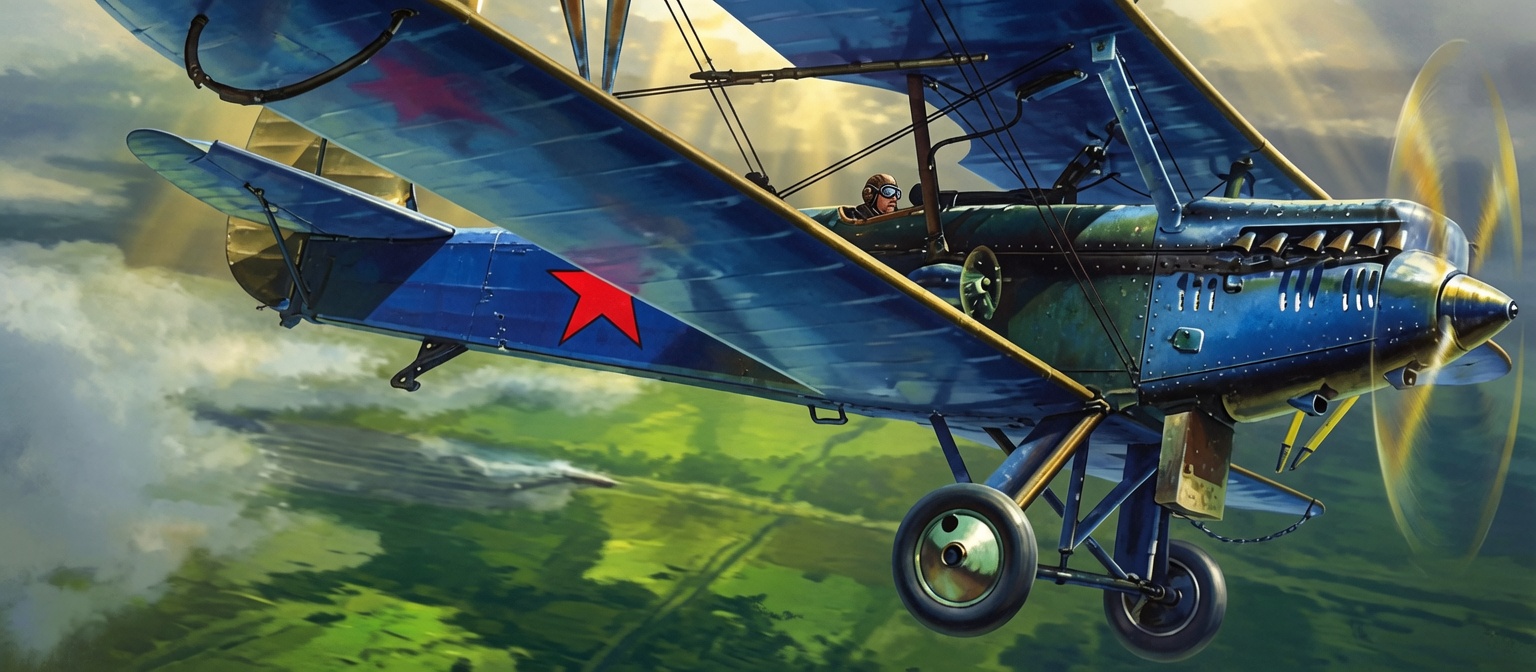
In 1928 it became clear: the Red Army needed a new reconnaissance aircraft, more advanced and faster than Polikarpov’s R-1, which had been in production since 1923. To design such a machine — the R-5 (“Reconnaissance Fifth”) — Polikarpov’s team began fully armed with the experience gained in the process of creating the training aircraft — the famous U-2, later named after its creator Po-2.
The design talent of N. Polikarpov manifested brilliantly in the choice of the R-5’s layout. At that time, two-bay biplanes around the world were built with a whole forest of struts and braces, which affected drag and, consequently, speed. And a more aerodynamically advantageous monoplane scheme would have led to high landing speeds, which would have complicated aircraft operation.
Polikarpov found an excellent solution — a sesquiplane, in which the lower wing is shorter than the upper one. Thanks to this, it was possible, on the one hand, to reduce the number of braces and struts compared to a biplane, and on the other hand, not to increase the landing speed. As a result, it became possible to create a reconnaissance aircraft with a speed of 250 km/h instead of 180, without worsening its takeoff and landing characteristics.
Immediately after flight tests, completed by early 1929, began the truly triumphant march of Polikarpov’s creation. On June 21, 1929, an outstanding nonstop flight of 1300 km on the route Moscow — Sevastopol was made on the R-5. In 1930, the Iranian government announced an international competition of reconnaissance aircraft to choose the best model for its air force. In connection with this, three R-5s made an overseas flight Moscow — Ankara — Tbilisi — Tehran — Termez — Kabul — Tashkent — Orenburg — Moscow, covering 10,500 km at an average speed of 171 km/h. It is not surprising that in the competition in Iran it was the R-5 that turned out to be the winner, leaving behind aircraft from England, France, and Holland.
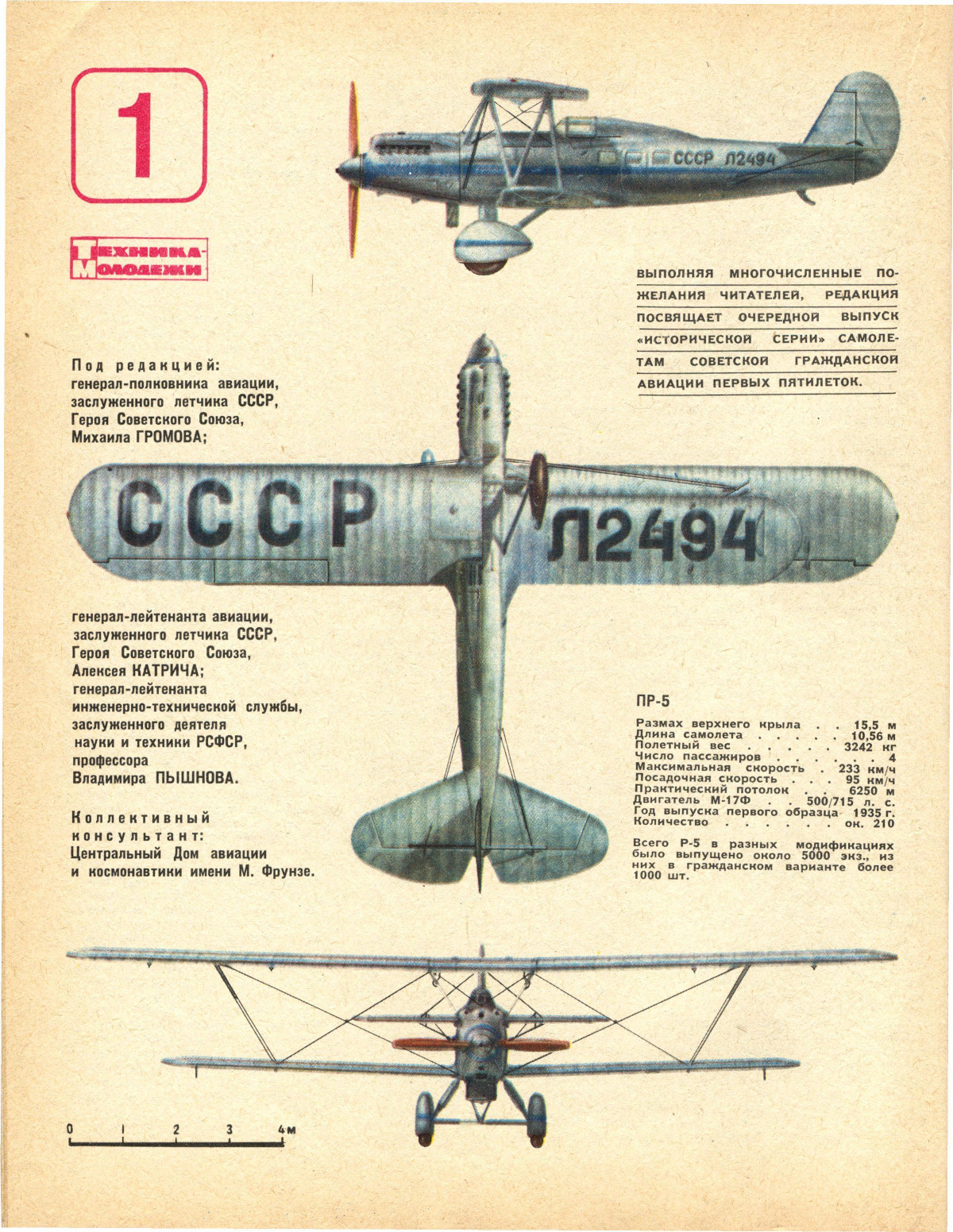
N. Polikarpov developed a simple modification of the two-seat reconnaissance R-5 — the postal-passenger version. In this civil variant of the aircraft, named P-5 (“Postal Fifth”), instead of removed armament, a cargo compartment was equipped under and behind the rear cockpit. The aircraft carried two passengers, placed in the observer’s position, and luggage — a total of 400 kg of commercial load.
In the summer of 1930, the Central Committee of the Party gave the instruction to deliver the newspaper “Pravda” to the largest cities of the country on the day of its publication in Moscow. Beginning on June 4, 1931, matrices of “Pravda” started being sent to Kharkov, and later to Leningrad and other cities by P-5 aircraft, from which the newspaper’s issue was printed on the same day as its publication in Moscow.
The bulk of airmail on the lines of the Civil Air Fleet in our country during 1932–1938 was carried on P-5 aircraft. The “Postal Fifth” was one of the first large-scale Soviet civil aircraft. In 6 years, starting in 1931, our industry produced more than 1000 of these transport machines in various modifications. There were a total of nine passenger-transport variants of the R-5; besides the main P-5, there were two most successful ones that were produced in series. These were the PR-5 and the HZ (P-Zet). The P-Zet was essentially a P-5 converted for a more powerful M-34NR engine — 820 hp — and equipped with a celluloid canopy over the cockpits of the pilot and passengers. About 100 P-Zet units were built.
In 1934, the chief engineer of the Civil Air Fleet workshops near Moscow, A. Rafaelyants, redesigned the P-5 into the PR-5. This modification had a spacious oval-section fuselage with a stressed plywood “monocoque” skin, with a four-seat passenger cabin. The nose, wing box, tail unit, and landing gear were kept the same as on the R-5, except that the wheels on the first units were covered with fairings. The pilot’s cockpit was enclosed, with a sliding canopy backward and an exit to the right, on top. The door to the passenger cabin was on the left side of the fuselage. The cabins of both passengers and the pilot were heated and ventilated. Later, it was necessary to move the upper wing back by 100 mm to maintain the required positioning of the aircraft’s center of gravity relative to the wings. In February–March 1935, Hero of the Soviet Union V. Molokov made a flight Moscow — Dixon Island on the PR-5.
The PR-5 was built in series and served on airlines until 1941.
In all its diverse modifications, after the famous U-2, the P-5 was the most mass-produced aircraft of Soviet civil aviation of the pre-war period.