


From the construction of a full-size airplane, carried out by A. Mozhaisky, there was only one step left to controlled flight.
Perhaps the Wright brothers became more thoroughly acquainted with the flight of birds and the laws of flow around lifting surfaces than their predecessors. Having understood how birds distort their spread wings, the designers tested this principle on a model glider. They were greatly helped by an ancient "flying machine" - a kite. It was as a kite that a one-and-a-half-meter model glider rose into the air. Standing on the ground, the brothers pulled the trailing edges of the wings with ropes.
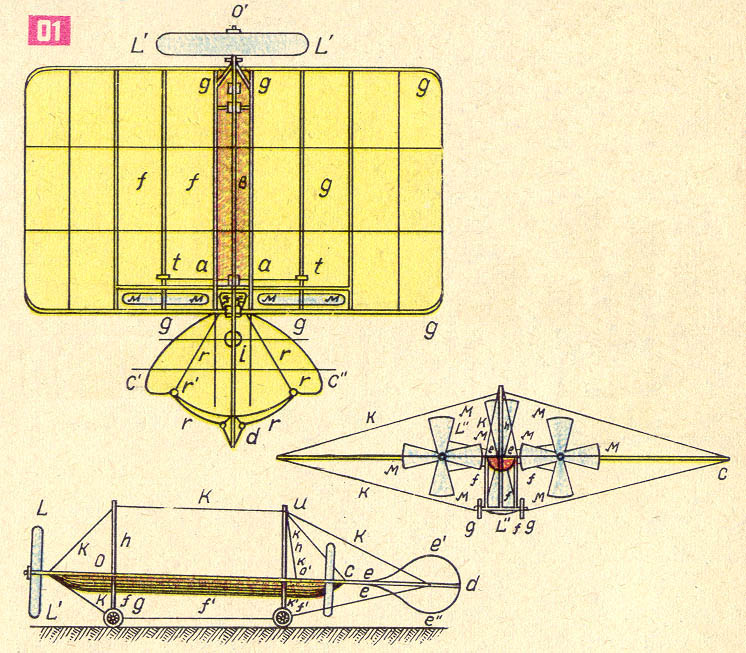 |
| 1. "Aerial Projectile" by A. Mozhaisky (Russia, 1885). Steam engines, designed by Mozhaisky, total power - 30 hp. Wing area - 370 m2. Flight weight - approx. 950 kg. The image of the aircraft, due to the lack of working drawings, is reproduced according to the diagram from the "Privilege issued by the Department of Trade and Manufacture in 1881 to Captain 1st Rank Alexander Mozhaisky for an aeronautical projectile." |
After the first success with the models, the Wrights decided that it was time to take off themselves. They built a glider, only not a balance beam, like Lilienthal's (that was controlled by changing the pilot's position), but of their own design, capable of maneuvering, obeying the rudders. This was the highlight of the Wright scheme, what later allowed them to create an airplane.
In the fall of 1902, the Wrights made about a thousand successful flights over the dunes of the Atlantic coast, near the town of Daytona. Their glider with a wingspan of almost 10 meters took off in any weather, even in strong winds. Now all that was left was to put an engine with a propeller on it and try to turn a motorless kite into an autonomous flying machine.
No one took on the task of creating an 8 hp engine weighing only 80 kg. The brothers solved this difficult task at that time: they ordered some of the parts from outside, and made the rest in their workshop. It turned out that the engine developed even 16 hp. The propellers were made in the same way: the Wrights calculated the shape and size of the propellers using their own method.
In the fall of 1903, both the old glider and the new machine with the engine were transported to Kitty Hawk. To facilitate the start, the designers made a catapult - the initial impulse was given by the force of a load falling from a height, to which a towing cable was tied. For takeoff and landing, the machine was equipped with two skids under the lower wing. On December 14, the airplane took off for the first time, but the flight stopped after 3 seconds due to a loss of speed. Only three days later did the machine really take off.
Only two years later, newspapers published the first sketches of the Wright biplane. The mystery surrounding all the activities of the unsociable brothers made readers quite worried before they were convinced of the reality of the American "duck" two years later. A curious coincidence - this popular expression, meaning the idle fiction of overseas newspapermen, suddenly acquired the accuracy and unambiguity of the term when applied to an airplane. After all, to this day, a "duck" is the name for a flying machine whose control surfaces are located in front of the wing. This is how the sketched Wright biplane appeared to European readers, and this is the design that the Brazilian-born European Alberto Santos-Dumont chose for his first airplane.
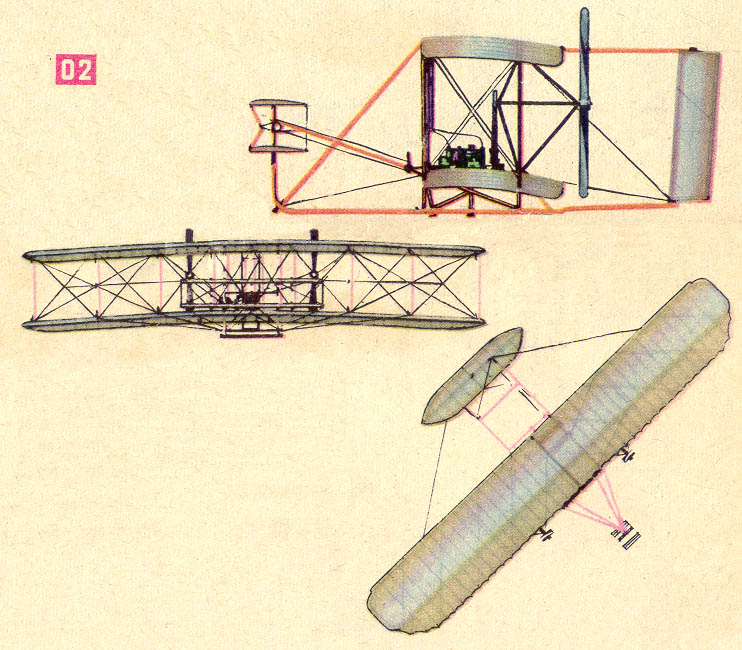 |
| 2. The Wright brothers' biplane (USA, 1903). Wright engine, 15 hp. Wing area - 48 m2. Span - 12.25 m. Flight weight - 415 kg. Speed - 48 km/h. |
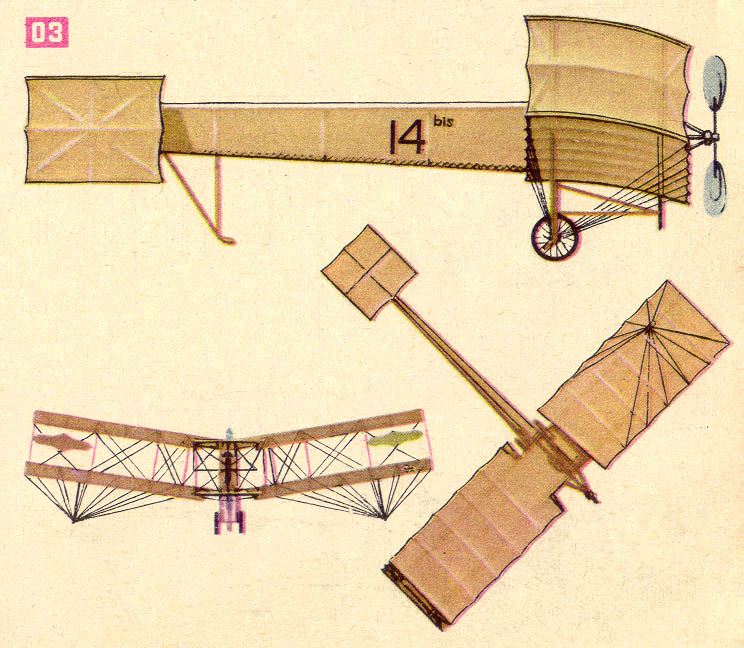
Less than a year had passed before the enterprising Santos built an airplane, managed to make several jumps on it, and then, in November 1906, fly a whole... 220 m. And although the machine never showed more worthy results, did not become the basis for subsequent designs, the giant box kite of Santos-Dumont rightfully opens the gallery of European flying machines of the beginning of the century. In the feverish rush of those years, when designers built their machines, guided not so much by engineering calculations and laboratory research data, as by intuition, the old kite once again served them well. At the end of the 19th century, the Australian engineer Hargrave, who had long and persistently been engaged in improving this ancient flying machine, developed a box kite - in fact, a ready-made basis for an airplane. Minimum weight, sufficient strength of the bearing surfaces - that is why the first "shelves" have so much of a kite. Santos-Dumont added a fuselage to the box, with a box-shaped stabilizer attached to the nose section on hinges. A 50-horsepower Antoinette engine with a pusher propeller at the trailing edge of the wings completed the transformation of the kite into an airplane.
Of course, it was not only the money of the wealthy Santos-Dumont that allowed him to outpace his competitors. Success was prepared by the Brazilian's many years of work in the field of aeronautics. In a few years, the indomitable Santos created a good dozen of the simplest airships, the flights on which clarified many issues of motor thrust in aeronautics. He proved the applicability of gasoline engines on aircraft, and most importantly, he attracted the attention of the public with his public flights. And when he took off a few years later in a heavier-than-air machine, his noisy fame largely helped the development of this type of aircraft.
The Wrights, on the contrary, were in no hurry to give wide publicity to their experiments, even during Wilbur Wright's European tour, who delivered a mysterious machine to the Le Mans racetrack near Paris. Of course, the mystery that so surprised the correspondents was explained not only by the elder Wright's unsociability. He was afraid of technical plagiarism, the leakage of the ideas embodied in the machine.
The main thing that favorably distinguished the Wright biplane from French flying machines (for example, the Voisin brothers' airplane) was perfect bank control and lateral stability. Wilbur rose to 15-20 meters, while the Europeans were afraid to fly higher than the roofs of one-story houses. His airplane described graceful eights in the air, and the pilots of European machines feared the bank more than any other danger and therefore tried to fly only in complete calm.
Wilbur Wright's European tour lasted from August to December 1908. An experienced pilot, he set several sensational records for altitude and flight range, which, however, did not last long. The following year, 1909, was marked by a stormy onslaught of French competitors. Having quickly adopted the design ideas of overseas aviators and their piloting techniques, the Europeans Bleriot, Farman, and the Vuvuzin brothers amazed the world with amazing flights and ascents to altitude...
 |
|
3. "Santos-Dumont 14-bis" (France, 1906). Antoinette engine, 50 hp. On the screensaver; |
NOTE: in this and subsequent publications, front and plan views of aircraft are given at a scale of 1:2 in relation to profile views.