


At the very end of the February issue of the magazine "Library of Aviation" for 1910, a review was published of a book that had just been released in Paris about Blériot's flight across the English Channel.
Praising the engineering talent and persistence of the great Frenchman, the reviewer recounts how Blériot was "greeted and honored by ministers, the Lord Mayor of London, deputies, and public figures, and a crowd of one hundred thousand in England and France greeted him with enthusiastic ovations." In conclusion, however, the reviewer unexpectedly laments with a somber note that "one cannot help but recall our sad story with Tatarinov, which could be called the story of Blériot, but in reverse."
 |
|
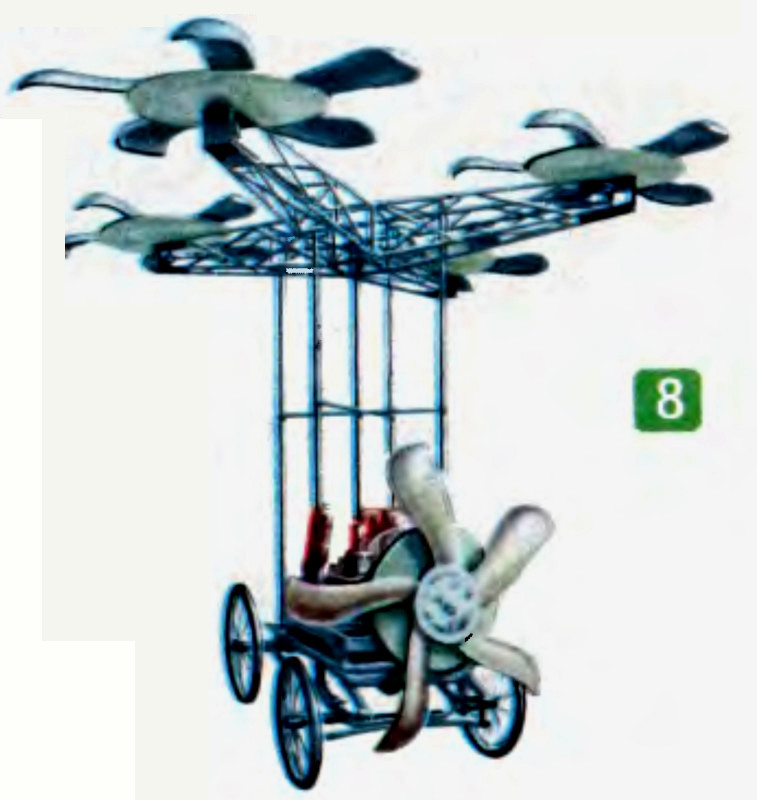
Fig. 8. "Aeromobile" by V. V. Tatarinov (Russia, 1909–1910). The design was repeatedly |
Even a quick glance at previous issues of the "Library of Aviation" and other popular publications explains why this gloomy phrase sounds like an obituary for the Russian helicopter, in which the public of the time had placed its faith.
And how could they not believe, when alongside sensational reports about the flights of foreign aviation pioneers, encouraging news was published about V. V. Tatarinov's work? After all, if an airplane could cross the English Channel, why shouldn't another heavier-than-air apparatus rise vertically and hover in place? Moreover, the "aeromobile" model demonstrated by Tatarinov to specialists from the Main Engineering Directorate managed to lift a load of 6.5 kg from the ground.
The military department allocated the inventor 50,000 rubles, a workshop-laboratory, and patiently awaited a full-scale flying prototype.
Only after a grand scandal involving the State Duma did the public learn what transformations Tatarinov's apparatus underwent behind the seven locks of the secret laboratory. Having extracted funds from the military using an ornithopter (flapping-wing aircraft) model, Tatarinov soon despaired of this principle for a large apparatus and, unbeknownst to his sponsor, began constructing a helicopter of an absurd, doomed design. When all deadlines passed, the sincerely believing yet unsuccessful inventor was declared a fraud, and the military was accused of wasting public funds. "The story with Tatarinov's helicopter had an extremely painful impact on subsequent helicopter work in Russia," noted decades later the prominent Soviet scientist and creator of the world's most widely used single-rotor helicopter design, Academician Boris Nikolayevich Yuryev. "Fearing another blunder, the military department completely ceased providing any real assistance to inventors in this field."
A graduate of the Moscow Cadet Corps, Boris Yuryev, as he himself recalled, "became interested in the idea of a helicopter under the influence of Jules Verne's novels, which inspired... me to enroll in the Moscow Higher Technical School, where Professor N. E. Zhukovsky, who was said to be close to solving the problem of human flight, was teaching at the time."
Together with his fellow student G. Kh. Sabinin, Yuryev developed the so-called impulse theory of the propeller, which, unlike all previous theories, made it possible to reliably calculate propellers of any shape. Naming the theory after its authors, Zhukovsky included it in his "Theoretical Foundations of Aeronautics," a series of lithographed lectures on aviation. Another student, Sorokoumovsky, was equally honored for his research on autorotating blades. He demonstrated that if a helicopter's engine fails, the machine is not doomed: the air flow from below will spin the rotor, slowing the descent — producing an effect equivalent to a parachute of the same diameter.
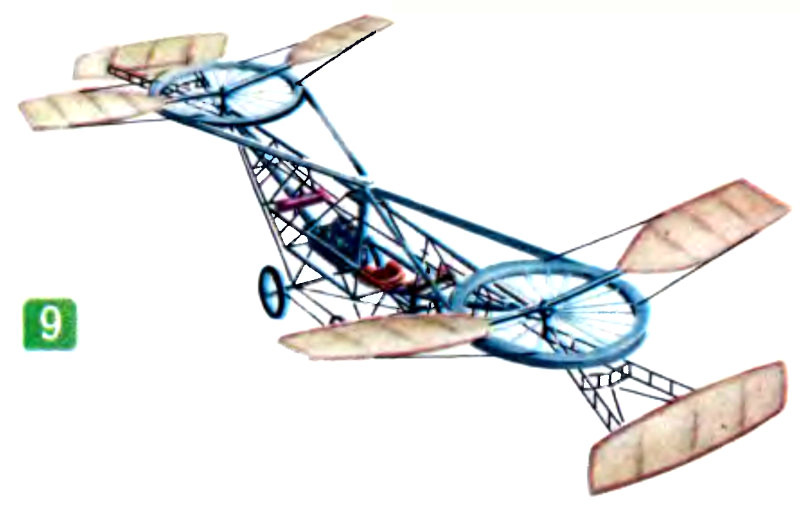 |
| Fig. 9. Cornu Helicopter (France, 1907). Engine: "Antoinette," with 24 hp; diameter of the adjustable-pitch main rotors: 6 m. Belt-driven transmission. Weight without pilot: 203 kg. The first lift-off occurred in August 1907. During tests, the machine initially rose 30 cm off the ground (total weight: 260 kg) and then 1.5 m (total weight: 326 kg). Subsequent tests were conducted with the helicopter tethered. |
What should the helicopter rotor look like? Yuryev already knew — it had to be large in diameter with narrow blades. But what about the helicopter itself? Should it have multiple rotors, like its predecessors? No, an analysis of student projects made it clear that the transmission from the motor to multiple rotors would be too heavy, as would the complex spatial frame supporting the lifting system and transmission.
It seemed simpler and lighter to have a single rotor driven by a gear reducer to lower its speed! Alas, the mechanical engineering students fully understood that the enormous reactive torque would cause the helicopter's body to rotate in the opposite direction.
Initially, Yuryev planned to counteract this torque... using the rotor itself. All that was needed was to install a special control surface, a deflector, on the body to redirect the airflow from the rotor in the direction opposite to the fuselage's rotation. This would create a new moment relative to the rotor's axis, balancing the system.
However, the "deflector" solution was only suitable for experiments with the simplest flying models. For a real machine, under flight conditions with variable speeds, rotor revolutions, and airflow around the fuselage and deflectors, this approach was impractical: the design was too bulky and heavy.
Yuryev found a solution in a design with additional control rotors located at the ends of a crossbeam on either side of the main rotor. Constantly rotating, one rotor generated thrust backward, and the other forward. The pitch of these rotors and the angle of their blades could be adjusted, allowing the pilot to easily balance the machine or turn it right or left. If both rotors were made to pull forward (naturally, with different forces to counteract the reactive torque of the main rotor), the problem of horizontal flight was solved. For lateral and longitudinal control, Yuryev provided deflectors on the body, which the pilot could adjust to direct the airflow from the rotor.
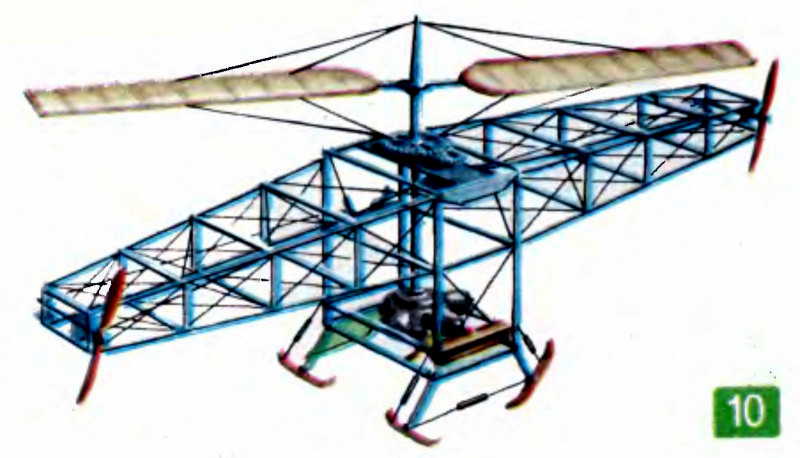 |
| Fig. 10. Diagram of B. N. Yuryev's helicopter, patented in 1910. The patent description stated: "A single-rotor helicopter, characterized by the fact that the rotational moment created by the lifting rotor is neutralized by the moments of force of two small rotors operating at the ends of a lever perpendicular to the axis of the main rotor." |
In September 1910, the young designer received a protective certificate for this design from the patent bureau of the Department of Trade and Industry under No. 45212.
The patent was granted, the design was approved by like-minded members of the Aeronautical Circle, and Zhukovsky himself blessed his talented student. However, Yuryev revisited the project once more. By simplifying the machine's layout to the maximum, he replaced the crossbeam with two control rotors with a longitudinal (airplane-style) fuselage featuring a single tail rotor. He then added the final touch: equipping the helicopter with a swashplate mechanism, solving the fundamental problem of balance and controllability. This mechanism is still used in helicopters today, regardless of their size or weight.
The idea of this device was simple and exceptionally ingenious. Tilting the axis of the main rotor forward, Yuryev believed, would direct the machine into horizontal flight — the horizontal component of the rotor's total thrust would give the apparatus forward motion. Tilting the rotor to the right or left would handle lateral control, while the tail rotor would assist in changing the direction.
Together with enthusiasts from the Moscow Higher Technical School (MVTU), Yuryev designed several single-rotor helicopters. However, it was only in 1912, on the eve of the Second All-Russian Aeronautics Congress and the International Exhibition of Aeronautics and Automobilism, that he began constructing a machine in metal. A lack of funds, quality materials, and a suitable engine hindered the realization of his plans. As a result, a full-size model, rather than a finished design, was displayed at the Moscow Manege. Nevertheless, the gold medal awarded to Boris Nikolayevich Yuryev by the organizers for the theoretical development of the helicopter project marked his significant contribution to the history of rotorcraft.
The title image depicts B. N. Yuryev's helicopter (Russia, 1912). Engine: "Anzani," three-cylinder, air-cooled, with 27–30 hp. The main rotor was two-bladed, with a diameter of 8 m and a rotation speed of 140 rpm. The blade construction was similar to that of an airplane wing — a steel tube spar, wooden ribs, and fabric covering. The tail rotor was two-bladed, with a diameter of 2.5 m. Belt-driven. The total weight of the constructed helicopter was 203 kg.