


"The propeller, the sacred propeller - that's what will carry us into space, the propeller that penetrates the air like a drill into a tree, dragging its motor along with it."
Doesn't it sound a bit pompous, quite in the spirit of the last century, when even quite prosaic things were spoken of in "high style". And heretical, in any case, for Europe in 1860, which had received a brilliant novelty from the 18th century - the balloon.
 |
| Leonardo da Vinci's 1475 project |
Fortunately, so-called common sense is not always the best judge in scientific disputes. Despite the obvious successes of aeronautics, the author of the above lines, the Parisian artist, journalist and photographer Felix Tournachon, believed that “control of the balloon is killed by the balloon itself” and “to fight the air, you need to be much heavier than it.” Nadar - this was Tournachon’s literary pseudonym - was not satisfied with the obvious helplessness of the balloon, its complete dependence on the will of the wind.
 |
| Lanois and Bienvenu's Project 1784 |
Having secured the support of a few enthusiasts, Nadar founded the "L'Automotion Aerinne" society with them and published the first aeronautical magazine in history, "Aeronaute". The experiments and the magazine needed money – so let the doomed balloon serve the future heavier-than-air devices! Having built a giant aerostat, the “Giant,” Nadar collected the necessary funds from air walk enthusiasts, but – alas! – the first issue of the magazine, published in a circulation of 100,000, interested only 42 subscribers.
 |
| De la Landelle's 1864 project |
No, the idea of a helicopter did not come to Nadar and his associates. The very first was... Leonardo da Vinci. His now well-known drawing of a vertical takeoff apparatus, published in the 18th century (Fig. 1), is dated by historians to 1475. According to the great Leonardo's idea, the rotor was to be made of starched canvas stretched over a wire frame; the "pilots" themselves would have to rotate it in the absence of other sources of energy. For this, da Vinci proposed placing a platform under the rotor, on which people would walk in circles, pushing the splines of the vertical shaft. Having shared the delusions of his century, Leonardo, like his contemporaries, did not even suspect the reactive moment that would arise on this platform when the rotor rotated. If the "pilots" had developed enough power for flight, the platform would have spun, but not the giant sail-propeller.
 |
| model d'Amécourt 1863 |
A completely different real scheme of a rotary-wing aircraft was proposed and implemented in a model by our Mikhail Lomonosov. Judging by the protocol description of experiments with the "aerodrome machine", stored in the archives of the USSR Academy of Sciences, its propellers rotated in different directions and balanced each other. A brilliant experimenter, Lomonosov very cleverly dealt with the main difficulty of the experiment, “eliminating” the weight of the rather heavy spring mechanism. As the protocol of July 1, 1754 states, “the machine was suspended on a cord stretched through two blocks, and was held in equilibrium by weights hung on the opposite side; when the spring was wound up, it immediately rose upward and thus promised the desired effect” (see p. and p. on the title page).
 |
| Binen Project 1696 |
З праектаў далёкага мінулага адзначым канструкцыю Лануа і Б'енвеню (р і с. 2).Новыя надзеі для верталёта, ці, як яго раней звалі, гелікоптара, спарадзілі ідэі Надара і... паравая машына, бесперапыннае ўдасканаленне якой прымушала чакаць з'яўленні лёгкай, нябачанай тады магутнасці авіяцыйнай сілавой усталёўкі.
«Вожык», запушчаны Надарам у |чарапную скрынку сучасных яму вынаходнікаў, вельмі хутка выклікаў хвалю праектаў - выдатна якія лёталі мадэляў і нават цяжкіх, у некалькі кілаграмаў вагай, прылад з паравымі машынамі. Класічнай сярод іх лічыцца мадэль паплечніка Надара - Понтон д'Амекура, пышна вырабленая механікам Жозэфам. І хоць пры вышыні ў 62 см яна важыла без паліва і вады ўсяго 2,7 кг, хупава выкананы «паравік» так і не змог падняць яе ў паветра. Затое канструктар пакінуў нашчадкам створаную ім схему прывада двух сувосева размешчаных шруб, якія круціліся насустрач адзін аднаму (р і с. 4).
 |
| Праект Вельнера 1902 г. |
From the projects of the distant past, we note the design of Lanois and Bienvenu (p and p. 2).
New hopes for the helicopter, or, as it was previously called, the helicopter, were generated by the ideas of Nadar and... the steam engine, the continuous improvement of which made us expect the appearance of a light, then unprecedentedly powerful aviation power plant.
The "Hedgehog", launched by Nadar into the brains of his contemporary inventors, very soon gave rise to a wave of projects - beautifully flying models and even heavy, several kilograms in weight, devices with steam engines. The classic among them is the model of Nadar's associate - Ponton d'Amécourt, superbly made by the mechanic Joseph. And although at a height of 62 cm it weighed only 2.7 kg without fuel and water, the elegantly executed “steam engine” was never able to lift it into the air. But the designer left to his descendants the scheme he created for driving two coaxial propellers rotating towards each other (p and p. 4).
|
| Vellner's 1902 project |
Following Ponton d'Amécourt, an unknown graduate of the Moscow Military School, Alexander Lodygin, took up helicopters. Fascinated by the miracle of the 19th century - electricity, in 1869 he proposed to the Ministry of War a project of "electroplane" - a helicopter-type device with an electric motor on board. Having received a refusal, Lodygin was forced to turn to Nadar's compatriots, but the construction of the helicopter was prevented by the Franco-Prussian War.
Having failed as an aircraft designer, 23-year-old Lodygin invented an electric incandescent lamp, which made him a world-famous electrical engineer.
 |
| Bykov's Project 1697 |
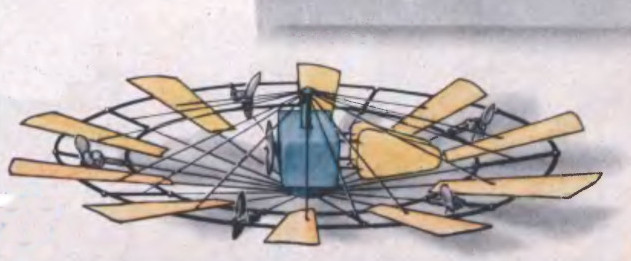
It should be said that Russian names are very common in the history of helicopter construction. In 1871, only a year after the approval of Lodygin's "electric plane" in France, another of our compatriots, the future academician Mikhail Rykachev, in his work "First Experiments on the Lifting Force of a Propeller Rotating in the Air" was the first to understand how much effort vertical flight using a rotor requires. And although numerous enthusiasts continued to flood patent offices with projects for muscle-powered helicopters (one of them is shown in Fig. 7), it became clear to specialists: vertical takeoff and flight are possible only with the help of a light and at the same time very powerful engine.
Several projects completed in the second half of the 19th - early 20th centuries are reproduced in Figures 3, 5 and 6.
But as soon as the designers, having believed in the design of a successful model, built an enlarged copy of it, the helicopter completely lost its ability to fly. It turned out that with all the tricks, the weight of the machine did not increase in direct proportion to the increase in engine power.
Only the recently invented gasoline internal combustion engine could give a new chance to the helicopter, which had not yet been launched.