


Urbanization and cybernetics. These terms entered our active vocabulary relatively recently, but have become so firmly rooted in it that anyone wishing to appear intellectual is now eager to flaunt these fashionable words in conversation.
However, at first glance, there seems to be no organic connection between these words. A prominent Soviet scientist, Hero of Socialist Labor, laureate of the Lenin and State Prizes, Vice President of the Academy of Sciences of the Ukrainian SSR Viktor Mikhailovich GLUSHKOV, holds the opposite view. He foresees the rapid introduction of cybernetics and electronics into the everyday life of each urban family. We offer our readers the first part of Viktor Mikhailovich’s conversation with our special correspondent G. FEDOROV.
 |
— Viktor Mikhailovich, many science fiction writers have dedicated their works to the life of a person at the turn of the 20th–21st centuries. But imagination is one thing, and a scientist’s foresight is quite another. Could you tell us how you, as a specialist in cybernetics, imagine the everyday life of people in the cities of tomorrow?
— Let us begin with a semi-fantastic scene that nevertheless seems quite real to me.
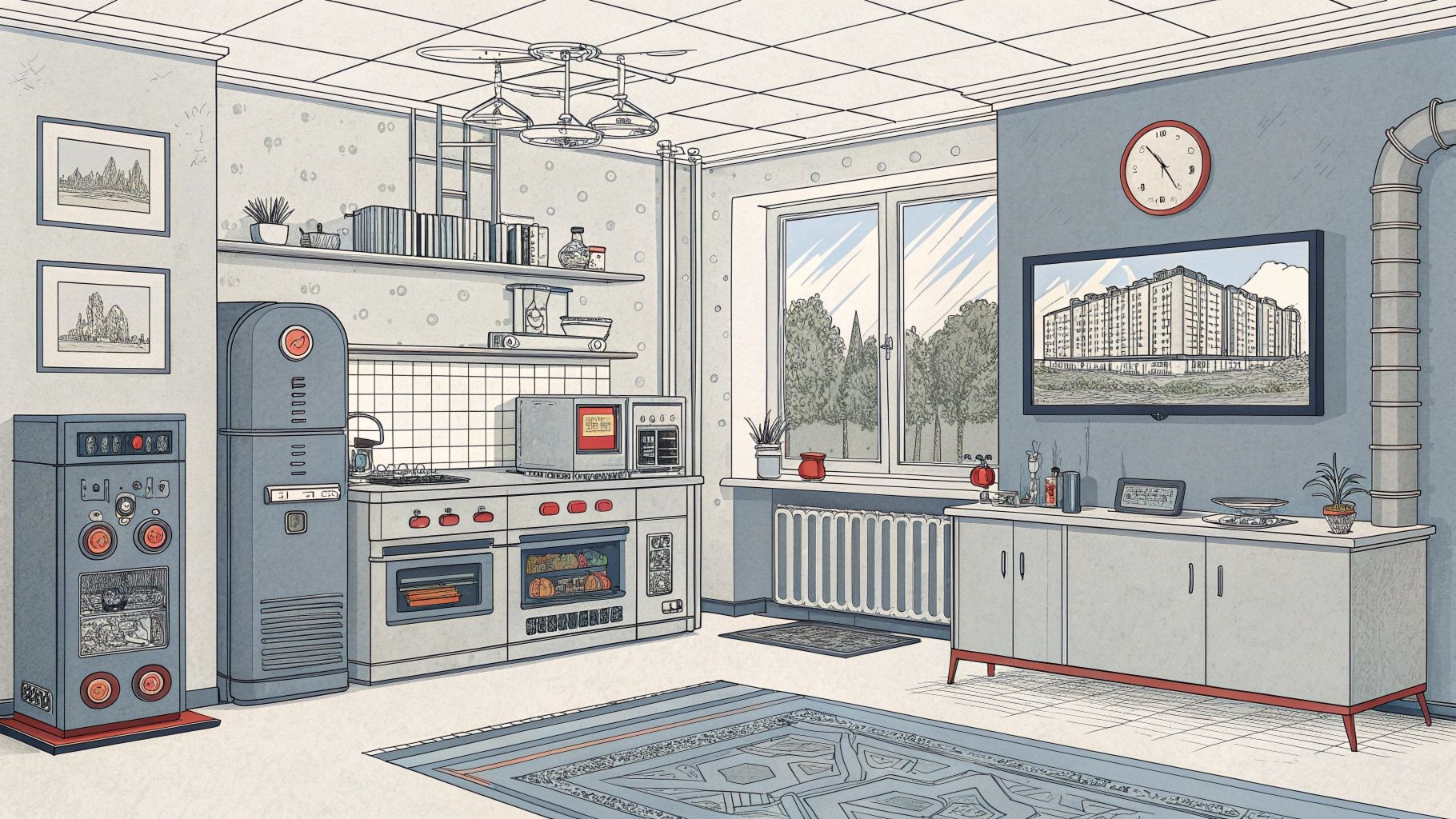
...Early morning. The entire house is still fast asleep. The apartment is cool. But then, obeying someone’s command, the walls begin to warm up. A few minutes later, the electric stove in the kitchen turns on. Some time passes, a small pot with eggs or sausages placed inside the night before begins to boil, and the kettle starts to hiss. In the room, a huge wall-sized television screen lights up, and soft music begins to play. And only after this, if the apartment’s occupants do not wake up on their own, a wake-up signal sounds.
On the wall before the waking eyes appears a sunrise on the Volga or somewhere in the mountains. A bright red sun slowly crawls out from behind the horizon. And the higher it rises, the more golden its rays become... The room grows warm, the ceiling shines brighter and brighter, and the gentle music gradually becomes louder and more cheerful. Breakfast is ready. Time to get up...
— It all looks quite beautiful, but will it really be like that? What is the basis for your confidence?
— Recently, there has been a leap forward in miniaturization. Computers have become sharply cheaper, especially those with small memory. And these are precisely the ones needed in household appliances. I am certain that every apartment at the end of the 20th and the beginning of the 21st century will have several mini-computers. Let us see how realistic the creation of the household appliances and devices I mentioned is. Let us start with heating.
 |
It is obvious to all of us that creating a comfortable indoor climate is necessary not only in the future, but even today. It must be acknowledged that much here depends not so much on computerization as on cheaper sources of electric power—atomic, and later thermonuclear power stations.
Very soon, familiar radiators will be replaced by a heating wall equipped with thermoelements with outputs to the apartment and to the outside. This system, following commands from a mini-computer, will maintain the desired temperature in winter and summer. It is enough to reverse the current, and the heater will work as a refrigerator, carrying the heat outdoors.
Unlike familiar electric fireplaces, the system consumes less electricity because it is a heat pump, transferring heat in one direction or the other. An important component is program control of air humidity.
— Please tell us, how will the automated kitchen work?
— It is easier to automate a kitchen when the stove is electric rather than gas. It is not difficult to build a micro-computer into such a stove for programmed control of the heating elements. Naturally, nothing on such a stove will burn or boil over.
If you place food on such a stove in advance, it will prepare everything by breakfast or by the time you return home. And if you’re delayed at work, you can call the computer by telephone and reprogram it.
— But household work is not limited to cooking. Will cybernetics help with other chores?
— I think that by the end of this century, or perhaps at the beginning of the next, a home robot will appear that will do all the housework in your absence according to a given program.
By the end of the century, a universal intelligent robot will also appear, responsive to your voice, not requiring programming, and fully understanding what is needed from it. However, the cost of such a machine is unlikely to allow every apartment to have one.
 |
At the same time, specialized inexpensive devices will also appear: robot vacuum cleaners, floor washers, and polishers.
It is clear that such a helper needs sensory organs. Vision is not necessary—it is expensive and complex. Tactile sensing is sufficient. Equipped with sensors similar to a cockroach’s antennae, such a robot will probe its way, and when it senses an object out of place, it will simply go around it. Although, perhaps, in its electronic “soul” it may scold the owners for their eternal disorder. Creating such a robot with tactile sensing and feedback is not difficult even today.
Laundry is even simpler. Here you have a programmed washing machine—a whole laundry combine capable of performing dozens of different operations. It will independently find the best washing mode, choose the proper water temperature, add the right detergent... And then your laundry will be ironed. Creating such a laundry robot is not so difficult either.
— Viktor Mikhailovich, we digressed slightly. Let us return to the television sunrise.
— Lighting, of course, is simpler. It will differ from modern lighting only in the types of light sources—fluorescent fixtures with large surfaces providing uniform illumination. It is very easy to assemble a ceiling from such fixtures and make a mini-computer control the color and intensity of the light.
Music can already be “programmed” today even by amateurs. But the automated television set of tomorrow will be much more complex than today’s “Rubins” and “Elektrons.” And not only because of a larger screen. Color and image quality will improve dramatically. It is likely that a holographic television will appear, creating a complete effect of presence.
Due to the development of satellite communication and fiber-optic cables, the number of television programs will increase many times over. Then you will be able to request a broadcast recorded on videotape. Let me remind you that even today there are special devices that let you play various games with the television: chess, checkers, football, and tennis.
 |
But let us return to the future. You get up, play a round of badminton with the television for your morning exercise, and wash up. During breakfast, on one of the text-information channels, you browse the latest magazine issues, newspaper articles, and even materials that did not fit on the printed page. The main thing is that they have been entered into the city’s paperless information system.
From a technical standpoint, this is quite feasible even today. But the issue is purely economic. Communication channels and display devices are still too expensive. But over time, they will become accessible to the broad public.
The television of tomorrow will help you check the weather forecast and theater listings, inform you about new items in stores, and even show samples of goods, since all necessary data will be constantly accumulated in the city’s information network.
— Viktor Mikhailovich, are you sure that people will so quickly abandon the habit of reading, at least on their way to work?
— Of course not. But you will always be able to obtain a paper copy of text information from the television or display. Even today this is done almost instantly. But the main point is that all essential information will be constantly stored in the computer’s memory, in global information centers, and can be retrieved to screens at any moment.
An indispensable assistant will also be an improved home telephone with a microprocessor, which will remember all the numbers you need, repeat a call if the line is busy, automatically forward calls at your request, and record messages for you.
It will also ask questions and listen to the caller. And when you return home, you will immediately know who called and what they wanted. Prototypes of such devices are already being produced.
— And how will the streets greet us with something new?
 |
— With the cleanest air! By that time, every city will have a vast system for monitoring airspace. Sensitive sensors installed everywhere will report even the slightest signs of pollution to the city’s computation center so specialists can take urgent measures, such as temporarily closing certain areas to automobiles.
By the way, computers will also be useful in fighting automobile exhaust gases. In engines controlled by them, fuel burns almost completely.
Micro-computerization will open a new era in street-traffic management. At first, in public transport with fixed routes, and later in individual vehicles. The first steps in this direction are already being taken. However, for the computer to choose the optimal route, an electronic city service is also needed—one that receives data from all intersections, repair sites, and high-traffic areas.
After turning on the ignition, you enter the starting point and destination into the computer, and it communicates with the Center and suggests the best route.
And by the end of the century, automatic drivers will sit behind the wheel—just like modern taxi drivers, they need only minimal information... True, to achieve this, the entire road-traffic system will have to be rebuilt. Otherwise, the automated driver would be too bulky and expensive.
This, I think, is what the urban transport of tomorrow will be like. Only on trips to nature will a person drive the car themselves. After all, they are unlikely to give up the feeling of speed and control over the machine. And the computer will only ensure safety.