


Your press, sir! - John Townbridge, the owner of a tavern in the English town of Milford-on-Sea in Hampshire County, handed a stack of newspapers to an elderly man. Retired Commodore Reginald Redmond was accustomed to appearing here precisely at 10 a.m. to have a cup of tea and look through the fresh newspapers. And this time, he unhurriedly unfolded The Times.
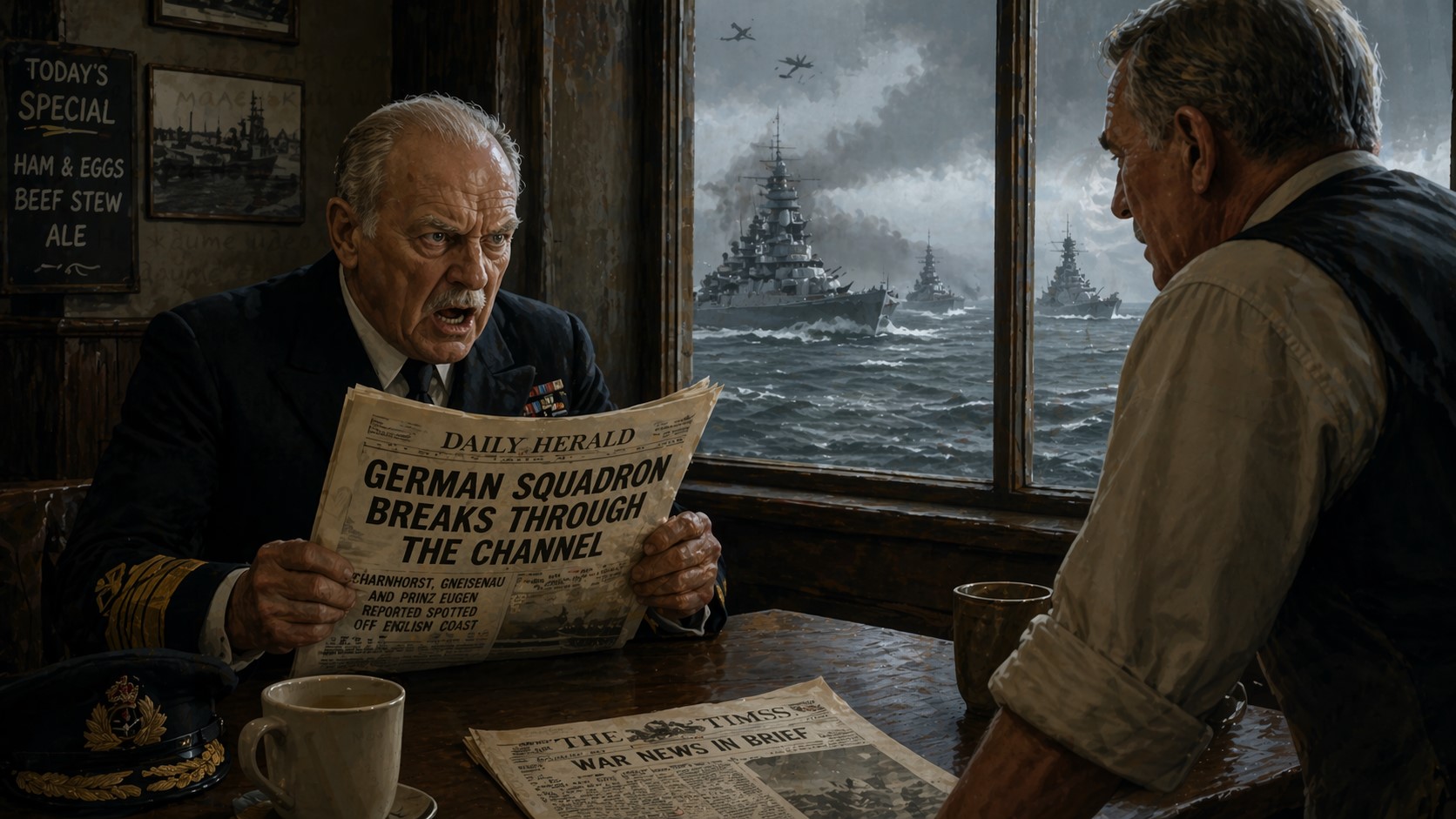 |
- Let's see what's new on the fronts... No, this is outrageous! - Suddenly red with anger, Redmond turned to Townbridge. - Just listen to what they write: "Vice-Admiral Ciliax has succeeded where the Duke of Medina Sidonia failed. Since the 17th century, British naval power has not experienced such humiliation..."
- What's happened there, sir? - the latter inquired.
- What do you mean? The day before yesterday, German ships, a whole squadron, passed through the Channel (as the British call the central part of the English Channel - B.R.) from Brest to the North Sea! And this within range of our aircraft, under the guns of our coastal batteries, through our minefields! - fumed the usually restrained commodore. - How could such a thing even happen?
Millions of Britons asked themselves the same question in February 1942. Yes, Britain had experienced tragedies - take the sinking of the battlecruiser Hood, sunk in May 1941 with all hands by the German battleship Bismarck. But Hood died in battle, and the honor of the fleet suffered no loss. But now? However, to understand the situation, let us turn to the events of late 1941.
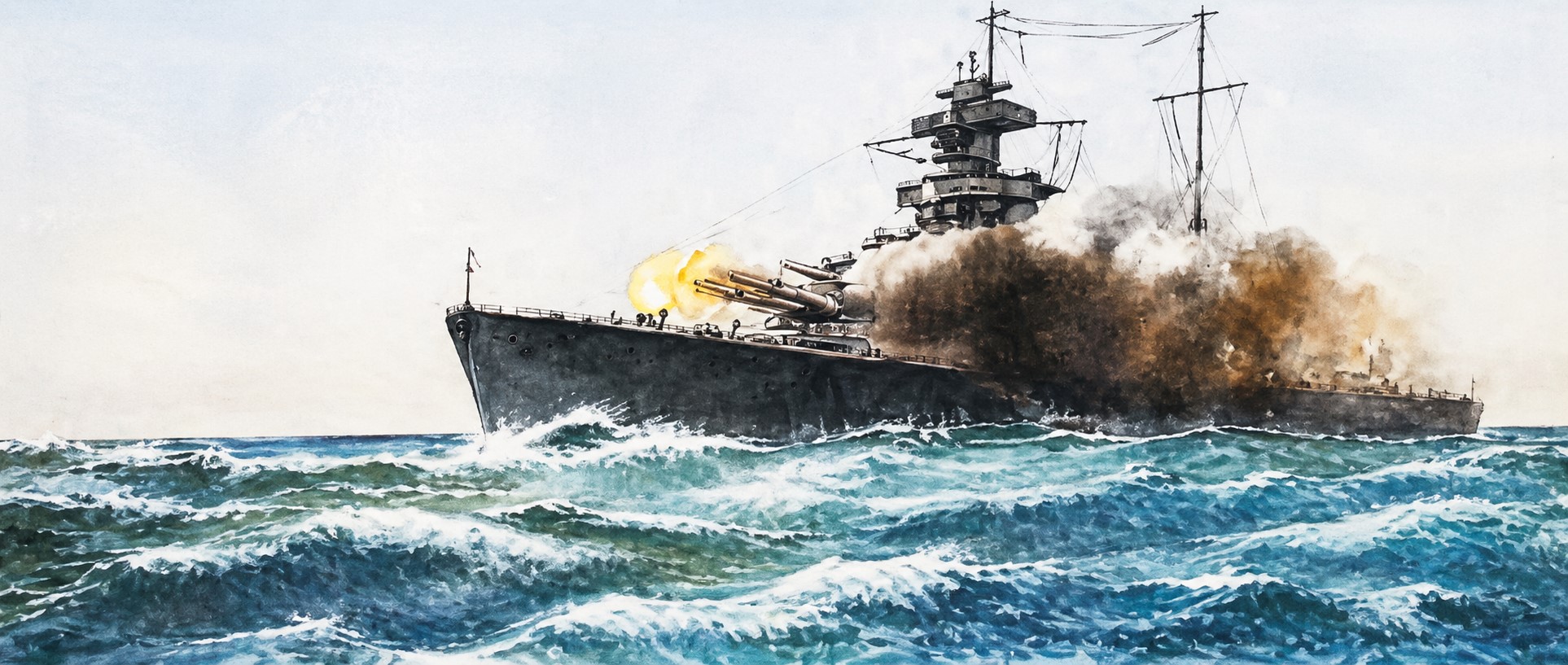
At that time, the Nazi fleet possessed impressive forces. In the Baltic were stationed the newest battleship Tirpitz, the heavy cruisers Admiral Hipper and Admiral Scheer, 4 light cruisers, and destroyers. In Brest stood the battleships Scharnhorst, Gneisenau, and the heavy cruiser Prinz Eugen. Destroyers and submarines were based in the ports of Nazi-occupied Norway.
The British Home Fleet at that time numbered the battleships King George V and Rodney, the obsolete battlecruiser Renown, the aircraft carrier Victorious, 4 heavy and 6 light cruisers, and destroyers. The latter were insufficient even to guard the Allied convoys crossing the central Atlantic.
Fears of a possible attack on these convoys by large enemy surface ships, including the Brest squadron, inclined the British Admiralty to launch a grand raid on that port. In January 1942, 612 bombers dropped 908 bombs on it, which, however, did not cause any serious damage to the battleships.
 |
As it turned out, the Admiralty officials had worried in vain. Hitler's attention was focused on the Eastern Front, where the Wehrmacht had suffered its first serious defeats near Moscow, Rostov, and Tikhvin. Therefore, Hitler decided to cease operations of surface ships in the central Atlantic and concentrate them in northern Norway, from where they could strike at the Arctic convoys heading to Soviet ports. On December 12, 1941, he ordered the transfer to Norwegian waters of the Scharnhorst, Gneisenau, and Prinz Eugen, which were stationed in Brest, and which were to break through the English Channel. The detailed plan for this operation, "Cerberus," was meticulously developed by the commander of the Brest squadron, Vice-Admiral Ciliax.
The squadron's departure from Brest was scheduled for 7:30 p.m. on February 11, 1942. As expected, the preparation of the operation did not go unnoticed by British intelligence, which promptly reported it to London. As early as 1941, a counter-operation plan, "Fuller," had been developed, outlining a series of measures aimed at preventing this breakout. In particular, British aviation was ordered to drop magnetic and ground mines on enemy fairways in the strait; the minelayers Manxman and Welshman laid an additional barrage between Ushant and Boulogne. Coastal batteries, units of torpedo bombers and bombers, and a destroyer flotilla were placed on combat alert. The torpedo boats stationed at Dover were reinforced by another flotilla. Constant air patrols were established in the areas of Brest, Ushant Island, and between the ports of Le Havre and Boulogne. On February 11, the submarine Sealion was sent to the waters off Brest, whose commander was ordered to continuously observe the enemy ships. Everything seemed to have been taken into account.
However... The Brest squadron put to sea at 8:45 p.m., an hour late due to an air raid on the port. The night was moonless, with a haze over the water. But the commander of Sealion did not spot the enemy for a different reason. During the bombing, he deemed it possible to leave his position to recharge the batteries.
The patrol aircraft did not see the squadron either, returning to base due to a failure of its onboard radar. Another plane, sent to the same area two hours later, naturally no longer found the enemy.
Meanwhile, the squadron proceeded through the strait at 7 knots and passed Alderney Island at 5:30 a.m. on February 12. At dawn, Messerschmitt fighters of the air cover appeared above the ships.
At 10:30 a.m., the ships came abeam of the mouth of the Somme, but the British Admiralty was still unaware of their departure from Brest. By the way, an hour earlier, interference had appeared on the screens of the British coastal radars. However, such things had happened before, so the staff officers attached no importance to it.
Two British Spitfire fighters on reconnaissance saw some ships in the strait but mistook them for one of their own convoys. Only upon returning to the airfield did the pilot note that one of the ships looked like a battleship.
At 10:42 a.m., two other Spitfires, chasing an enemy aircraft, emerged from the clouds directly above the squadron. The flight leader, Colonel Beamish, immediately realized that the ships below were from Brest, but mindful of the order to maintain radio silence, he reported the incident only after landing, at 11:09 a.m.
And then it began... Telephones rang in the British headquarters, orders poured out, often ill-conceived and contradictory. Instead of the clear "Fuller" plan, a completely dysfunctional military machine sprang into action. For instance, it occurred to no one that the Swordfish torpedo bombers were twice as slow as the fighters sent to cover them, that the high-altitude bombers would not reach the battle site in time, and that of the dozen torpedo boats allocated for Operation Fuller, only eight were battle-worthy.
Finally, the gun barrels of the British coastal batteries stirred, although the gunners were sure that firing at ships hidden by fog and rain was pointless without radar guidance (and those, as we know, were "blind"). Nevertheless, at 12:18 p.m., the guns opened fire, firing 33 salvos over 27 minutes. Alas, not a single 229-mm shell fell closer than a mile from the squadron.
The echo of the gunfire was still rolling over the strait when only five torpedo boats set out from Dover. Moreover, one soon fell behind due to engine failure. At 12:23 p.m., the boats sighted the squadron, but the unit commander did not dare to engage the enemy without air cover. More to rid themselves of their load than to hit the enemy, four boats launched torpedoes in a fan from a distance of 4 cables and withdrew. The crew of the fifth boat, having repaired the engine, broke through the escort's fire and fired torpedoes at the Prinz Eugen - also to no effect!
It was the turn of the air force. Around noon, six torpedo bombers took off one after another from the runway of Manston airfield. The squadron was led by Lieutenant Commander Esmonde, a veteran of the successful hunt for the battleship Bismarck in May 1941. But then Esmonde's Swordfish had dealt with a strong but lone opponent; now they were to attack a squadron guarded by escort vessels and fighters. Soon, Spitfire fighters appeared above the slow torpedo bombers.
- Weak cover... - grumbled the commander. He never learned that poor visibility had prevented the other Spitfires from finding their charges, the Swordfish.
German fighters met the British near Ramsgate and, engaging the Spitfires, fell upon the torpedo bombers, whose crews sighted the enemy squadron at 12:50 p.m. Splitting the squadron, Esmonde led the aircraft of Lieutenants Rose and Kingsmill into the attack. From the other side, Lieutenants Thompson, Wood, and Blye advanced on the enemy. The commander's Swordfish passed through the escort's barrage zone and, skimming the waves, dashed toward the dark grey bulk of the Scharnhorst. Shells from the Messerschmitts, which had locked onto it, were already hitting the torpedo bomber's wings and fuselage. With a final effort, the wounded Esmonde released his torpedo, and immediately his blazing aircraft crashed into the sea. Lieutenant Rose's Swordfish, after releasing its torpedo, flashed over the deck of some ship, burst into flames, and ditched clumsily. Climbing into a rubber dinghy, the airmen watched as Kingsmill's burning aircraft slammed into the waves... An hour and a half later, the frozen airmen were picked up by a British torpedo boat. The desperate Swordfish attack cost England six aircraft, on which 13 airmen died, and not a single torpedo struck the enemy ships!
Meanwhile, the squadron entered the mined waters, and Admiral Ciliax reluctantly ordered a reduction in speed. Surely the British would now resume their attacks on the ships crawling along the narrow fairways, unable to manoeuvre! But oddly enough, no one interfered with the squadron's passage through the minefields.
By 2:00 p.m., the ships had regained speed, but the Scharnhorst immediately shuddered from a powerful explosion. However, the damage caused by the mine was not too serious, and soon it was again steaming at 25 knots. The Brest squadron was entering the North Sea, and the only force that could still stop it was a destroyer flotilla from Harwich.
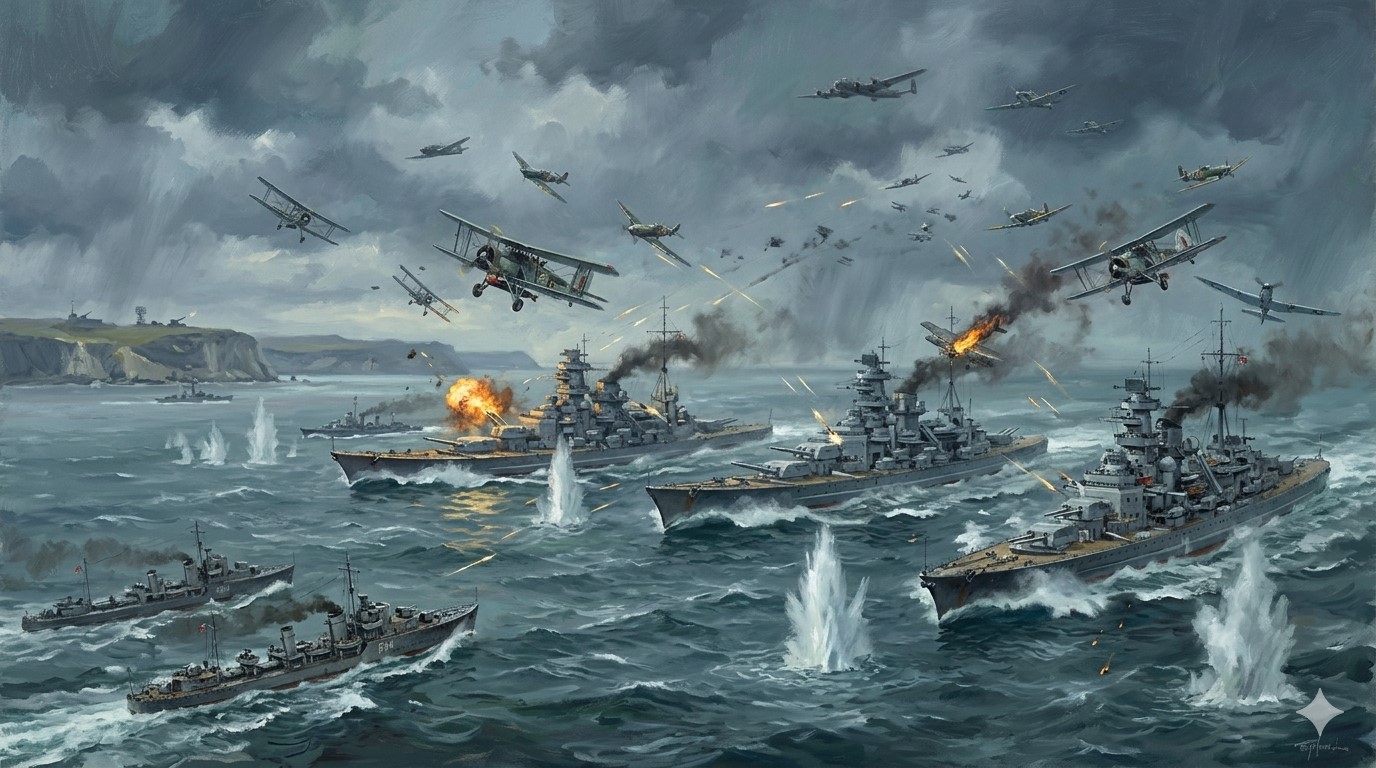 |
The commander of this flotilla, Captain Pizey, received the order to attack the Nazis while his ships were on exercise at sea. The flotilla consisted of two flotilla leaders and four destroyers, built back at the end of the First World War. They were even slower than the German battleships. Realizing that his flotilla was hopelessly late for the attack, Pizey took a risk and led his ships through the minefields. True, the destroyer Walpole was forced to turn back to base due to engine failure, but the rest proved the saying "nothing ventured, nothing gained."
At 3:17 p.m., lookouts on the flotilla leader Campbell sighted Ciliax's battleships 9.5 miles away through rain and fog. Using the poor visibility, Pizey closed the distance by another 2 miles, after which the Campbell and the Vivacious launched torpedoes simultaneously. The Worcester, which had approached even closer to the Scharnhorst, was immediately bracketed by a salvo from the battleships and received several direct hits. The Mackay and the Whitshed launched their torpedoes last. And not one found its mark!
Now only 242 British bombers could catch the squadron steaming at full speed along the Dutch coast. But luck was not with them either – only the crews of 39 aircraft located the squadron, and they attacked the target piecemeal, without escort. The result: the Nazi ships' anti-aircraft guns and fighters shot down 15 bombers, and all the British bombs exploded harmlessly in the sea...
At 7:55 p.m., abeam of the island of Terschelling, the Gneisenau also struck a mine. A powerful explosion damaged the battleship's hull aft, and she temporarily lost power, but at 7 a.m. the next day, she was nonetheless the first of the squadron to drop anchor at the mouth of the Elbe. She was followed by the Prinz Eugen, the only one of Ciliax's major ships to survive the breakout undamaged. As for the Scharnhorst, she struck another mine at 9:35 p.m., took on over 1,000 tons of water, and with great difficulty, assisted by tugs, crawled to the base at Wilhelmshaven. Nevertheless, the Kriegsmarine command had reason to consider Operation Cerberus a success.
The subsequent fates of Ciliax's armoured ships varied. The Scharnhorst, transferred to ports in occupied Norway according to Hitler's orders, was sunk by a British squadron in December 1943. The Gneisenau was bombed repeatedly and sank at the entrance to the port of Gdynia in early March 1945. After the war, she was broken up for scrap by Polish divers. The Prinz Eugen was allocated to the United States in the division of the Nazi German fleet, and they used it as a target for nuclear weapons testing at Bikini Atoll.
...Thus, Ciliax's squadron managed to pass unimpeded through the zone controlled by the British fleet and air force in February 1942. At the time, representatives of the British Admiralty lamented the bad weather that hindered the British airmen and sailors, the exceptionally "unfavourable set of circumstances," and simply fate, which had played a cruel trick on the staff officers during the execution of the Fuller plan. But were there other reasons that contributed to the success of the Nazi plan Cerberus? British historians, at any rate, are silent on this matter.