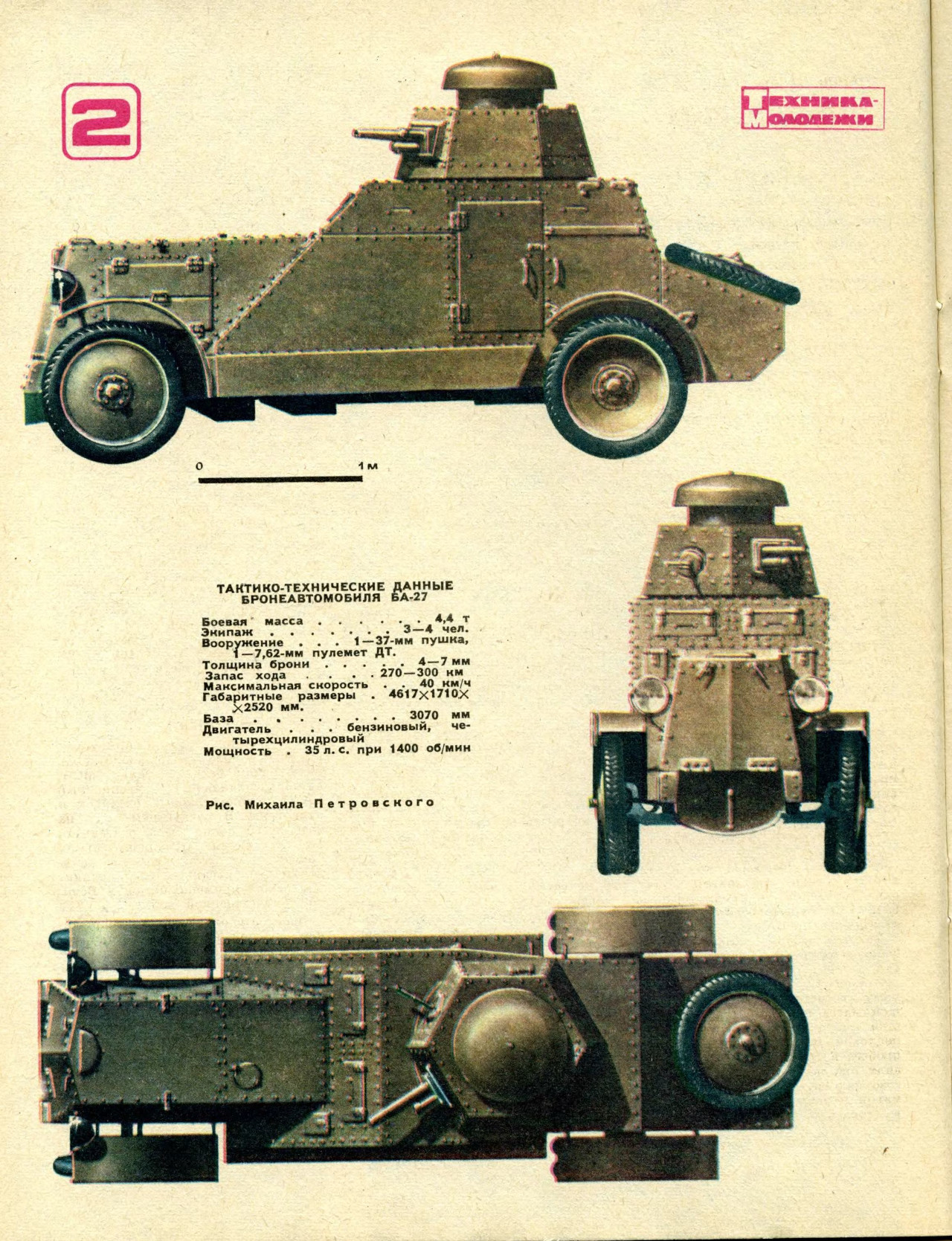
After the Civil War, the Red Army units had several dozen already obsolete and heavily worn-out armored cars. The time came to replace them with modern armored vehicles, and this became possible after the establishment of the first Soviet automobile manufacturing plants.
Earlier, it was impossible to begin rearming the Red Army with armored cars. The country was surrounded by hostile capitalist states, so one could not count on foreign firms agreeing to fulfill Soviet orders.
...On November 7, 1924, ten bright red trucks drove across the festive Red Square in Moscow. These were the first Soviet-made vehicles, the AMO-F15. On the side of one of them blazed a poster: "We will provide vehicles for our cherished Red Army!" A few years later, army trucks and the first Soviet production armored cars, the BA-27, built on the AMO base, appeared at military parades.
The fact that the choice fell on the AMO-F15 was natural. Thanks to a successful layout of components, significant ground clearance (245 mm), and low weight, this simple and reliable vehicle had good off-road capability. During a test run under difficult road conditions, it demonstrated its superiority over foreign-made trucks and took first place. It was proven that the Soviet vehicle's chassis was quite suitable as a base for an armored car.
Work on it began in 1926 at the AMO plant under the direction of V. D. Strokanov, head of the design department. The design was developed by his deputy, E. I. Vazhinsky. By the summer of 1927, a technical project was ready, and a little later, with the participation of engineer I. I. Vitebenberg, the chassis was tested. The future vehicle was designated BA-27: "armored car of 1927". The chassis and all documentation were then transferred to the Izhora Plant, where the armored hull was built. After successful trials in December 1928, the vehicle was adopted into service under the name "BA-27 Armored Car, Model 1928".
Early production BA-27s had a second, rear driving position. This was later abandoned, which simplified the design and reduced the crew by one person.
A combat vehicle must operate in far more severe conditions than an ordinary truck. Moreover, it was burdened by a massive steel shell: the combat weight of the BA-27 was almost a full ton greater than the gross weight of the AMO-F15. Therefore, the designers of the armored car reinforced the AMO frame and springs, installed higher-capacity tires on the wheels, improved the clutch mechanism, and added an extra fuel tank.
Drivers of the AMO-F15 started the engine using a fixed hand crank. This was unsuitable for an armored car: restarting a stalled engine this way under fire was dangerous. Therefore, the BA-27 was equipped with an electric starter.
Electric headlights replaced the AMO's acetylene lamps, a modification later also made to the truck. The problem of engine cooling was solved in a unique way on the armored car.
The fact is that on the AMO-F15, the engine's flywheel, 60 cm in diameter with eight spiral spokes/blades, served as the fan. Since there were no slots in the hood, and the engine was covered from below by an oil pan, air drawn by the flywheel into the engine compartment passed intensively through the radiator. But on the BA-27, the front of the radiator was covered by two armored doors that could be opened from the driver's seat. Naturally, in combat conditions, the doors were closed, allowing little air to reach the radiator, and the engine often overheated. To avoid this, the doors were fitted with four air intakes, covered by armored "pockets".
The riveted hull of the BA-27 was made of armor plates 4–7 mm thick, with the front wall sloped to increase the vehicle's bullet resistance. At the rear, there was a stepped protrusion that provided a good view from the rear driving position. A spare wheel was mounted externally on the sloping plate here as well.
In the center of the hexagonal riveted turret, the gunner sat on a small suspended seat. To his left was a 37-mm Hotchkiss gun, to his right a 7.62-mm DT-29 machine gun with a retractable shoulder stock (Degtyaryov, tank mounted). In the turret, it was mounted in a ball mount consisting of a circular socket in the side and a rotating "apple" into which the machine gun was inserted. This design provided good firing angles and, if necessary, allowed the weapon to be easily removed.
From 1929, BA-27 armored cars also began to be produced on the chassis of the then-newest one-and-a-half-ton Ford-AA truck, with a four-cylinder water-cooled engine producing 40 hp. The armament and armor protection remained essentially the same, but the vehicle's combat weight decreased to 4.1 tons.
By the end of 1931, Soviet factories had built about 100 BA-27s. Many of them took part in fighting bands of Basmachi in Central Asia and in battles against Chinese White militarists during the armed conflict on the Chinese Eastern Railway.
In 1929, an experimental mechanized regiment was formed, including a battalion of MS-1 tanks, an armored car battalion equipped with BA-27s, a motorized rifle battalion, and an air detachment. The following year, the 1st Independent Mechanized Brigade was deployed from this regiment. This marked the beginning of mechanized formations that were successfully used in the Great Patriotic War.
A few years later, new, superior armored cars entered service with the Red Army, replacing the BA-27. Only one example of this combat vehicle survives to this day. Furthermore, the BA-27 was once immortalized by cinematographers. This refers to the film "Chapaev", in which the BA-27 "played" the role of an armored car from the Civil War period.
LEONID GOGOLEV,
engineer