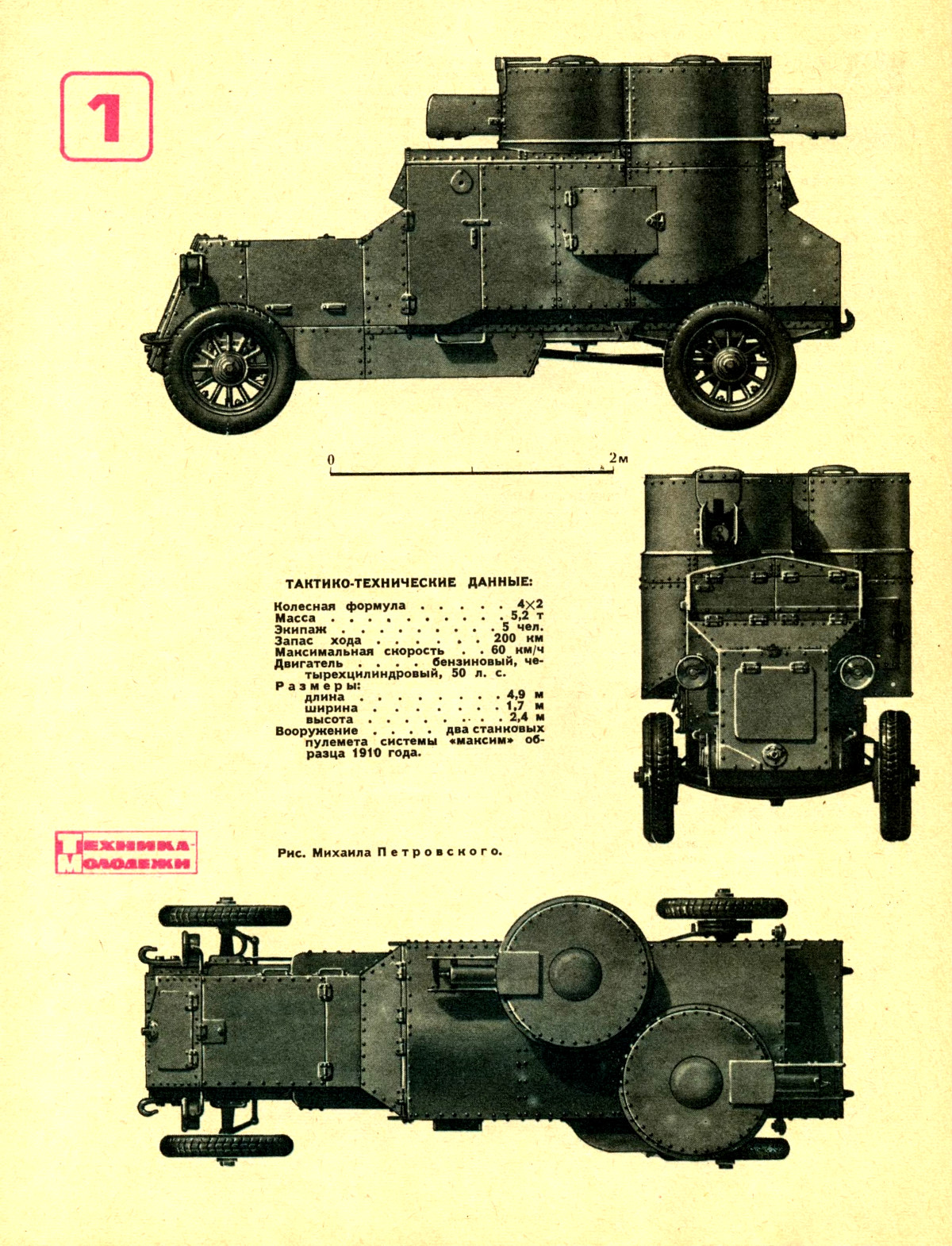
In the Leningrad branch of the Central Museum of V. I. Lenin, an authentic armored car from the First World War is preserved.
This is the so-called "Russian Austin" (or "Austin-Putilovets"), the most common armored car of that time. It was from this vehicle that, on the night of April 3–4, 1917, the leader of the revolution delivered his historic speech near the Finland Station in Petrograd.
 |
It should be noted that the first attempts to create an armored car in our country were made at the beginning of the century. In 1904, Sub-Lieutenant of the Siberian Cossack Corps M. Nakashidze developed a design for an armored vehicle. Built the following year, it successfully passed tests, and the military department ordered ten such armored cars, which entered service.
By 1914, even the most developed countries had only a few types of armored cars. Only with the outbreak of the First World War did mass production of these highly needed front-line vehicles begin. In Russia, one of the first batches was produced on the chassis of “Russo-Balt-M” trucks. A small number of armored cars were built according to the designs of officers Mgebrov, Poplavko, and Gulkevich. And from 1916 onward, imported armored cars began to appear in the army.
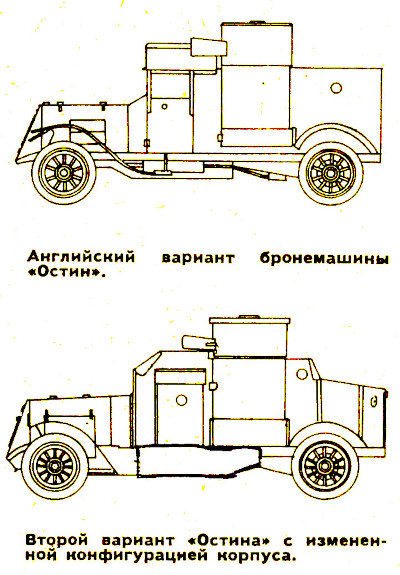
The most common among them was the British “Austin.” However, this otherwise decent vehicle had several serious drawbacks. These included the sagging of the rear axle when driving over rough terrain, which caused the half-axles to jam and made movement impossible. The armor of the “Austins” was too thin (4–6 mm) and could be pierced from 200 meters by an ordinary rifle bullet. The two machine-gun turrets, mounted side by side, interfered with each other when firing to the flanks, and the high roof of the front part of the hull obstructed firing forward.
The “Austins” had to be withdrawn from the front in batches for modification. They were fitted with 6 mm armor plates and reinforced rear axles. Moreover, combat experience showed that most armored cars were hit by the enemy while reversing. Therefore, Russian craftsmen, sometimes even under field conditions, installed secondary (rear) control posts on the “Austins,” allowing them to quickly retreat backward out of enemy fire.
Eventually, Russia abandoned foreign armored cars altogether. Only truck chassis were purchased, which were then armored at the Putilov and Izhora plants. From 1916 onward, the most common vehicles in the Russian army became twin-turret machine-gun cars based on the British “Austin” and the American “Fiat” chassis (produced under an Italian license).
The blueprints for the “Russian Austin” were developed by engineers at the Putilov Plant. On the chassis of a one-and-a-half-ton truck with reinforced frame, rear axle, and springs, they mounted a hull made of Izhora steel 8 mm thick, which could not be penetrated by rifle bullets from any distance. To protect the crew from fragments, the interior of the armored car was lined with cloth or felt. The low turrets were placed diagonally, allowing simultaneous flanking fire from both “Maxims.” The machine guns’ casings were armored and connected by hoses to additional water tanks located under the turret roof. This system improved barrel cooling. The armored car also had a secondary control post.
The British designed their “Austins” with two sets of wheels. Under normal conditions, the vehicle ran on pneumatic tires, but before combat it was “re-shod” with solid rubber battle tires, resistant to bullets and punctures. The disadvantages of this system were obvious: constantly carrying “extra” wheels and wasting time changing them in front-line conditions was an unaffordable luxury.
A solution was found. Just before the war, St. Petersburg chemist A. Guse invented a light and resilient filler for armored car tires. These tires were nicknamed “Gusmatics.” The “Austins-Putilovets” equipped with them went into battle…
In August 1916, a rather unusual armored car built at the Putilov Plant went out for trials. In fact, it was the same “Austin,” but with a wide rubber track of the “Kégresse” type instead of rear wheels. The front wheels were widened, and small rollers were placed in front of them to help overcome ditches and trenches. The new “Austin” surpassed wheeled armored cars in cross-country ability and was almost equal to them in speed, reaching up to 40 km/h. Thus, for the first time in the world, combat vehicles with a combined propulsion system were created. In 1917, “Austins-Kégresse” began to enter service and proved so effective that it was decided to convert all Russian army armored cars into half-track vehicles.
In October 1916, a new turret was designed for the half-track armored cars, allowing fire to be directed at aerial targets as well.
...Many of the 200 “Austins-Putilovets” took part in the October Revolution, fought on the fronts of the Civil War, and remained in service with the Red Army during the 1920s.
Leonid Gogolev, engineer.