About a hundred years ago, when automobiles around the world could be counted on one's fingers, no one even thought to register them in any way. But over time, the need arose. And then, without much ado, they decided to take advantage of the rich experience of registering horse-drawn carriages and draymen.
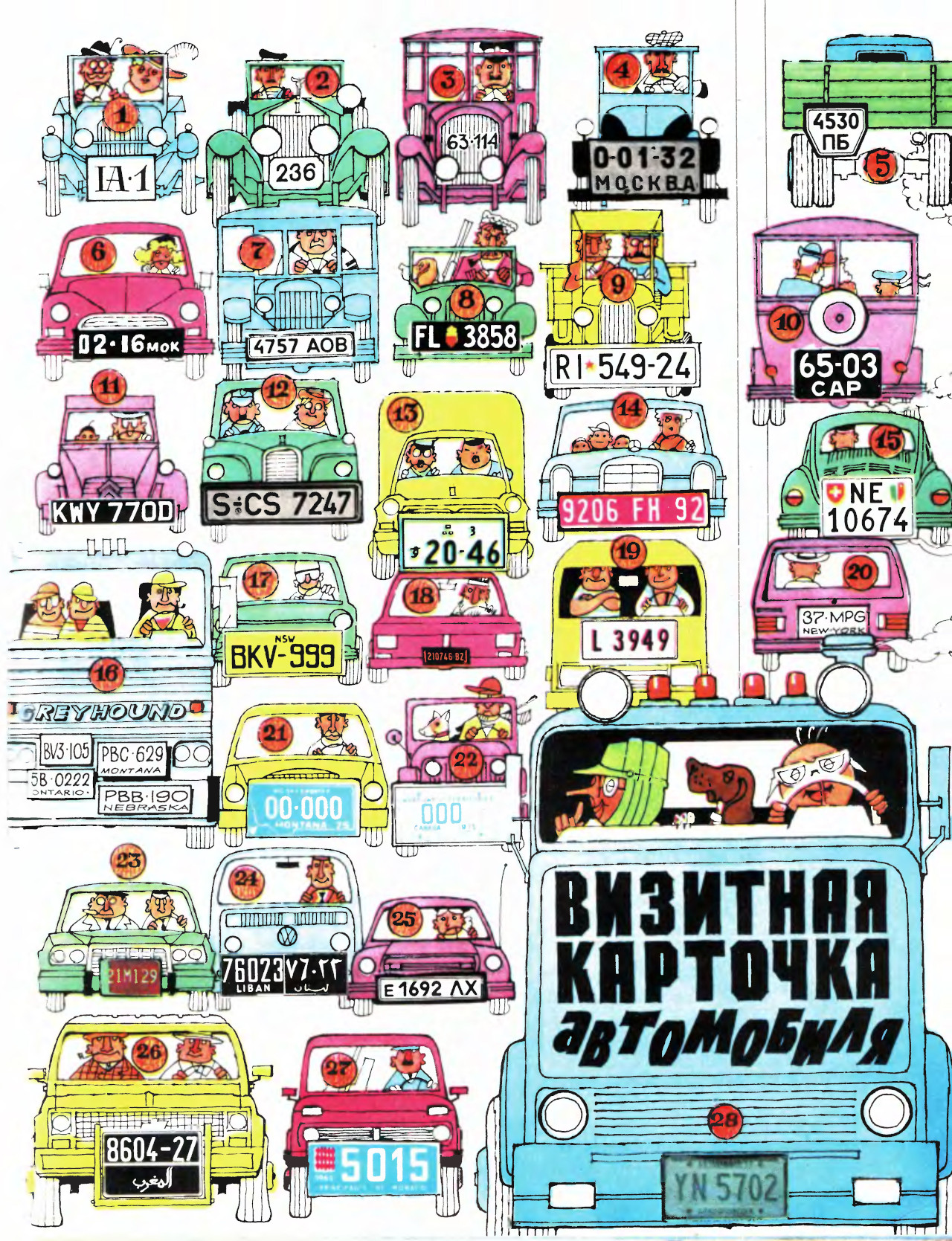
The first registration plates were simple metal tags with a sequential number, issued by city authorities. They were placed in the most conspicuous place on the vehicle. But in 1901, a Berlin merchant named Rudolf Hertzog unexpectedly became an innovator. Wanting to please his young wife Johanna Anker, he inscribed her initials on the plate of his newly purchased car. This is how the world's first combined index, IA-1, appeared (see Fig. 1 on the 3rd cover page). And these letters became traditional for Berlin vehicles! Later, a letter code was used to denote the city or locality where the car was registered.
Number-only plates appeared in Munich as early as 1899. Their use became mandatory in Paris in 1900, in New York in 1901, and in London in 1903.
In Russia, such plates were introduced at the beginning of the 20th century. They consisted of sequential numbers of newly registered vehicles. For instance, the Rolls-Royce registered before World War I that was later used by V. I. Lenin was issued plate number 236 (Fig. 2). City governments usually issued two plates — for mounting at the front and rear. It was permissible to paint the front number on the radiator grille, as was practiced in Italy (Fig. 3).
In the first years after the revolution, the Soviet authorities issued decrees on the organization of motor transport. They addressed the census of automobiles and motorcycles and traffic regulations. On June 13, 1920, the decree "On License Plates" was also published. It required that the front plate be mounted on the left fender of the vehicle, and the rear plate on the body or a special stand no higher than one arshin (about 71 cm) from the ground. "License plates," the decree stated, "must be kept clean and in good condition and must fully serve their purpose: identifying the vehicle while in motion. Handwritten plates are not permitted."
The "registration certificates" of that time continued the sequential numbering of automobiles, though the numbers had already become four- and five-digit (Fig. 4). Later, letter indices were added to them. In the 1930s, vehicles were re-registered, and in the late 1950s, a new license plate system was introduced, which remains in use today. Thus, on domestic general-purpose vehicles, black plates with 4 digits and 3 white letters appeared—front plates single-line (Fig. 6), rear plates two-line (Fig. 10).
The first letters of the series are the code for the city, region, territory, union republic, or autonomous republic where the vehicle is registered. For example: MO, MK — Moscow, LE, LD — Leningrad, KZh — Kaluga Region, TT — Tatar ASSR, MD — Moldavian SSR. The third letter of the series is the next sequential letter of the alphabet. As a result, each plate with the same two-letter prefix can include 9,999 serial numbers, multiplied by 27 letters (since the letters E, Y, Ь, Ъ, Ы are not used). But over time, even that number of plates became insufficient. Therefore, new indices began to be introduced, consisting of letters that often had no connection to the locality's name.
On the plates of Moscow vehicles, the letter series included combinations such as MM, MN, ME. And for some cities and regions, there were not enough "popular" letters. If you see a plate with the first letter Yu, don't try to recall a city whose name begins with it. Such vehicles are from the Moscow Region. The combination TsPA refers to Novorossiysk, since the more logical NO was given to Novgorod. For vehicles traveling abroad, letters identical in writing to Latin letters are used, for example AVT, VEK, SOT.
On January 1, 1980, new license plates were introduced in our country for registered vehicles. They are made with black paint on a white background. The construction principle remained the same, but to increase the number of possible registrations, separate types were provided for private vehicles (Fig. 25) and vehicles of state institutions and enterprises (Fig. 7). As before, special plates are provided for trailers (Fig. 5), tractors, and motorcycles. The new plates can be read from a distance 30–40% greater than the old ones. They will become an integral element of external signaling — thanks to the reflective film, they will clearly indicate to passing vehicles a car standing in the dark without lighting from a distance of up to 400 m. For high-speed passenger cars, preference was given to single-line placement of indices. Studies have shown that they are perceived faster than two-line ones. The font was simplified, allowing the number of a speeding car to be easily seen from a distance of 40 m, which was previously practically impossible.
In recent years, specialists have been leaning toward black indices on a white background. Incidentally, the very first registration plates were exactly like that. They are still the most popular — used in the GDR, Hungary, Bulgaria, Czechoslovakia, Yugoslavia (Fig. 9), Sweden, Switzerland (Fig. 15), and West Germany (Fig. 12). Even England, where white lettering on a black background had become traditional over many decades (Fig. 11), began transitioning to new plates.
However, the "white on black" combination that appeared here in the 1930s will still be seen on license plates for a long time until the full transition to the new color scheme is complete. The same system is used by Poland, Austria, Finland, France, India, Italy (Fig. 18), and some countries in Asia and Africa.
A yellow and orange background is used in Brazil, Australia (Fig. 17), China, as well as for English rear plates. Red plates can be seen in Belgium and France (Fig. 14), blue and light blue — in the Netherlands and Monaco (Fig. 27). Red indices on a white background appear on Belgian (Fig. 19) and Czechoslovak plates; in Japan, green is used for them (Fig. 13).
Particularly colorful are the plates of the USA and Canada (Figs. 21, 22, 23, and 28), where each state or province, each type of transport, has its own color scheme.
The simplest and most readable form of a registration plate is a rectangle with a single-line inscription. More complex shapes are usually used for slow-moving vehicles. Since 1980, a rectangle with clipped upper corners has been adopted here for tractor trailers, and with clipped lower corners for motor vehicle trailers (Fig. 5) and tractors.
Italian cars are easily recognized by their miniature front plate, introduced as early as 1927 (Fig. 18). It is so small that it can be covered with a palm. It is difficult not only to read but even to notice on a fast-moving vehicle. Only recently, in order to increase traffic control, its dimensions were somewhat increased.
French plates, on the other hand, are more than half a meter long. They have 6 digits and 2–3 letters written in a single row. Some of the shortest indices are Finnish — they have only 4–5 characters. The most complex were the Austrian plates of the 1920s, which consisted of one letter and a combination of Arabic and Roman numerals, for example A-XXXIV-365.
Until recently, on our roads one could still see "old-timers" like the Pobeda and ZIM vehicles with only a single rear yellow plate issued in the 1940s–50s, when that was allowed by the regulations. In North America, there is another extreme. There, intercity buses and trucks traveling through several states or provinces are literally covered with plates certifying their registration in all transit and destination areas (Fig. 16).
Abroad, the meanings of the inscriptions on modern license plates are similar to ours: the digits are the registration serial number, while the letter index indicates the place of "registration" of the vehicle. But there are exceptions. For example, in English codes, the last letter indicates the year the plate was issued (Fig. 11), while on Cuban and French plates, separate digits encode the province or department. In Japan, the names of cities or localities are expressed by a set of geometric shapes. For instance, the city of Tokyo is encoded with three small squares (Fig. 13). The upper digit 3 means that the vehicle belongs to a private owner. An enterprising US resident, Doug Baxter, chose for his Volkswagen (distinguished from American cars by its superior fuel efficiency) the unusual index 37-MPG (Fig. 20), which stands for "37 miles per gallon." This means that on one gallon of gasoline one can drive 37 miles (in our units, this corresponds to a fuel consumption of 6.36 liters per 100 km). On all American plates, one can read the names of the states where they were issued, the year of issue, and... short advertising slogans such as: Montana — "Big Ski Country" (Fig. 21), Illinois — "Land of Lincoln" (Fig. 28), and so on. In fact, American and Canadian plates often feature all sorts of embellishments: state outlines (Fig. 21), a polar bear (Fig. 22), stars (Fig. 23), and coats of arms. By the way, the smallest European states — Andorra and Liechtenstein — provide their license plates with their coats of arms for better recognition (Fig. 8). And in Switzerland, in addition to the flag of the Swiss Confederation, the coat of arms of the canton where the vehicle is registered is also displayed (Fig. 15). On Monaco plates (Fig. 27), the left side features an image reminiscent of a coat of arms. However, this is actually an indicator of the plate's validity period made up of pink diamonds — one diamond corresponds to one year. Colorful are the Asian and African plates, featuring inscriptions in the languages of those countries. Some states, such as Lebanon, include the name of their country (Fig. 24), while in Morocco the city where the plate was issued is indicated in Arabic (Fig. 26).
YEVGENY KOCHNEV, engineer