


The First World War had ended. On its battlefields light, medium, and heavy tanks had been used. And yet some specialists felt that even this variety was not enough.
Colonel J. Étienne and the English Major J. Martel had dreamed as early as 1915 of “swarms of armored skirmishers.” After the war this idea was revived by the well-known military theorist J. Fuller. He believed that it was necessary to have a large number of light and inexpensive armored vehicles designed for one or two men.
The first similar project in our country was developed in 1919 by engineer Maksimov. The designer sought to create a simple and inexpensive combat vehicle. He called it the “Shchitonoska.” The only crew member of the “Shchitonoska” was positioned in it… lying down, which made it possible to achieve an extremely low vehicle height. But, of course, in such a very uncomfortable position the driver of the tankette could not simultaneously control it and fire the machine gun; he could not even observe the battlefield. A little later Martel approached the British War Office with his project for an ultra-light one-man tank. After being refused, he began building it in his garage in 1924.
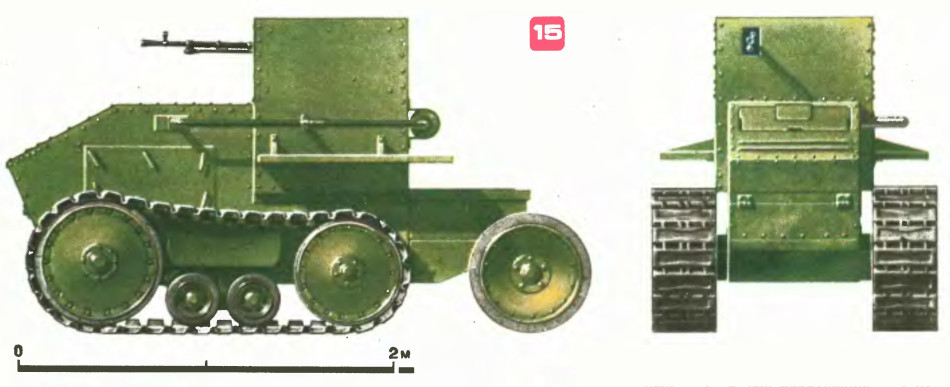 |
| Fig. 15. English Martel tankette. Combat weight — 2.2 t. Crew — 1–2 men. Armament — 1 machine gun. Armor thickness — 8–10 mm. Engine — 16 hp. Road speed — 25 km/h. |
The construction of a mini-tank was also undertaken by Captains V. Loyd and J. Carden in a workshop owned by Carden.
Martel’s efforts were crowned with success: in 1925 he demonstrated to representatives of the War Ministry a peculiar hybrid between a car and a tank. The vehicle was well received, and the automobile companies Morris and Crossley continued developing Martel’s idea. The ministry also became interested in the work of Carden and Loyd and instructed the Vickers-Armstrong company to provide them with its technical facilities. Thus a whole series of one- and two-man tankettes was built — as these very small tanks came to be called (“tankette” being a French diminutive derived from the English word “tank”). During testing it became clear that one man could not perform simultaneously the duties of driver, observer, and gunner. The idea of a single-man tankette was abandoned. Its last model — the Carden-Loyd Mk-VI (late 1928) — became at the same time one of the most famous and one of the most criticized vehicles in world tank building. It was adopted by the British Army, but due to its weak armor protection the tankette was used only to a limited extent — as a light artillery tractor. In addition, it served as the basis for experimental self-propelled mounts carrying a 47-mm gun and a 94-mm mortar.
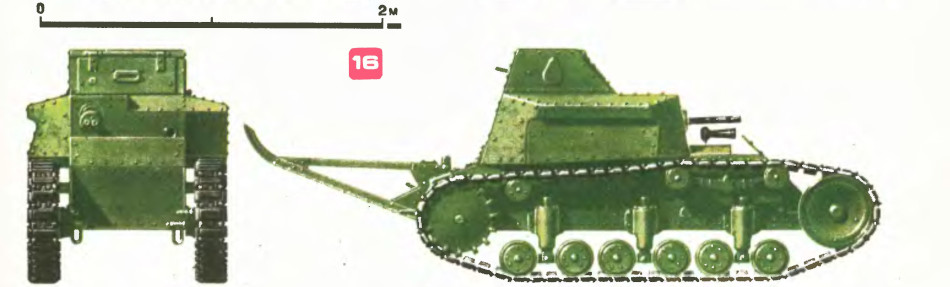 |
| Fig. 16. Soviet T17 tankette (“Lilliput”). Combat weight — 2.4 t. Crew — 1 man. Armament — 1 machine gun. Armor thickness — 7–14 mm. Engine — 18 hp. Road speed — 16 km/h. |
The Mk-VI tankette was a reliable vehicle of extremely simple design. The engine, insulated with asbestos, was located in the middle of the hull between the driver’s and gunner’s positions, which made it possible to shorten the vehicle while retaining a fairly large width and thus improving its maneuverability. It had a planetary gearbox and an automobile differential used as the steering mechanism. There were no return rollers — the upper track run slid along a guide channel. The water-cooled Vickers machine gun was mounted on a removable installation and could easily be removed from the vehicle and set up for firing on a tripod carried on the roof. Because of the absence of a turret, the height of the tankette was small.
The low position of the center of gravity prevented it from overturning on steep slopes.
The Mk-VI tankette, because of its obvious tactical shortcomings (primarily the lack of a turret, which did not allow the armament to be used effectively enough), was withdrawn from production after only a year.
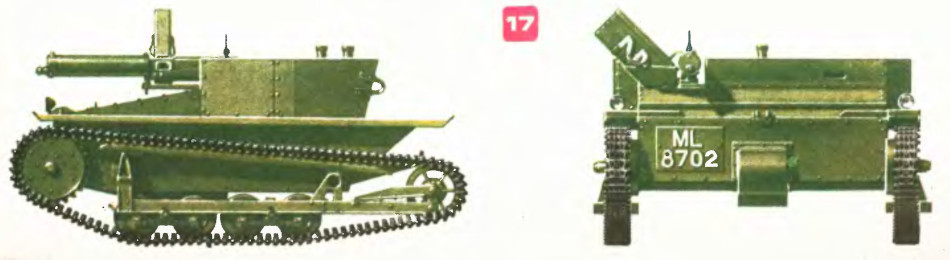 |
| Fig. 17. English “Carden-Loyd” Mk-VI tankette. Combat weight — 1.4 t. Crew — 2 men. Armament — 1 machine gun. Armor thickness — 9 mm front, 6 mm hull sides. Engine — Ford T, 22.5 hp. Road speed — 45 km/h. Road range — 160 km. |
At the end of the 1920s an economic crisis broke out in the capitalist world. The British government could not allocate large funds for maintaining and arming the army. On the other hand, the British arms industry needed markets for its products. Tankettes needed advertising. It was precisely this cheap and easy-to-produce vehicle that in years of financial hardship promised to satisfy the requirements of theorists of mechanized warfare. For colonial powers it was a real find. At that time the pages of magazines and newspapers carried a photograph of a horse standing next to a tankette. Look, they said, how small the modern armored “horse” is: inexpensive, reliable in any conditions, and requiring minimal maintenance. Perhaps the advertisement played its role: Mk-VI tankettes were purchased by 16 countries, and Italy, Poland, France, Czechoslovakia, and Japan acquired licenses for their production. For the needs of the British Army 325 tankettes were built and more than a hundred for export. Bolivia purchased five tankettes and used them in the war with Paraguay (1932–1935). Saudi Arabia employed such tankettes in numerous border incidents with Yemen. The first combat encounters, however, showed the vulnerability of tankettes even to small-arms fire. The concept of using tankettes as mechanized armor for infantry proved untenable. Yet in the 1920s and early 1930s almost all armies of the world “went through” this fascination.
At the end of the 1920s Soviet designers, already having some experience in tank construction, created several experimental tankette models. At that time it was believed that the Red Army needed a light multipurpose armored vehicle — for reconnaissance, security, communications, and escorting tank units.
The Main Design Bureau of the Artillery-Arsenal Trust developed the T17 tankette (“Lilliput”). In September 1927 its construction was entrusted to a factory in Leningrad. The tankette was planned in two versions: machine-gun and cannon. A specially designed air-cooled engine, transmission, and rubber-metal track were created for it. Somewhat later, based on the MS-1 tank, a two-man tankette T23 was developed, which represented a kind of lighter version of it. It had no permanent armament; it could serve as a carrier for machine guns or a light armored personnel carrier.
In 1929–1931 several T17 and T23 vehicles were produced, but they never entered serial production.
Designers in France and the United States also did not lag behind. From 1921 to 1928 the already familiar company Saint-Chamond created four experimental models of one- and two-man wheeled-tracked tankettes. The American T1 tankette of the Cunningham company (1928) was also intended for a single man. However, all these developments never went beyond the experimental stage.
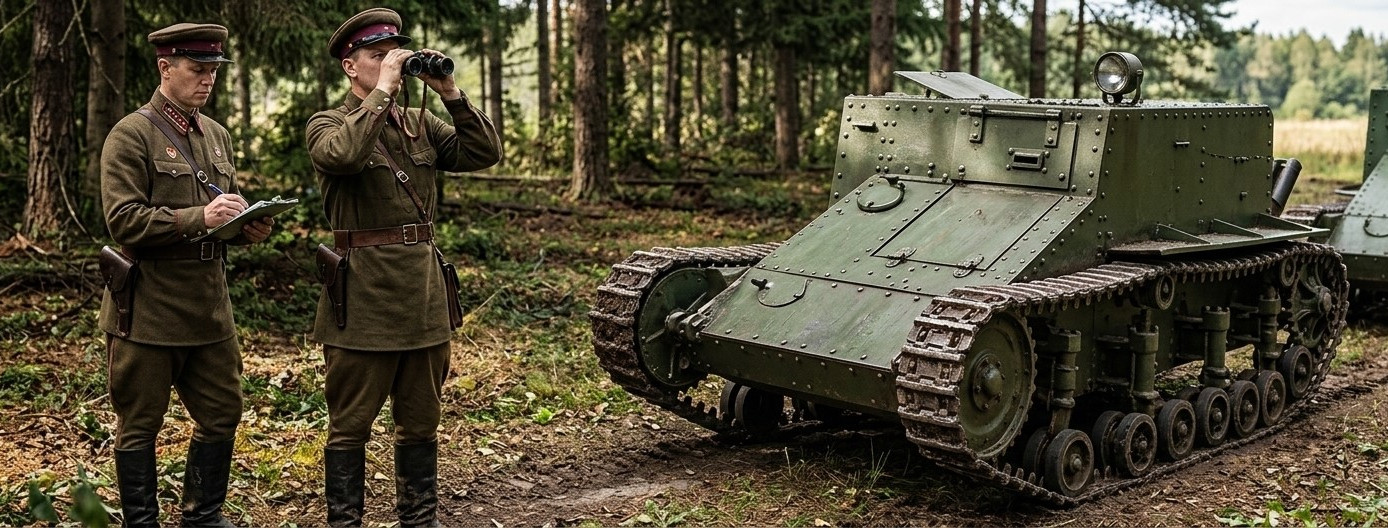
In the header illustration: Soviet T23 tankette. Combat weight — 3.5 t. Crew — 2 men. Armament — not installed. Armor thickness — 6–10 mm. Engine — 40 hp. Road speed — 35 km/h.