


AT THE REQUEST OF READERS, WE ARE BEGINNING TO PUBLISH MATERIALS FROM THE TM MUSEUM ON THE HISTORY OF TANK DEVELOPMENT.
Since tanks first appeared on the battlefields in 1916, they have undergone an evolution driven by changing views on the role of armored vehicles in combat. Soviet military specialists played a significant role in this evolution.
It was in our country that the operational capabilities of tanks were first appreciated. It was in our country that large tank formations were created long before World War II. It was in our country that the theory of deep operations was developed, according to which tanks, interacting with aircraft and penetrating deeply into enemy positions, could solve major operational tasks. The Great Patriotic War confirmed the validity of this theory and demonstrated that tanks could rightfully be considered the most powerful ground attack weapon for many tasks faced by ground forces.
Of course, these military successes of the Soviet armored forces would not have been possible without powerful and effective equipment. Following Lenin's commandment that in war "the one with the greatest technique, organization, discipline, and best machines wins," Soviet tank builders created tank models in the pre-war years that became classics and gained worldwide recognition. This is a significant achievement: in more than 60 years, over a thousand tank models have been created worldwide.
By opening the new section "Our Tank Museum," the editorial team aims to tell readers about the development of tanks, the most important stages of their evolution, and the most famous tanks, both those that were adopted and those that remained experimental models. Soviet tanks will be examined in the greatest detail, but due attention will also be paid to foreign models. This will help readers better understand and appreciate the depth and importance of the design solutions proposed by the creators of domestic tanks, self-propelled artillery units, and more.
***
Like a battleship, a tank combines three combat qualities — firepower, protection, and mobility. Thus, it could not appear instantly without a long preliminary period during which the main elements of its design — rapid-fire artillery, an internal combustion engine with a track drive, and armor — were developed. This is why, long before tanks appeared on the battlefields, various people in different countries with different goals developed devices that, when combined, led to the creation of one of the most powerful combat machines. In this preliminary stage, domestic inventors and engineers played a significant role. It is sufficient to mention at least the creator of the rapid-fire gun V. Baranovsky and the organizers of armor production in Russia P. Obukhov and V. Pyatov.
In 1837, the Ministry of Finance granted a privilege to Staff Captain D. Zagryazhsky for the project "carriage with moving rails," which contained the main elements of the track drive: metal tracks, support rollers, and a track tensioning mechanism. Zagryazhsky's carriage was not self-propelled; the inventor saw the benefit of his project in the fact that "a horse can pull double the load in such carriages, that they can be used on highways and regular roads, and especially useful on sandy and muddy roads."
The next step towards the creation of the tank was made by the Volga steamship engineer F. Blinov, who in 1878 applied to the Department of Manufactures and Trade for a privilege for "a wagon with endless rails for transporting goods." Nine years later, he built the world's first functional tractor with metal tracks, each driven by a separate steam engine. This device easily solved the problem of tractor control.
After Blinov's death in 1902, his apprentice Ya Mamin continued improving the tractor. In 1903, he built the first compression-ignition engine, and seven years later, he created a transport model based on this engine and installed it on his "Russian tractor" for the first time in 1910.
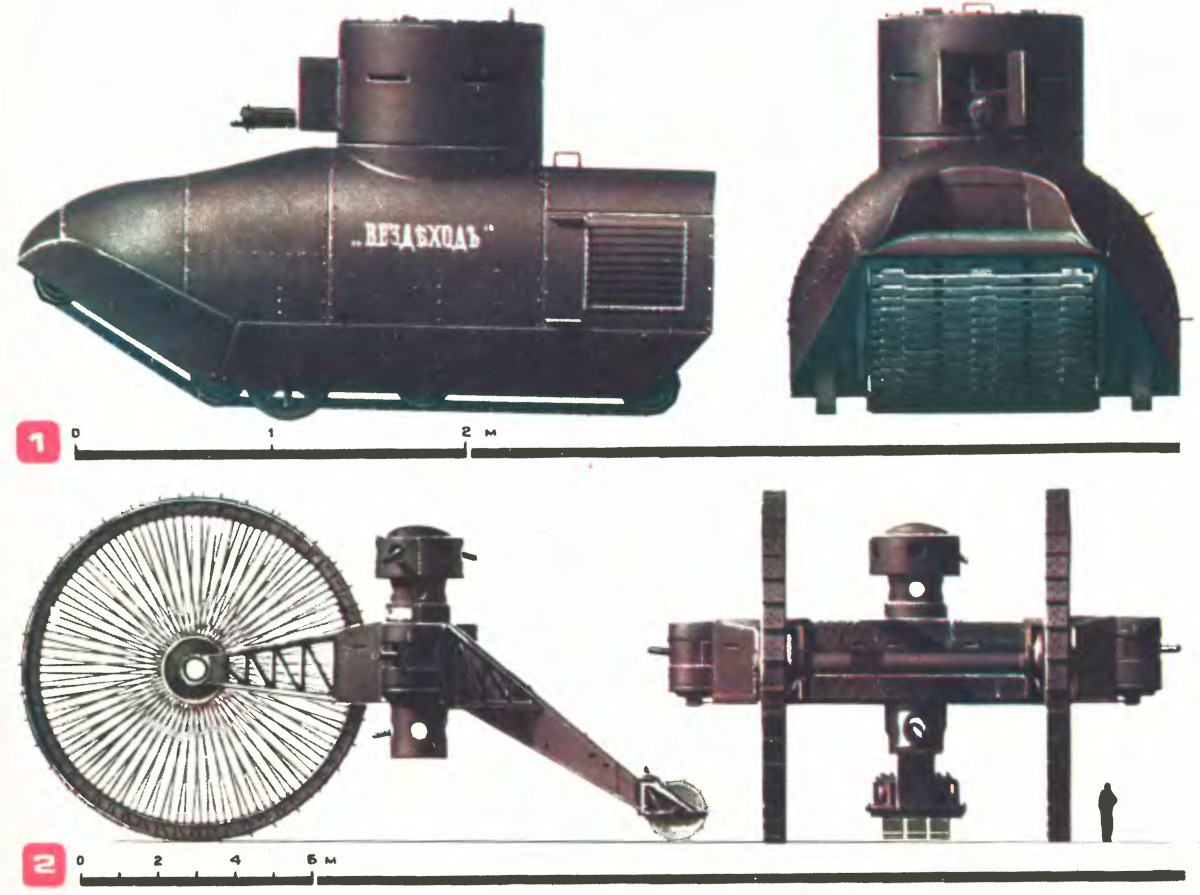
World War I gave a powerful impetus to military invention. The first combat tracked vehicle was built in 1915 based on the project by A. Porokhovshchikov. In August 1914, shortly after the start of hostilities, he approached the headquarters of the Russian army's Supreme Command with a proposal to build a high-speed combat vehicle for off-road movement. The project was approved, and by early 1915, the prototype of the "all-terrain vehicle" was ready.
The "ancestor" of the tank was a small vehicle with a crew of two, resting on a wide track under the hull and two wheels located on the sides in the front. These wheels allowed the "all-terrain vehicle" to turn. On roads, the vehicle moved on wheels and the rear drum of the track. When an obstacle was encountered, the "all-terrain vehicle" would lay on the track and "crawl" over it. The advantage of Porokhovshchikov's vehicle was the use of automobile components — an engine, steering system, and planetary gearbox.
The first test of the all-terrain vehicle was conducted on May 18, 1915 — several months earlier than the British tested their "Little Willie." Despite its success, further experiments were discontinued. The improved "all-terrain vehicle-2" project by Porokhovshchikov was also not implemented.
Around the same time, Captain N. Lebedenko, head of the Experimental Laboratory of the Military Ministry, began designing his combat vehicle with large-diameter wheels. Lebedenko rightly believed that a large wheel would more easily overcome ditches and trenches. The vehicle resembled an enlarged gun carriage. Each of the two nine-meter diameter wheels was driven by a 200-horsepower Maybach engine, taken from a downed German airship. A smaller-diameter tail roller provided stability and was steerable.
Lebedenko's idea was approved, and he was immediately allocated a large sum of money. Notable figures such as N. Zhukovsky and B. Stechkin worked on the tank project.
In August 1917, the vehicle was assembled in great secrecy on the edge of a forest near Dmitrov. The tests conducted in the forest did not yield positive results. The work was halted, and the giant frame rusted in the forest for many years, frightening passersby with its size. "Tsar-Tank," as it is sometimes called, was the largest combat vehicle ever built.
Despite the failure, Lebedenko's idea was not fundamentally flawed. Several years later, engineer Pavese built a series of high-wheeled military tractors for the Italian army. Pavese also created several models of wheeled tanks, but they were not adopted. The tank remained a purely tracked vehicle, but the wheeled drive many years later served as the basis for the creation of armored personnel carriers.
Top: the tractor of Russian inventor F. Blinov.
Bottom: 1. A. Porokhovshchikov's "All-Terrain Vehicle": Combat weight 4 t, Crew 2, Dimensions: length — 3.6 m, width — 2 m, height without turret — 1.5 m, Armament 1 machine gun, Armor 8 mm, Engine carburetor 20 hp, Road speed 25 km/h
2. N. Lebedenko's Tank: Combat weight 40 t, Armament cannon and machine guns, Engines two Maybach carburetor types, Power 2x200 hp, Speed (projected) 20 km/h