


Lenin’s directive—to introduce diesel locomotives into operation on the railways as quickly as possible—found an enthusiastic response among transport and industrial specialists.
In the 1920s, steam locomotives of the E series were built in Germany by order of the Soviet government. The work was supervised by the Russian Railway Mission. Guided by Ilyich’s directives and instructions from the People’s Commissariat of Railways (NKPS), the head of the mission, Professor Yu. V. Lomonosov, concluded a contract for the construction of two diesel locomotives using funds remaining from steam locomotive orders. The first machine was completed at the end of 1924, and the second in 1927. The new diesel locomotives were designated Eel 2 and Emkh 3 respectively. This meant that in power they were equivalent to the E-series steam locomotive, had electric and mechanical transmissions, and were built as the second and third units (the first being ShEL1).
Both locomotives were equipped with German diesel engines rated at 1200 hp at 450 rpm. The speed of one locomotive was controlled by regulating the excitation current of the generator, while the other was controlled by changing the gear ratio of the gearbox. The locomotives were tested on the Moscow–Kursk line and near Moscow, at the diesel locomotive base of Lyublino station. It was precisely there that, in 1927, a delegation of American railroad engineers arrived. They wanted to see Soviet mainline diesel locomotives with their own eyes, since such locomotives did not yet exist in the United States at that time.
Trial operation under a wide variety of conditions and regimes confirmed the advantages of diesel traction. However, the EEL2 locomotive with an axle arrangement of 2–5o–1 and electric transmission proved to be the best. Therefore, another similar diesel locomotive was built in Germany and delivered to Kolomna in a semi-assembled state. After completion of assembly, it received the designation EEL5.
The experimental operation of the new locomotives was closely observed by the country’s scientific and technical community. The results were actively discussed in the periodical press, in laboratories, and in institutes. Many specialists at that time proposed introducing diesel locomotives into service as quickly as possible, primarily on lines remote from coal basins and in areas with limited water supplies. A bold project emerged to dieselize the mountainous North Caucasian Railway, and it was proposed to design the Turkestan–Siberian Railway from the outset for diesel traction.
However, the leadership of the NKPS was in no hurry to make rash decisions. It was necessary, they believed, to thoroughly test the new machines in operation, and under the most difficult conditions. The first railway in the country to have freight diesel traction was the Central Asian Railway. Nature itself seemed to have prepared it for the role of a test line. Air temperatures on hot sunny days there reach 50°C, metal objects heat up to 75°C, and water sources are extremely rare.
While locomotives built abroad were being tested, designers at the Kolomna Locomotive Works designed the diesel locomotive 3EL9 with the same axle arrangement of 2–5o–1. It was manufactured for the 15th anniversary of the Great October Socialist Revolution and, after testing, was also sent to the Central Asian Railway. All components and assemblies in it, except for the diesel engine, were of domestic production. As soon as the Kolomna plant mastered production of its own 42BMK-6 diesel engine, serial production of mainline locomotives of this type began. The first machine (designated Eel12) was built at the end of 1932. Two other plants also participated in the serial production of diesel locomotives: the Moscow-based Dynamo plant and the Kharkov Electromechanical Plant.
The two-axle leading and single-axle trailing bogies allowed locomotives of this series to easily negotiate curves with a radius of more than 150 m. The six-cylinder naturally aspirated diesel engine with mechanical fuel injection developed a maximum power of 1150 hp. The cooler for water and oil (in automobiles this device is called a radiator) had forced exhaust ventilation and consisted of 11 sections located in the front part of the locomotive. Traction electric motors were mounted on a cradle-type sprung suspension, similar to that used on trams. The speed of the diesel locomotive was regulated by changing the excitation current of the main generator or the rotational speed of the diesel engine. All units, except the cooler, were located in a common demountable body. The workplaces of the driver, his assistant, and the diesel mechanic were also located there.
The Eel series locomotives (29 units were built) were continuously improved. This was especially necessary because during bench tests of the fuel pumps not everything went smoothly—cracks appeared in their housings. As recalled by veteran of the Kolomna Locomotive Works A. I. Kozyakin, the designers together with technologists conducted the most thorough investigations and found the cause of the defect. It turned out that the metal of the housing had unequal strength in different directions. They then began forging the blanks in two mutually perpendicular directions. The cracks no longer appeared.
In 1938, a diesel locomotive depot was commissioned in Ashgabat. This immediately improved the technical maintenance of the new machines. They consumed 5–6 times less equivalent fuel, and maintenance costs were 30–50% lower than those of SO-series steam locomotives. The monthly mileage of diesel locomotives on a single-track section reached 14,000 km, and the average daily mileage reached 650 km. They did not take on water anywhere, but only periodically replaced it upon returning to the depot. A five-ton fuel reserve was sufficient for 800 km of running.
Serial Eel diesel locomotives proved to be reliable and easy to repair. They remained in service until the mid-1960s, when they were replaced by more advanced locomotives.
SERIAL DIESEL LOCOMOTIVE Eel
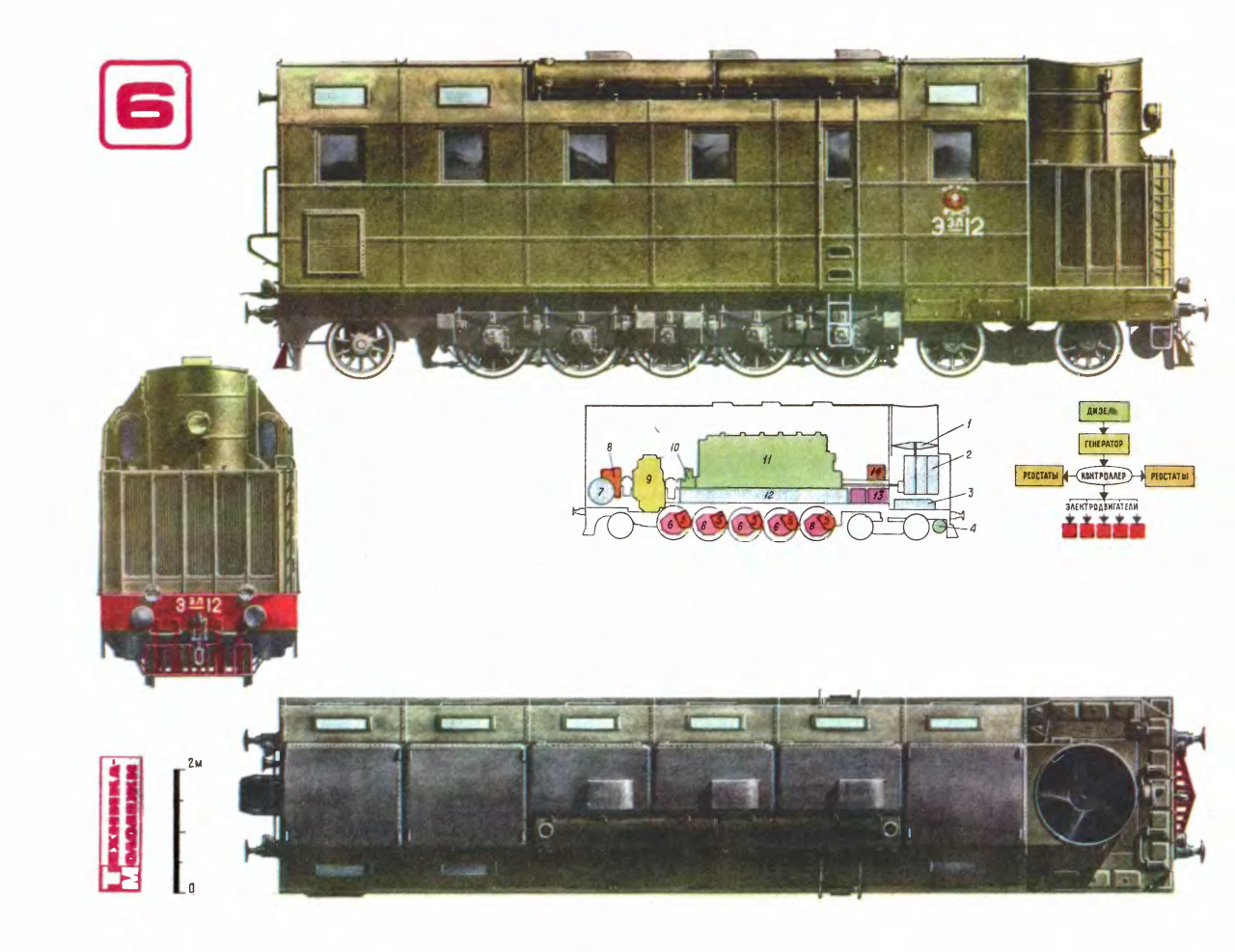
Axle arrangement – 2–5o–1
Design weight – 132 t
Adhesive weight – 98 t
Load per driving axle – 19.6 t
Length – 15,710 mm
Width – 3,150 mm
Height – 5,056 mm
Diesel engine power at 450 rpm – 1,150 hp
Main generator power – 796 kW
Hourly power of traction motors – 5 × 140 kW
Design speed – 55 km/h
Tractive effort at speeds up to 10 km/h – 21,000 kg
In the diagram, the numbers indicate: 1 — cooler fan, 2 — cooler sections, 3 — water tank, 4 — main brake reservoir, 5 — traction electric motors, 6 — gear transmission, 7 — cooling fan for traction motors, 8 — exciter, 9 — generator, 10 — flexible coupling, 11 — diesel engine, 12 — fuel tank, 13 — oil tanks, 14 — main control controller.
OLEG KURIKHIN
Candidate of Technical Sciences