In the mid-1920s, the flow of freight on the Baku–Tbilisi–Batumi railway mainline increased sharply.
Since Baku oil was exported through the Batumi port, oil tank trains predominated westward. Eastward, freight trains carried timber from Borjomi, ore from Chiatura, imported goods, and empty tank cars from Batumi.
The most difficult section of the route was the 63 km stretch from Khashuri to Zestafoni. From Zestafoni, the steel tracks wound serpent-like into the mountains, passing through a four-kilometer tunnel on the Surami Pass before descending to the Khashuri station. The elevation difference on this section reached 500 m, and the road twisted constantly, so curves with a radius of less than 200 m accounted for more than a third of the route. Only 20–22 pairs of trains could pass through per day. Here’s why.
In oil tank trains, every 10–15 cars—at that time not yet equipped with brakes—loaded platforms with manual brakes were attached. Whole teams of brakemen set out on these platforms. To climb the pass, two or three locomotives were required. During the descent, the engineer of the lead locomotive let the train accelerate to 40–45 km/h and whistled in the most dangerous spots. Hearing the signal, the engineers of all locomotives and the brakemen on the platforms slowed the speed to 10–12 km/h. This required highly coordinated actions. Brake shoes heated red-hot and literally burned out after just a few trips. The smoke, mixed with the locomotive steam, enveloped the entire train.
Sometimes the train accelerated so much that it derailed. To prevent accidents, at the end of long and steep descents, trap tracks with counter-slopes up to 1 km long were built. Runaway trains ended up in them. Nevertheless, despite all safety measures, movement over the pass was fraught with great difficulties and sometimes risk.
The only solution was to switch from steam traction to electric traction. Such a decision was made on May 7, 1926, by the Council of Labor and Defense. A few months later, preparatory work began. Two years later, construction of the catenary, traction substations, and a high-voltage power line started.
Back in 1921, the Technical Committee of the NKPS recommended the use of direct current with a voltage of 1500 V for suburban traffic and 3000 V for mainlines. By the late 1920s, 3000 V equipment was already well developed. It was particularly suitable for mountain railways, as it allowed regenerative braking on electric locomotives.
In March 1931, the works at the Surami Pass were included in the list of priority construction projects. On the night of July 1–2, 1932, the high-voltage power line was energized, and a month later current was supplied to the catenary.
The construction of the electric locomotive took place at the Dynamo electric machine-building plant in Moscow. One of the participants in this work, Kh. Ya. Bystritsky, recalls: “First of all, we had to produce prototype samples of traction electrical equipment: motors, controllers, relays, contactors. Although our theoretical training was quite high, the lack of production experience was evident, so many parts and units had to be redone, which required time. But we did not despair. Youth, perseverance, and enthusiasm helped us create a much-needed machine. It was this locomotive that the plant first put into series production.”
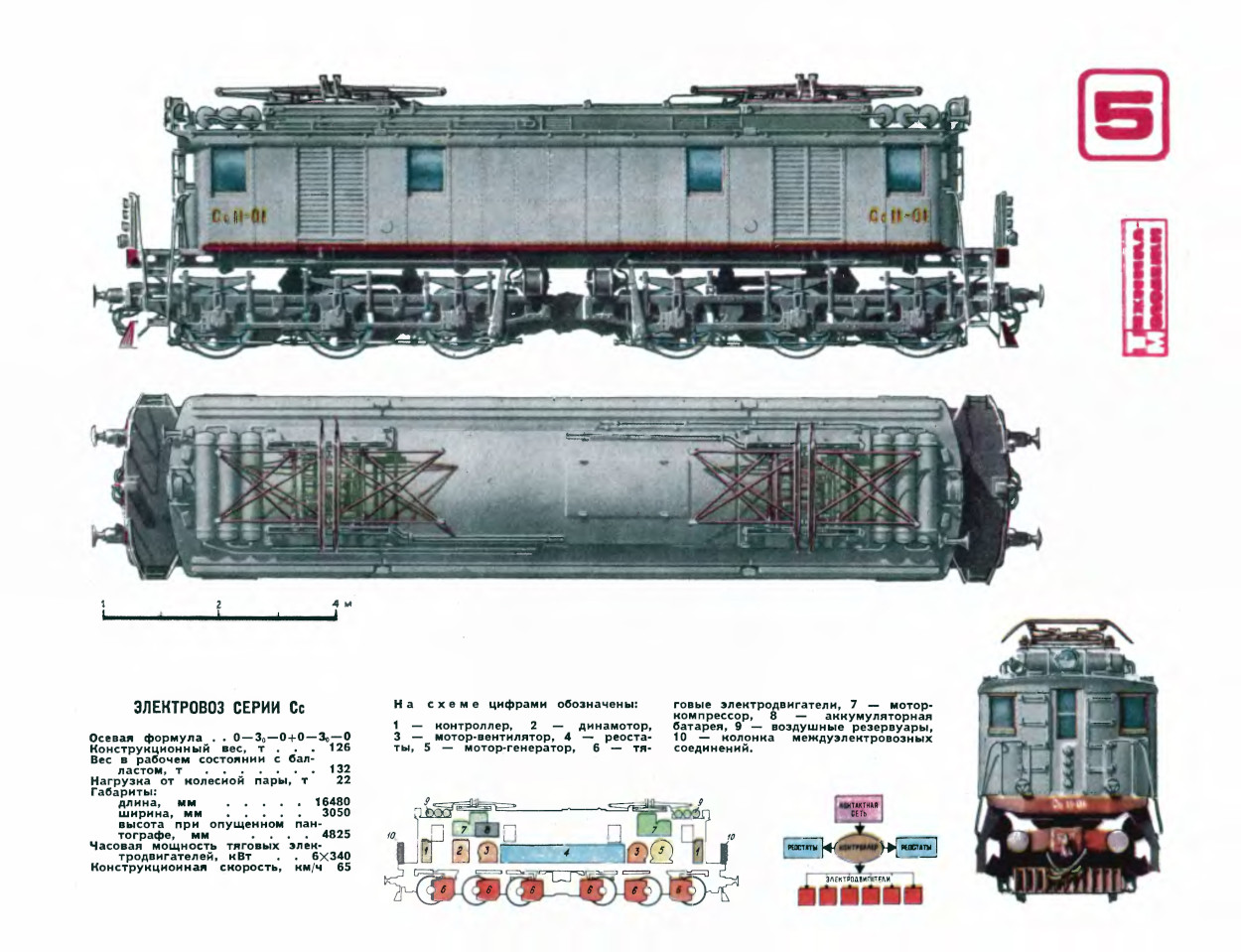
In August 1932, the workers of the Kolomna Machine-Building Plant delivered the mechanical part of the locomotive to Dynamo, and in November the electric locomotive was already assembled. It was designated Ss, which stood for “Surami Soviet.”
In this series of electric locomotives, a chassis with the wheel arrangement O—3o—O+O—3o—O was used. The traction motors differed only slightly from those used on the VL19. The gear ratio was set at 4.45. The locomotives were equipped with a regenerative braking system and controls for operating two coupled locomotives from the cab of one machine.
The first unit, Ss11-01, was tested on the Northern Railway and at the beginning of 1933 transferred to the Surami Pass. During the year, three more machines followed. After electrification of the Khashuri–Zestafoni section, the speed on the steepest climbs increased 2–2.5 times, train weight by 20%, throughput capacity by 92%, and transportation cost dropped by 57%. Sixteen electric locomotives replaced 42 steam locomotives of the E series. In just one year, railway workers saved 14,000 tons of oil that had previously been burned in steam locomotive fireboxes. In addition, more than 200 workers servicing the section were freed up.
In 1933–1934, 21 Ss-series electric locomotives were built. They also worked on the Perm railway, where an electrified mainline section Kizel–Chusovskaya (112 km long, with a mountainous profile, long climbs, and descents) was already in operation. Results there were also excellent. Train weight increased from 710 t to 1050 t, and average speed rose from 19 km/h to 27 km/h. Throughput capacity more than doubled.
On March 29, 1935, on the Perm Railway, coupled locomotives Ss11-16 and Ss11-18 hauled an especially heavy freight train (weighing 2165 t). This revealed the advantages of such a system. The fact was that the tractive effort of a single locomotive, due to the slipping of even one wheelset, decreased by almost 30%. With double traction, however, short-term slipping had much less impact on the overall effort. The probability of speed reduction, let alone stopping the train, dropped significantly. The experience gained during these tests was useful in increasing the throughput capacity of many electrified mainlines.
On mountain sections, Ss-series locomotives demonstrated the advantages of regenerative braking. For example, on the Perm Railway, during downhill runs, voltage in the catenary rose to 3300 V. This facilitated the further work of another locomotive climbing uphill, saved electricity, reduced wheel and brake shoe wear, and improved smoothness and speed on descents.
In the postwar years, Ss-series electric locomotives were repeatedly modernized: traction motors were replaced with more powerful ones, and the control scheme was improved. Such locomotives were designated Sms. Two of them (Sms-05 and Sms-14) have now become monuments. They can be seen permanently on display at the electric locomotive depot of the Perm-II station.
OLEG KURIKHIN
Cand. of Technical Sciences