


It turns out that although the first-ever “Air Steam Transport Company,” which planned to carry “mail, cargo, and passengers from one place to another” on heavier-than-air flying machines, was officially registered by the British Parliament as early as 1843, it took almost 70 years before an aeroplane lifted into the air not only itself and the pilot, but also passengers.
Until 1909, in their pursuit of records for endurance, speed, and altitude, aviators could take only one person aboard. A year later, two. In 1911, Breguet and Sommer biplanes, equipped with engines of 100 or 70 horsepower, took off with a full dozen passengers. Since useful load was then recorded not by weight but by the number of “seats,” pilots resorted to tricks: they seated short people or adolescents in the aeroplane.
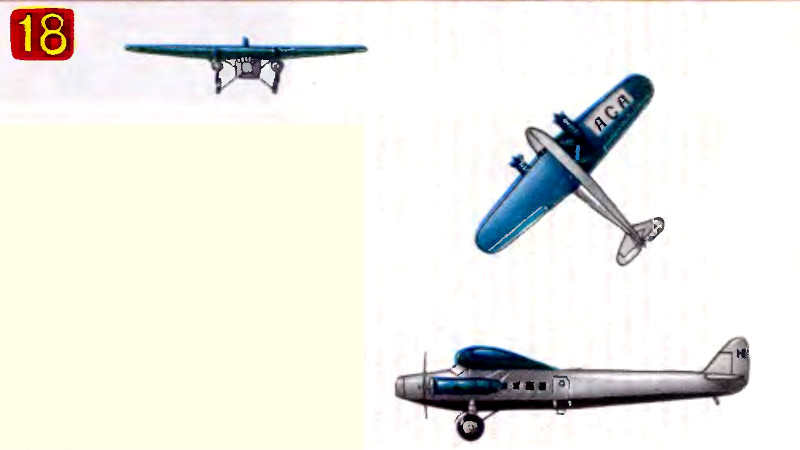 |
| “Fokker F-VIII” (Netherlands, 1926). Engines — 2× “Gnome-Rhône Jupiter,” 420 hp each. Wingspan — 23 m. Length — 16.8 m. Wing area — 82 m². Takeoff weight — 5,500 kg. Payload — 2,300 kg. Maximum speed — 200 km/h. Service ceiling — 4,800 m. Seating capacity — 15. |
One can imagine the level of comfort with which passengers flew in a cramped, wind-swept open cockpit—and what conveniences were enjoyed by the lucky ones who found a place on the wing! The joy of flight made them forget about bruised sides and rumpled clothing.
While pilots and volunteer passengers indulged in these sporting exploits, a 24-year-old Russian designer, I. Sikorsky, built and flight-tested the world’s first multi-engine civilian aircraft with an enclosed cabin. Even today, the cabin of the “Russian Knight” would not seem cramped: it comfortably accommodated a sofa, four armchairs, a coffee table, a washbasin, and a wardrobe. Mirrors hung on the walls, and a large window was covered with elegant curtains. There was even an open balcony in the nose section of the fuselage for passengers—contemporary speeds allowed one to step outside and breathe fresh air. On the very first flight of the “Knight,” the flight engineer greeted the crowd gathered at the airfield from the balcony… World War I interrupted both the carefree rides of onlookers and Sikorsky’s serious experiments with the next passenger giant, the “Ilya Muromets.” The “Ilya Muromets” began its combat service. In the midst of the war, in 1916, attempting to look into the future of peace, a German aviation encyclopedia defined the significance of the formidable Russian bomber as follows: “In Sikorsky’s giant biplane one can see the beginning of the transport aircraft of the future.” Postwar Europe did not immediately realize the accuracy of this prophecy. Hundreds of now-unneeded bombers stood on airfields, and it seemed that these former formidable swords could easily be reforged into plowshares.
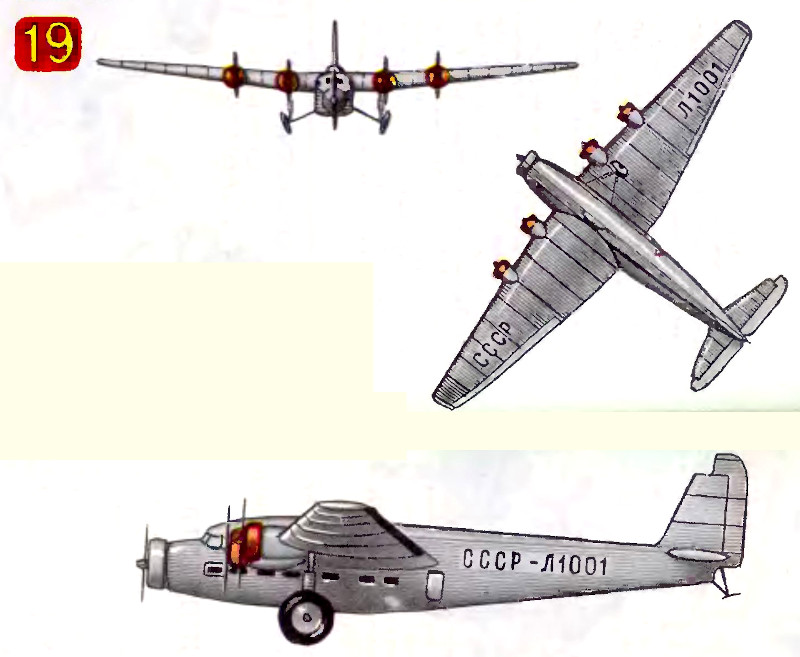 |
| ANT-14 “Pravda” (USSR, 1931). Engines — 5× “Gnome-Rhône Jupiter-VI-9-AKKh,” 480 hp each. Wingspan — 40.4 m. Length — 26.49 m. Wing area — 240 m². Takeoff weight — 17,530 kg. Payload — 6,702 kg. Maximum speed — 236 km/h. Service ceiling — 4,220 m. |
The “demobilization” of combat aircraft, although it helped the newborn passenger aviation take its first steps, proved to be only a temporary measure. Former bombers, having replaced their protective camouflage with attractive paint schemes, fully retained their shortcomings. Their unreliability—which small crews had been forced to tolerate under harsh front-line conditions—now compelled even cautious passengers to take risks. It was also difficult to arrange a sufficiently spacious cabin in the fuselage: previously, the aircraft had carried a heavy but compact bomb load. The payload turned out to be too small in relation to the takeoff weight. The machines were also unsuitable because of their low economic efficiency, which had been disregarded during the war.
Civil aviation required special aircraft designed specifically for it. At first, these were mainly single-engine 7–10-seat machines of mixed or all-metal construction. “Fokkers” and “Junkers” of various models enjoyed great popularity on many local and international air routes. About 20 Fokker F-III aircraft with 360-hp Rolls-Royce Eagle engines, operated by the joint Soviet-German company Deruluft, were used on the Moscow–Berlin line (from 1922), and later on the Moscow–Mineralnye Vody route. The Junkers J-13, produced by the company in 1919, also belonged to the class of single-engine civilian aircraft. It flew on the Moscow–Nizhny Novgorod line (1922–1923), Moscow–Kazan, Tashkent–Alma-Ata, Tashkent–Bukhara… Several dozen Junkers W-33 aircraft (on an aircraft of this type, in 1928, the first east-to-west transatlantic flight was accomplished) were used on Siberian air routes and in the Arctic.
In 1927, the design team led by A. Tupolev received an assignment for a large passenger aircraft that could replace outdated German machines on Soviet routes. In the summer of 1929, the new aircraft astonished Europe with its unique qualities. Piloted by M. Gromov, with eight passengers on board, the ANT-9 (“Wings of the Soviets”) flew the route Moscow – Berlin – Paris – Rome – London – Paris – Berlin – Warsaw – Moscow in 53 flight hours. The distance of 9,037 km was covered at an average speed of 177 km/h. The prototype ANT-9 was built as a three-engine aircraft—with one nose engine and two wing engines. Because of difficulties with imported “Titans,” production aircraft were equipped with two domestic M-17 engines. Under the designation PS-9, the monoplane was successfully used on relatively short routes in Central Asia and Transcaucasia. The first Soviet passenger aircraft also served extensively in the early years of the Great Patriotic War as a transport.
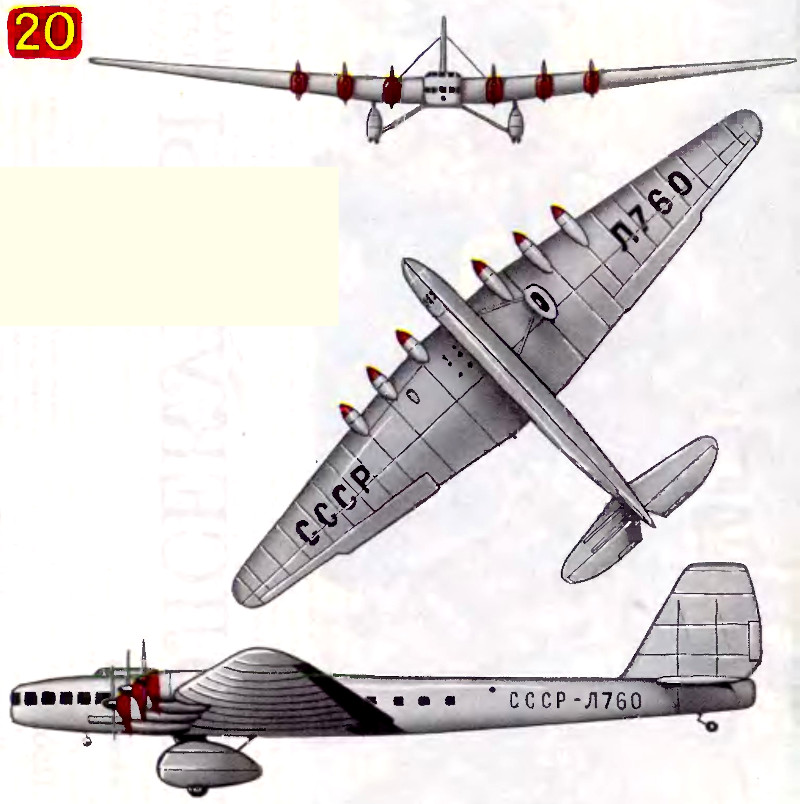 |
| PS-124, ANT-20bis (USSR, 1939). Engines — 6× AM-34 FRNV, 1,200 hp each. Wingspan — 63.0 m. Length — 34.1 m. Wing area — 486.0 m². Takeoff weight — 44,000 kg. Payload — 12,800 kg. Maximum speed — 275 km/h. Service ceiling — 5,500 m. |
In parallel with the creation of original passenger aircraft, “converted” designs also entered service with Aeroflot in our country. On the basis of the widely used R-5 biplane by N. Polikarpov, employed in military aviation and the national economy, engineer A. Rafael’yants developed the civilian PR-5 modification in 1936. A small series of these four-seat machines was built at the Bykovo workshops of the Civil Air Fleet. The giant aircraft “Maxim Gorky” (ANT-20)—the flagship of the Maxim Gorky agitation squadron (which crashed on May 18, 1935, due to a fatal error by the escort pilot)—became the prototype for the unique passenger aircraft PS-124 (ANT-20bis). Equipped with six 1,200-hp engines, the aircraft carried 64 passengers and was used, though in a single example, on the Moscow–Mineralnye Vody route. Externally, the PS-124 differed from the “Maxim Gorky” in the cleanliness of its lines: there was no paired propeller-engine installation on the “back” of the aircraft.
Of course, the still small civilian aviation of the interwar period could not offer worthy competition to traditional modes of transport. Nevertheless, it forced belief in itself and laid in the skies of almost all continents of the world, over seas and oceans, the air routes that are so well known today.
On the opening spread: ANT-9 “Wings of the Soviets” (USSR, 1929). Engines — 3× “Gnome-Rhône Titan,” 230 hp each. Wingspan — 23.7 m. Length — 17.0 m. Wing area — 84 m². Takeoff weight — 5,043 kg. Payload — 1,690 kg. Maximum speed — 209 km/h. Service ceiling — 3,810 m. Range — 1,000 km. Endurance — 5 h.