


The unsuccessful design of the “Schneider” and “Saint-Chamond” tanks forced the French to seek a new solution to the problem.
Colonel Étienne insisted on the creation of light and inexpensive vehicles, which he considered a necessary complement to medium and heavy tanks. In his imagination he already saw thousands of such machines attacking in the battle formations of the infantry. Ultimately, thanks to his enthusiasm, in 1917 the most successful tank of the First World War was built.
As early as December 1915, Étienne approached Louis Renault, a well-known designer and owner of the largest automobile manufacturing company in France, proposing that he undertake the development of a light tank. Renault initially refused, citing a lack of experience in producing armored tracked vehicles. Étienne nevertheless managed to persuade him, and in December 1916 the designer presented his model to the Special Artillery Advisory Committee. Official trials began on April 9, 1917, and ended in complete success. Time, however, did not wait—the front demanded as many light and inexpensive tanks as possible.
Étienne increased the order to 2,500 vehicles, including a third version of the “armored vehicle”—the so-called radio tank, intended as a command vehicle for communication between tank units, infantry, and artillery. The commander-in-chief supported this proposal and, in turn, increased the order to 3,500 units. The Renault company could no longer build such a number of vehicles on its own within the required timeframe. Several other firms were therefore brought into tank production: Berliet, Schneider, and Delaunay-Belleville. Designers initially encountered many difficulties. It was not immediately possible to establish production of the conical turret, so the first vehicles were equipped with an eight-sided riveted one. Considerable time was also spent developing the gun mounting system.
The new tracked vehicles (designated “Renault FT” or “Renault M17” and “Renault M18”) began entering the French Army in March 1918. By the end of the war, 3,177 units had been produced. Their layout (engine, transmission, and drive sprocket at the rear; driver’s compartment at the front; and between them the fighting compartment with a rotating turret) became classical.
Unlike the “Saint-Chamond” and “Schneider” vehicles, the hull was a structural element (the chassis) and consisted of a framework of angle irons and shaped components, to which the armor plates and running gear elements were riveted.
The large-diameter idler wheel helped overcome vertical obstacles and climb out of shell craters. On many vehicles (to reduce noise and weight) it was made of wood—this was the only case of such a material being used in tank construction. To improve trench-crossing capability, a tail mounted at the rear on an axle was used; when marching, it could be swung up onto the roof of the engine compartment.
The tank proved to be a simple, reliable, and inexpensive machine. Its low ground pressure—0.6 kg/cm^2—provided good mobility: it could climb slopes of up to 45° and cross trenches up to 1.8 m wide. Speed and range, however, were limited. For more than ten years, the “Renault FT” served as a model for the design of light tanks.
The “Renault” was produced in four versions: machine-gun, gun-armed, signal or command (“Renault TSF”) with a fixed rectangular superstructure housing a radio station and a three-man crew, and finally a version with a 75-mm gun (“Renault BS”), mounted in a superstructure open at the front and rear and firing to the rear.
The combat service of the “Renault” tanks was long. They fought their first battle on May 31, 1918, near the Retz Forest, close to the city of Soissons. During the Russian Civil War they were used by the White forces and interventionists, and later (as trophies) by the Red Army. In 1925–1926 they fought in Morocco against the Rif insurgents, and in 1936–1939 in Spain, in the Republican army. Moreover, these tracked vehicles even took part in the Second World War. In the 1920s, Italy built the “Fiat 3000A” tank of the 1921 model based on the “Renault” design. Thanks to a more powerful engine, its speed reached 22 km/h. In 1930 it was modernized (“Fiat 3000B”) with a new engine and reinforced running gear.
During the Civil War, the Red Army captured about 80 tanks, including “Renaults.” In the autumn of 1919, the Council of the Military Industry of the RSFSR decided to begin building tanks based on the “Renault” type. Under the conditions of postwar devastation and industrial collapse, this choice was the most rational. Soviet workers and technicians, accomplishing a true labor feat, successfully fulfilled the task—on August 31, 1920, the first Soviet-produced tank went out for mobility trials. It received its own name: “Fighter for Freedom, Comrade Lenin.” By the end of 1921, another 14 vehicles of this type were delivered; they were then called KS or Tank M. They differed from the French prototype in the engine and turret shape. Later, mixed machine-gun and gun armament was installed on the KS.
In the 1920s, the French undertook a number of attempts to modernize the “Renault.” The new “Renault M24/25” vehicles, however, turned out to be merely reworked older “Renault FT” tanks. They were equipped with rubber-belt tracks and a softer suspension. Speed increased to 12 km/h, fuel consumption decreased, and range increased.
Further modernization—new running gear, engine, and transmission, as well as a slightly altered hull layout—led in 1927 to the appearance of the “Renault NC1” (or NC27) tank.
The influence of the “Renault FT” can be seen in the designs of French light tanks of the 1930s: the R35, H35, and H40. By then it played a negative role—the turrets of the new “armored vehicles” still housed the same “jack-of-all-trades”: the commander-gunner-loader.
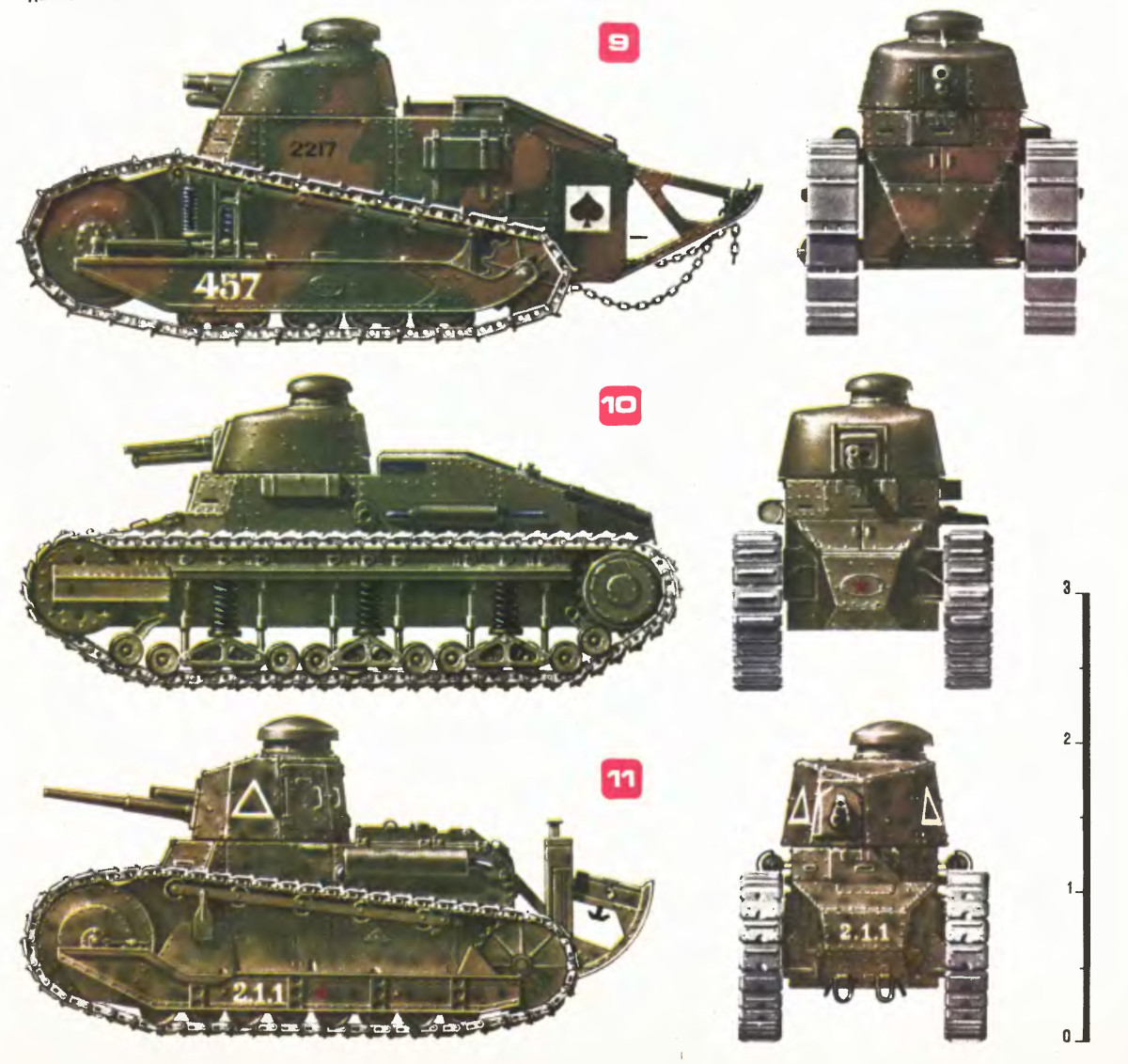
9. French light tank “Renault FT”. Combat weight – 6.7 t. Crew – 2. Armament – one 37-mm gun or one machine gun. Armor thickness – 16 mm hull front, 8 mm side. “Renault” engine – 35 hp. Road speed – 7.8 km/h. Road range – 35 km.
10. Japanese light tank “Otsu” (French “Renault NC1”). Combat weight – 8.5 t. Crew – 2. Armament – one 57-mm gun or one machine gun. Armor thickness – 30 mm hull front, 22 mm side. “Mitsubishi” engine – 75 hp. Road speed – 25 km/h. Road range – 100 km.
11. Italian light tank “Fiat 3000B”. Combat weight – 5.6 t. Crew – 2. Armament – one 37-mm gun or twin machine guns. Armor thickness – 16 mm hull front and side. “Fiat” engine – 63 hp. Road speed – 16 km/h. Road range – 100 km.
On the cover – the Soviet light tank M. Combat weight – 7 t. Crew – 2. Armament – one 37-mm gun and one machine gun. Armor thickness – 16 mm hull front and side. AMO engine – 34 hp. Road speed – 8.5 km/h. Road range – 60 km.