


In 1918, not only the British and the French, but also the Germans had already gained experience in the use of tanks.
When the British, in the battle of Cambrai, failed to exploit on an operational scale the breakthrough achieved by heavy tanks, they realized that they needed the support of lighter, more mobile vehicles. During the First World War, the French mainly produced light tracked vehicles. True, these were intended only for infantry support. The French built significantly more tanks than the British (3,977 versus 3,027), precisely because the emphasis was placed on producing cheaper and lighter machines. And this fully justified itself. Heavy tanks were cumbersome, and it was difficult to deliver them to the starting positions for an attack.
Thus, striving to create a kind of “armored strategic cavalry,” the British began designing a medium tank. It received the designation “Medium Mk A,” or “Whippet.”
This vehicle was the unfinished brainchild of engineer W. Tritton. The designer developed a relatively light tank with a rotating turret. However, due to difficulties and delays in setting up turret production, it was decided to abandon them. As a result, Tritton’s tank went “into production” without this important component. An order for 200 vehicles was placed as early as June 1917, and their production began in December.
The first vehicles began to arrive from the Foster factory in March 1918.
The “Whippet” tanks (“greyhound”) were considered fast: their speed was twice that of the Mk IV–V. An interesting feature of the vehicle was the presence of two engines with their own gearboxes. Each of them drove one track.
The tank proved difficult to control and required great skill from the driver. If even one engine failed, the vehicle could not move. The Mk A tanks were expensive, complex to manufacture and maintain, but despite this they proved significantly more reliable than their older counterparts, the Mk I–Mk V. Tank crews joked that the “greyhounds” were capable of returning to their unit under their own power after a battle. In the Battle of Amiens in 1918, 96 of these vehicles took part. For the first time in the history of armored forces, they carried out something like an operational breakthrough. Breaking away from their infantry and accompanied by cavalry, they conducted a raid into the German rear.
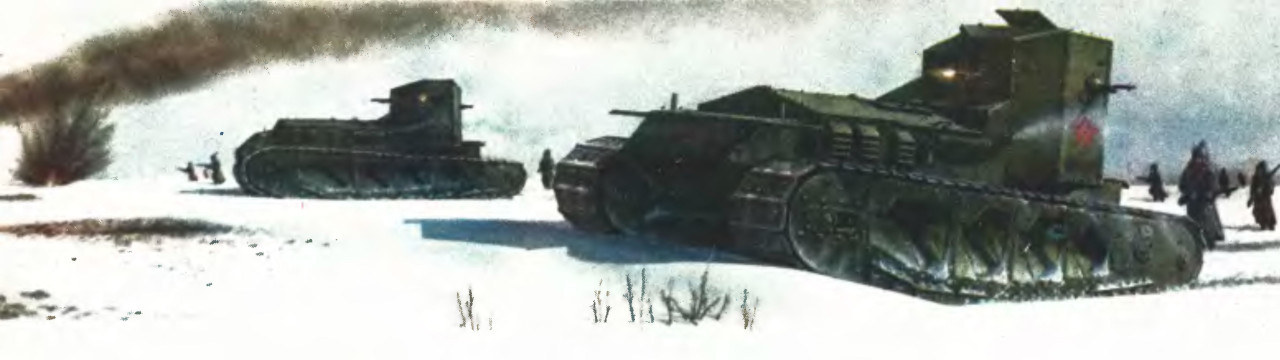
Captured as trophies, “Whippet” tanks were also used in the German army. They fought as well in the forces of the interventionists and the White Guards during the Russian Civil War. Later, also as trophies, they entered service with the Red Army, where they remained in use until the early 1930s. In the USSR they were called “Taylor” (after the engine designer). Several vehicles were also purchased by Japan in the early 1920s. In the British army, however, the “greyhounds” served only briefly and after the war were replaced by the medium tanks Mk V and Mk C.
The headquarters of the British Tank Corps, convinced that the war would continue into 1919, raised the issue of mass construction of fast tanks. The chief of staff, Colonel J. Fuller, believed that in addition to heavy infantry tanks, fast tanks should be produced, intended for operations against enemy headquarters and communications. The Medium Mk A proved unsuccessful. Therefore, already in 1918 the British designed two new models: the Medium Mk V and Mk C. However, following tradition, they retained the shape of heavy tanks with tracks encircling the hull. The rigid suspension was also retained. An order was placed for 6,000 medium tanks, but the war ended on November 11, 1918. After the armistice, only 45 Mk V and 36 Mk C were built.
The Mk V turned out to be heavy for a medium tank. Since the engine power was clearly insufficient, its speed was even lower than that of the Mk A.
On both tanks, the armament was mounted in a casemate in ball mounts with limited firing angles. The Mk V tank was equipped with apparatus for creating smoke screens. However, it was never considered a good vehicle: the crew compartment was cramped and uncomfortable. Several Mk V tanks in 1919, during the foreign military intervention, took part in combat operations in northern Russia as part of British forces. They were captured by the Red Army and entered its service.
The last medium tank designed by the British before the end of the war was the Mk D. It had a rotating turret and a low hull and was the first tank capable of “swimming.”
The Germans also attempted to improve their tanks. They began by imitating British heavy vehicles. Designers modernized the A7V tank by equipping it with tracks encircling the hull and sponsons for mounting armament. Its weight increased to 40 tons. In all parameters it surpassed the British tanks: its speed reached 12 km/h, armor thickness was 30 mm. The armament consisted of two 57-mm guns and four machine guns. The crew consisted of seven men. Only two prototypes of this vehicle were built, as it proved very complex and expensive.
In the spring of 1918, Germany began designing several models of light tanks. Already in October 1918, J. Vollmer presented two of his designs. Under the terms of the armistice, Germany was obliged to hand over to the Allies all tanks, even experimental ones. The Treaty of Versailles prohibited it from building armored vehicles. Nevertheless, in complete secrecy, the Germans manufactured several LK II tanks. Only recently it was established that Hungary (which was also forbidden to have tanks by the Treaty of Trianon) secretly purchased fourteen LK II tanks. They were delivered to Hungary in disassembled form. Five of them were assembled in 1928.
Meanwhile, J. Vollmer moved to Sweden and continued developing light tanks at the Landsverk factory (in the city of Landskrona), which was essentially a branch of the Krupp company. Based on the LK II, several dozen M-21 light tanks were built for the Swedish army, remaining in service until the mid-1930s. In 1929 they were modernized (receiving the designation M-21/29). Unlike the LK II, their armament was placed in a rotating turret. All vehicles were equipped with radio receivers, and command vehicles (from platoon commanders upward) were fitted with transmitters.
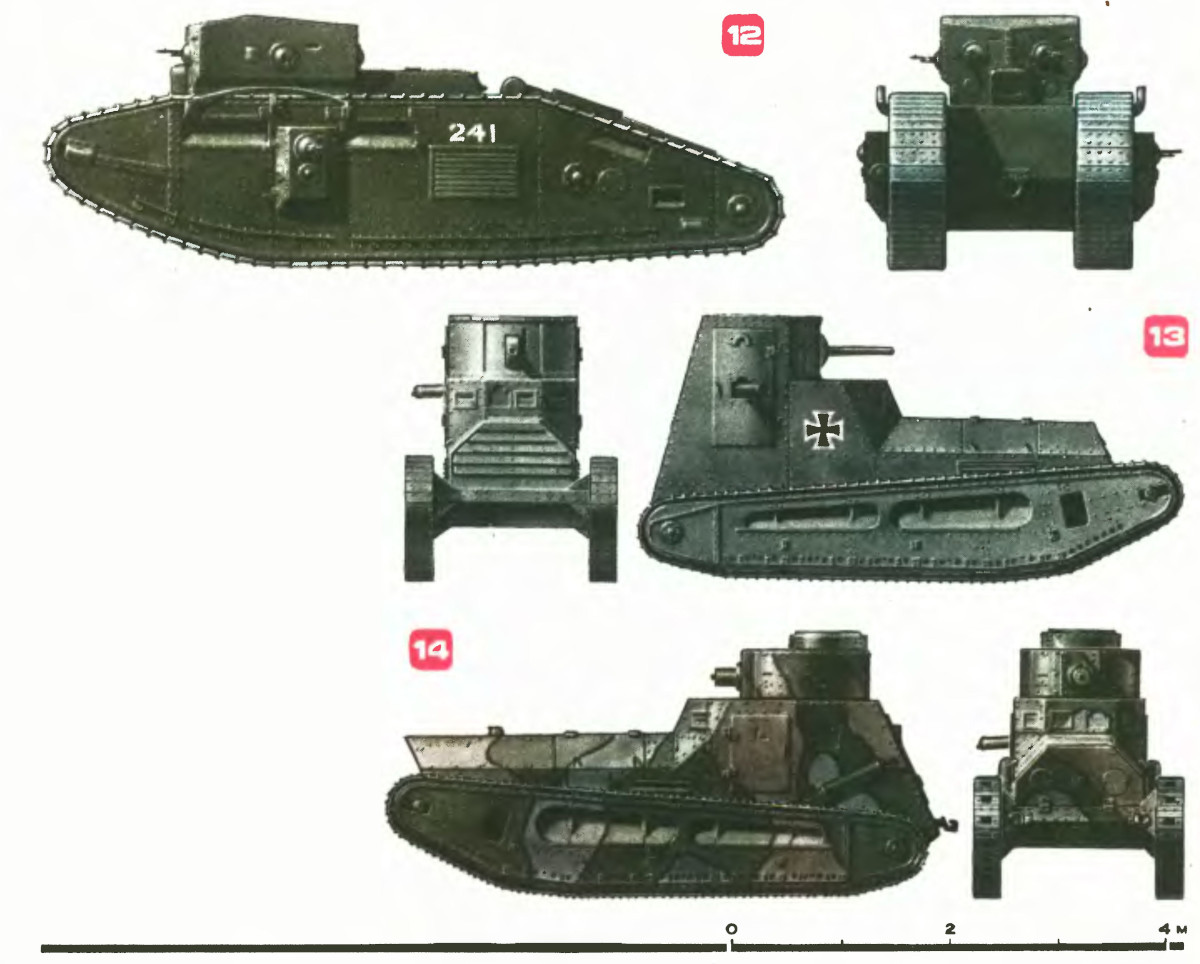
Fig. 12. British medium tank Mk V. Combat weight – 18 t. Crew – 4–5 men. Armament – 6 machine guns. Armor thickness – 14 mm on the front and sides of the hull. “Ricardo” engine – 100 hp. Road speed – 9.6 km/h. Road range – 105 km.
Fig. 13. German light tank LK II. Combat weight – 8.75 t. Crew – 3 men. Armament – one 57-mm gun or two machine guns. Armor thickness – 14 mm on the front and sides of the hull. “Daimler” engine – 55 hp. Road speed – 13 km/h. Road range – 64 km.
Fig. 14. Swedish light tank M-21/29. Combat weight – 9.5 t. Crew – 4 men. Armament – one 37-mm gun or two machine guns. Armor thickness – 14 mm on the front and sides of the hull. “Scania-Vabis” engine – 60 hp. Road speed – 18 km/h. Road range – 70 km.
On the cover – Trophy medium tank Mk A, which served with the Red Army. Combat weight – 14 t. Crew – 3 men. Armament – 4 machine guns. Armor thickness – 14 mm on the front and sides of the hull. “Taylor” engine – 45 hp. Road speed – 13 km/h. Road range – 130 km.