


It is difficult for us today to imagine what people felt when they first saw firearms in action. Fire, clouds of smoke, thunderous noise, and invisible projectiles hitting targets from great distances — all of this must have been terrifying.
Let us add — it was entirely new. The appearance of firearms literally overturned the established system of warfare in medieval Europe. Knights clad in magnificent armor, armed with swords and lances, fighting until complete exhaustion — steel armor was impervious to arrows or swords — were becoming a thing of the past. From now on, war was becoming different — brutal, bloody, and large-scale...
Traditional foundations were shaken not only in military affairs. The new weapon left its mark on state politics, the development of sciences such as chemistry and ballistics, craftsmanship, and later industry. However, the history of firearms, as is often the case with major inventions, had a long and somewhat unclear prehistory.
There are numerous accounts suggesting that in ancient times, weapons capable of emitting fire and smoke and operating at a distance existed. Naturally, their design was kept secret, and later everything associated with them was enveloped in the fog of legends. But was this weapon truly firearm-based? Did it use energy released from the combustion of certain substances? Based on ancient descriptions, in some cases, the answer seems to be yes. It is believed that gunpowder originated in China, where explosive substances were used centuries ago in warfare and for festive fireworks. Later, gunpowder reached India, and incendiary or perhaps even explosive substances were known in Byzantium.
Nevertheless, the history of firearms began in Europe at the turn of the 13th and 14th centuries, which in no way diminishes the role of Eastern peoples, who were the first to use gunpowder in warfare. The unique economic, social, and cultural development of Europe played a decisive role.
...Firearms are generally divided into artillery and small arms. The former operates over long distances, striking targets with both indirect and direct fire, and all calibers of artillery systems require crews. The latter, primarily individual weapons, are used for shooting at open, relatively close targets.
Modern handheld firearms are characterized by a variety of systems, calibers, and specifications. These include automatic and semi-automatic rifles, pistols, optical sights, and grips tailored to fit the hands of specific shooters. Compared to all of this, the first models appear crude and primitive. However, it must be remembered that the transition from bows and crossbows (projectile weapons) to firearms was far more challenging than the subsequent development of firearms. So what were the ancestors of today's automatic weapons and revolvers like?
Their general appearance and design can be reconstructed from old drawings and descriptions, and a few authentic specimens have been preserved. In our country, these are kept in the State Historical Museum, the State Hermitage Museum, the Military Historical Museum of Artillery, Engineers, and Signal Corps, and the State Museums of the Moscow Kremlin.
Structurally, they were almost identical to cannons, except for their size, caliber, and the fact that they were designed for handheld use. Even their names often reflected their artillery origins — in Western Europe, there were "bombardellas" (handheld bombards), and in Russia, there were handheld muskets called "ruchnitsy."
In the late 14th and early 15th centuries, the barrel of such weapons consisted of a short iron or bronze tube about 30 cm long with a caliber of 25–33 mm, closed at one end. Near this closed end, a small "priming" hole was drilled on the top. The barrel was placed in a groove hollowed out of a stock (a wooden support) about 1.5 meters long and secured with metal rings or clamps.
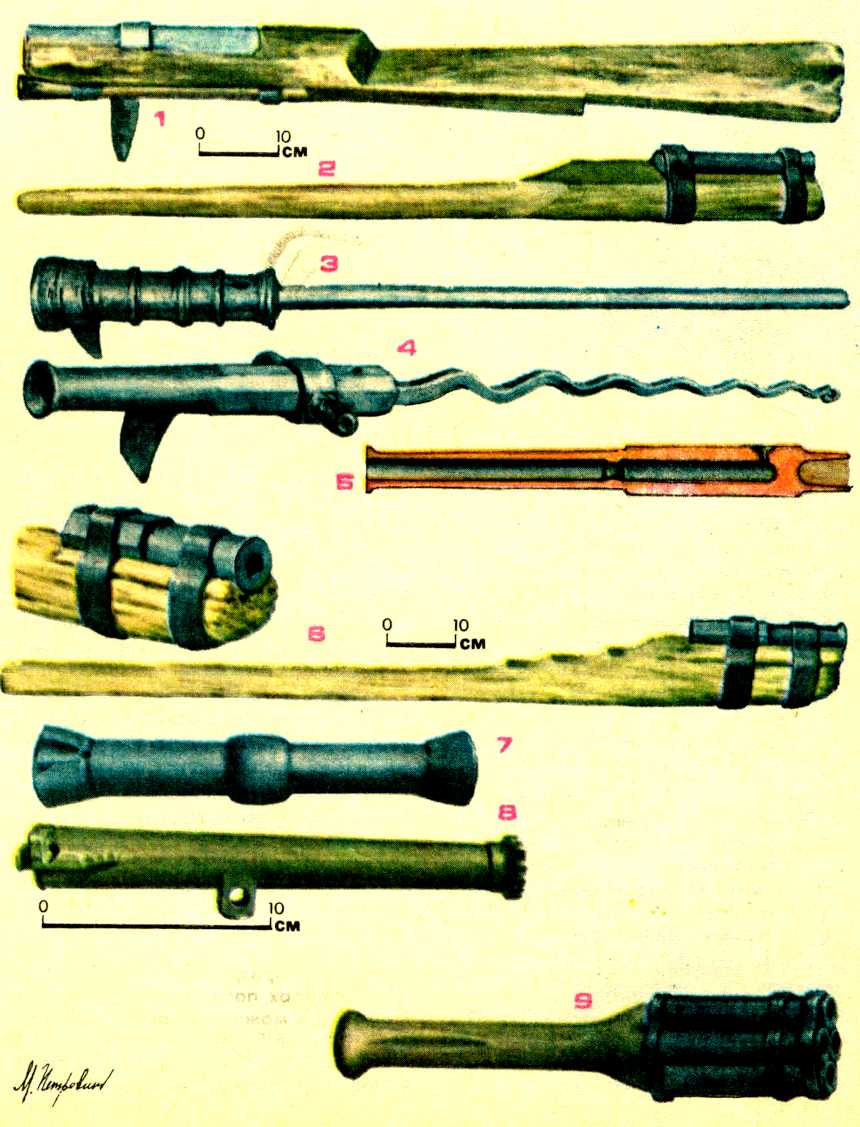
Bombardellas and ruchnitsy were loaded with powdered gunpowder (grained powder was developed later) and spherical bullets made of copper, iron, or lead. Interestingly, such bullets remained in use throughout the entire period of smoothbore, muzzle-loading firearms. This was because they were easy to manufacture and did not require stabilization in flight.
After loading the musket, the shooter aimed it at the target, bracing the stock against the ground, chest, shoulder, or under the arm, depending on its length, and ignited the charge using a heated metal rod or a smoldering wick, which they brought to the priming hole.
The first firearms lacked standardized sizes, shapes, and calibers. For instance, some ruchnitsy were mounted on long wooden poles, and on certain 15th-century barrels, a metal rod was welded to the breech, which the shooter braced against their chest. Sometimes, a ring was added to the end of this rod to make the weapon easier to carry. In Russia, there were also "zatinnye pishchali" (precursors to fortress guns) with a barrel length of 18–23 calibers. These had a hook mounted under the muzzle, which the shooter used to stabilize the overly long weapon, for example, on a fortress wall. Interestingly, "zatinnye pishchali" remained in service for quite some time: the State Museums of the Moscow Kremlin house one such musket manufactured in the 16th–17th centuries.
In the Military Historical Museum of Artillery, Engineers, and Signal Corps, you can also see a short iron barrel from the 14th–15th centuries, reinforced with three rings. On the rear, there is a groove leading to the priming hole — this is the ancestor of modern pistols.
When creating handheld firearms, the craftsmen of the 14th–15th centuries faced and addressed the same challenges as modern designers: they sought to increase range and accuracy, reduce recoil, and improve rate of fire. Range and accuracy were enhanced by lengthening the barrels, while recoil was mitigated by equipping muskets with support hooks and additional braces. Achieving a higher rate of fire — defined as the number of shots fired per unit of time — was more challenging. To address this, 14th–15th-century gunsmiths began producing multi-barrel guns and muskets. Although these took longer to reload, they allowed shooters to maintain relatively intensive fire in combat.
...The advent of new weaponry quickly influenced tactics. By the 15th century, many countries had formed units, sometimes quite large, armed with muskets. Initially, however, these weapons were inferior to perfected bows and crossbows in terms of rate of fire, accuracy, range, and sometimes even penetrating power. Additionally, barrels forged or cast without precision often had a short service life and occasionally exploded upon firing. Nevertheless, firearms left their mark on history.
By the late 15th century, gunsmiths relocated the priming hole to the right side of the barrel. This change addressed the inconvenience of simultaneously aiming and igniting the weapon with a match; previously, the flash of flame blinded the shooter, and the smoke obscured the target. From then on, a small amount of priming powder was poured into a pan with a recess located near the priming hole, which ignited the main charge through the hole in the barrel. This small innovation sparked a minor revolution in the history of handheld firearms...
In the illustration: A Western European knight armed with a musket. The front of its barrel is supported by a brace attached to the saddle, while the breech is held by a strap on the warrior's shoulder. During firing, the weapon was braced against the chest.