


On the early examples of handheld firearms, the ignition hole through which the fire was transferred to the main charge was located at the top of the barrel.
However, this was quite inconvenient—the flash of flame blinded the shooter. In the early 15th century, gunsmiths producing handheld firearms and muskets moved the ignition hole to the right side of the barrel and attached a small pan with a groove underneath it. The ignition powder was poured onto this pan. Shortly afterward, the pan was covered with a hinged lid to protect it from rain and snow.
Almost simultaneously, unknown inventors found a replacement for the heated rod that was typically used to ignite the powder. This was a long match, which in Western European countries was soaked in saltpeter or wine alcohol, while in Russia, it was boiled in ash. A match treated in this way did not burn but smoldered slowly, allowing the shooter to activate the weapon at any moment.
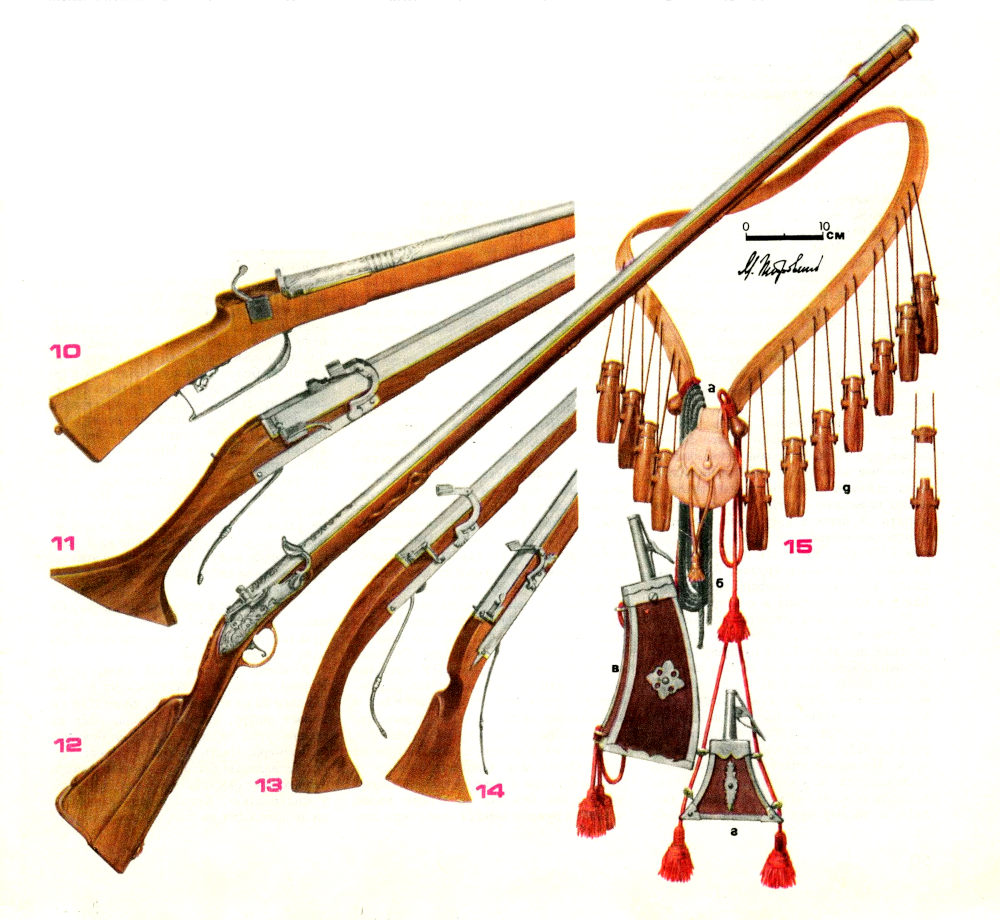 |
| 10. Matchlock rifle. Turkey, 17th century. 11. English musket, 16th–17th centuries, with a matchlock. 12. Dutch musket with a matchlock, 1695. 13. French rifle, 17th century, with a matchlock. 14. Western European musket with a matchlock, 17th century. 15. On a Western European bandolier of the 16th–17th centuries, they usually hung a bullet pouch (a), a match (b), a powder flask (c), a primer (d), and a container for gunpowder (e). Drawings 10–14 are based on exhibits from the State Armory of the Moscow Kremlin. |
However, bringing the match to the pan every time was inconvenient. This operation was simplified and accelerated by integrating the match with the weapon. For this purpose, a hole was made in the stock, through which a strip of metal shaped like the Latin letter S with a clamp on one end, called a serpent (in Muscovy, "zhagra"), was passed. When the shooter raised the lower end of the serpent, the upper end, with the smoldering match, touched the ignition powder on the pan. From then on, the warrior no longer needed to stay close to a fire or brazier to heat an iron rod.
In the late 15th century, handheld firearms were further improved by adding a matchlock mechanism. It consisted of the already familiar serpent, to which a plate spring with a protrusion—called a sear—was added, mounted on an axis on the inner side of the lock plate. It was connected to the serpent in such a way that when the shooter pulled the trigger, the rear end of the sear immediately rose, and the match fell onto the pan with the ignition powder. Later, the pan was moved to the lock plate.
In the 16th–17th centuries, the English added a small shield to the pan, a kind of screen that protected the shooter’s eyes from the flash of flame. Around 1575, the first rifled guns in Western Europe, with straight stocks that transmitted recoil energy to the fighter’s chest, were manufactured in Nuremberg. Taking this shortcoming into account, French gunsmiths replaced such stocks with curved ones, which directed part of the recoil not only backward but also upward. The Spanish were the first to rest the stock against the shoulder instead of the chest, and this technique has since become standard.
The variations in shapes, sizes, and weights of firearms led to the emergence of numerous names—arquebuses, carbines, muskets, etc. For example, a musket referred to a heavy matchlock firearm equipped with a rest, which the shooter braced against the ground. Muskets measured up to 1.25 meters in length, weighed 7 kilograms, and had calibers ranging from 18 to 20 mm. In 1624, the Swedes armed their army with lighter muskets that no longer required rests, allowing soldiers to hold them comfortably by hand. In 17th-century Russia, the regiments of the new system adopted both Dutch muskets and domestically produced ones, the latter being significantly lighter than their foreign counterparts.
 |
| Diagrams of matchlock firearms show: A) Serpent, or "zhagra," B) A simple matchlock mechanism using a sear, and C) An improved matchlock mechanism from the second half of the 17th century (internal view). |
Matchlock firearms featured almost all the elements of modern firearms—barrel, stock, lock—and the soldier only had to pull the trigger to fire. However, before this, he had to remove the match from the serpent and hold it in his left hand, away from the powder, brace the rifle's stock against the ground, pour the required dose of powder into the barrel, tamp it with a ramrod and secure it with a wad, then drop in the bullet. Next, he would pick up the firearm, pour ignition powder from a priming flask onto the pan, close the lid, blow off excess powder, reopen the lid, and take aim. All these actions took an experienced soldier about two minutes.
In 1608, a manual for training shooters was published in Germany, illustrated by the famous Dutch engraver Jan van Gheyn. The first part contained 42 (!) illustrations of loading and unloading techniques for muskets and firing procedures, while the second part showed 43 images of drill exercises used by musketeers armed with matchlock rifles equipped with rests.
In some illustrations, a leather strap, or bandolier, worn over the soldier's left shoulder, can be seen. This strap carried a variety of items—10–12 wooden containers, sometimes leather-clad, with pre-measured doses of powder, a flask for fine ignition powder made of horn, leather, or wood, a pouch for bullets, wads, and tools (needle for clearing the ignition hole, cleaning cloth, scraper), and a powder horn. Additionally, coiled matches hung from the bandolier. An interesting detail: during marches, every tenth soldier was required to keep his match lit so that his comrades could quickly "borrow fire" in case of enemy contact. Only after the invention of ready-made cartridges in the mid-18th century were heavy and cumbersome bandoliers replaced by cartridge belts worn across the shoulder or with a waist belt.
In the second half of the 16th century, a more efficient type of gunpowder came into use. The previous type, ground into fine powder, absorbed moisture quickly in damp weather, clumped together, burned unevenly, and its unburned particles frequently clogged the barrel and the ignition hole. Experience showed that the gunpowder mixture should first be formed into hard cakes and then crushed into relatively large grains. These grains burned more slowly but left no residue and released more energy. The new type of gunpowder quickly replaced all others and remained in use until the mid-19th century when smokeless powder based on nitrocellulose was invented.
Bullets also underwent significant changes. Initially, they were made from stone, iron, steel, bronze, copper, and tin, shaped like arrows, spheres, cubes, and rhombuses. In short, the development process relied on trial and error. Eventually, the design settled on round bullets cast from lead—a metal that is easy to work with and gives bullets good ballistic properties due to its high density.
Interestingly, at one time, it was believed that the material of the bullet should match the intended target. For instance, steel and iron bullets were designated exclusively for shooting at armored warriors. A certain French conspirator, preparing an assassination attempt on King Charles V, even cast bullets from gold!
Handheld firearms with matchlocks remained in use for quite a long time, despite their drawbacks. These included the visibility of the glowing match tip, which could reveal the soldier’s position at night, the relatively slow action of the firing mechanism, and the difficulty of maintaining a lit match in rain or snow.
Illustration: Western European musketeers and a shooter armed with matchlock rifles. Late 16th to early 17th centuries.