The structure impresses not only with its grandeur but also with how it remarkably harmonizes with the mountain slope: as if giant compasses inscribed the smooth curves of the foundation into it.
This is the largest ski flying hill in the world, built in a small mountainous area in Yugoslavia called Planica, known to all athletes. We did not misspeak. The structure is built specifically for flights, not for jumps.
Giant hill... Mammoth hill... We've heard many names for it. Each person tries to name this fantastic structure in their own excited and admiring way, where ordinary people fly almost 200 meters without wings, not angels.
|
|
| This is what the complex of three hills in Planica looks like. On the left is the mammoth hill, soon someone will fly 200 meters from it. |

"How is this possible?" — an uninformed person might exclaim.
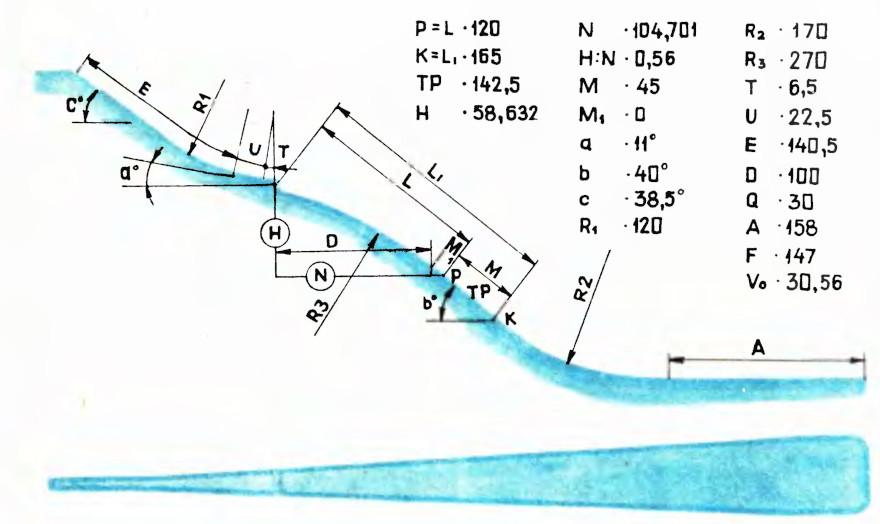
Yes, it is possible! It's all about the exceptional precision in calculating the slope on which the skier accelerates, and, most importantly, the landing slope. The first slope "shoots" the skier into the air, and the second receives them, dissipating the "fall" inertia.
The most critical moment is the transition from flight to sliding. During this phase, the athlete flies freely according to the laws of gravity and aerodynamics: the movement of a streamlined body in the air...
All these phases, subjected to thorough mathematical analysis and aerodynamic modeling, formed the basis for constructing the giant hill. Thus, science and skill have allowed us to create a wonder: a person flying without wings...
Last year, we, Soviet journalists, visited Planica for the first time. Here, the traditional meeting of SKIJ — the International Ski Journalists Club — took place.
SKIJ is an organization where journalists from countries with different social systems have been regularly gathering for 25 years. Representatives from over 30 countries have repeatedly competed on the slopes in giant slalom, special slalom, and arranged cross-country ski races on various distances.
Slow ascents on chair and drag lifts, rapid descents on marked trails, and flights from the hill. A remarkably picturesque view from 1000 meters above sea level... And then a bus trip to the hotel, where hot discussions about Chinese aggression against socialist Vietnam took place.
French, Italian, English, and Scandinavian colleagues discussed this sharp political problem with interest. Everyone agreed that armed conflicts, wherever they arise today, pose a risk of sharply escalating the entire international situation, inevitably undermining the foundations of international stability and the security of all countries.
"This is a place for the hottest clashes of any states," laughed Italian Ernesto Pratti, pointing to the dazzlingly white giant hill. "Please, compete as much as you like! Prove your superiority and rightness! The battlefield is open to anyone..."
And the journalists' conversations shift to a different, sporting, direction.
Once, the FIS — International Ski Federation — officially recognized ski jumping on medium and long distances, limiting them to certain frameworks. But suddenly there was a need to change the seemingly established sports tradition. The skills of the jumpers improved, the designs changed, and the hills grew in size. And then a person flew, breaking these limits. "This is no longer sport," cautious voices were heard. "This is a circus! This is an adventure..." After long discussions, ski flying was officially recognized as a sport. This happened relatively recently, at the FIS session in 1971.
 |
| During the meeting in Yugoslavia, journalists visited the factories of the famous "Elan" company, producing alpine skis, plastic boats, and gliders. We were once again convinced that the production of first-class sports equipment requires first-class technology. |
A new sport has established itself in four parts of the world. In the GDR, a giant hill was built in the mountainous area of Oberstdorf. In the resort town of Kulm, Austrians erected a similar structure. The Norwegians built a mammoth hill in Vikersund. And finally, the super-giant in Yugoslav Planica. Today, all competitions in ski flying are held in these four places.
To prove the feasibility of transitioning from jumping to flying, let's look at a few figures of international record growth in this sport. 1808 — in Eidsberg, Norwegian jumper Olaf Rye sets the first record at 9.5 meters. 1913 — in Ironwood, another Norwegian, Ragnar Omtvedt, overcomes the 50-meter mark with 51.5 meters. 1936 — for the first time in history, a flight exceeds 100 meters when Austrian Sepp Bradl jumps 101 meters in Planica. 1967 — the 150-meter barrier is broken in Oberstdorf by Norwegian Lars Grini. And finally, 1977 — in Planica, Yugoslav Bogdan Norčič jumps 181 meters.
So, we are on the verge of a 200-meter flight! Imagine this fantastic trajectory of a human-bird, soaring from the table of the hill high above, gliding swiftly, seemingly right at you, standing bewildered at the foot of the white giant.
Hill designers, engineers — brothers Lado and Janez Gorišek — had to work hard at the drawing board before the precise geometric contours of the hill cut into the mountain slopes. Safety was the priority in their designs. And their calculations were fully justified. The skier, bending sharply, "automatically" transitions from sliding to flight and also "automatically" lands on the snowy slope, continuing their free fall.
Ski flying attracts immense attention. People from all over the world come to the magical slopes of Planica, not only skiers eager to test their courage and skill but also numerous spectators. During competitions, the vast areas at the foot of the Mammoth hill are literally packed with buses and cars.
Soviet athletes also participate in ski flying competitions. In Planica and Oberstdorf, Yuri Kalinin successfully performed, in Kulm — Alexander Karapuzov, and in Vikersund — Alexei Borovitin. The latter took third place, and it can be hoped that Soviet flying skiers will soon aim to break world records. And the upcoming record is right before our eyes. It is 200 meters!
 |
| Soviet participants and their Bulgarian friends near the traditional SKIJ flag, on which the names of the countries and places where annual international journalist competitions are held are inscribed. Two years ago, it was held in the Caucasus, in Bakuriani. |
...Satisfied and excited, we left Planica for our hotel in Kranjska Gora. Another discussion took place here, the main topic of which was the fate of détente primarily on the European continent. A heated debate ensued. Some of our interlocutors, particularly American journalist Simon Kantin, expressed skepticism about the results and prospects of the Helsinki agreements, stating that "détente has reached a dead end."
However, the general opinion of the participants prevailed, agreeing that détente has become a decisive factor in the development of international relations in recent years. The participants acknowledged the significant role of the Soviet Union in strengthening peace and deepening comprehensive cooperation between peoples.
The meeting in Planica contributed to the convergence of numerous viewpoints on the fundamental issues of our time...
Before the departure of the ski journalists, they met with the chairman of the Federal Executive Council of the SFRY, V. Džuranović. He, welcoming the delegation of Soviet journalists, expressed satisfaction with the development of comprehensive cooperation between the Soviet Union and Yugoslavia, the strengthening of friendship between our peoples, and the efforts of both countries in the fight for détente. And that evening, we felt the friendly atmosphere of the International meeting, warmed by the desire to find a common language among journalists from different countries.
VASILY ZAKHARCHENKO, RUDOLF MOLCHANOV,our special correspondents.
 |
In today's sports, there is a unified process happening in all its types: the transition from visual record fixing to electronic. And perhaps the last sport not yet covered by the technical revolution is ski jumping.
Indeed, it is extremely difficult to accurately determine the landing spot of a skier flying at a speed of 120 km/h.
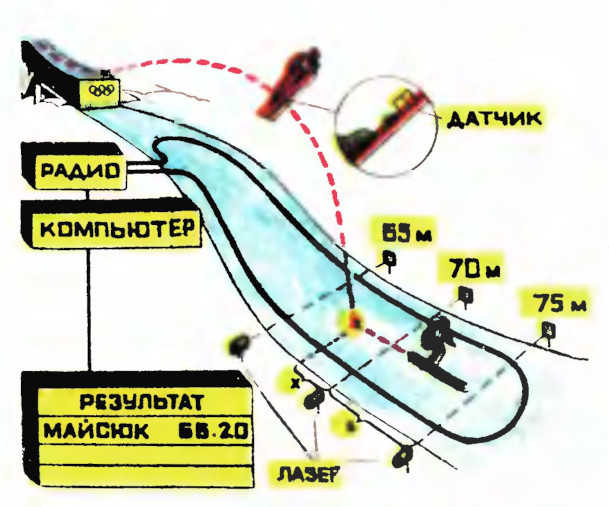
Several proposals have been made. Soviet designers created a simple device attached to the jumper's boot. At the moment of landing, a small pump sprays a bright red liquid, marking the skier's contact point with the slope's surface.
Finnish designers proposed using ultrasonic location, but the design turned out to be too complicated.
Recently, Swedish inventor Carl Erikson invented an entirely new method. A tiny radio transmitter attached to one of the skis sends a signal to an antenna, activating at the moment of landing when the skier slides between two laser beams. The time between the landing and crossing the first beam, as well as the time between crossing the first and subsequent beams, is automatically measured. The computer uses this data to instantly calculate the exact length of the jump. The Swedish inventor's proposal may find practical application.
Creating the profile of a modern ski jump is a very responsible task. This profile follows strict geometry. Each of its points is determined based on the position of the freely gliding skier.
As can be seen from the attached diagram, the airflow around the skier is similar to the airflow around an airplane wing.
The interaction of all these principles forms the basis for designing giant ski jumps.