M. Chekurov’s article is commented on by Hero of the Soviet Union, Vice Admiral Grigory Ivanovich SHCHEDRIN
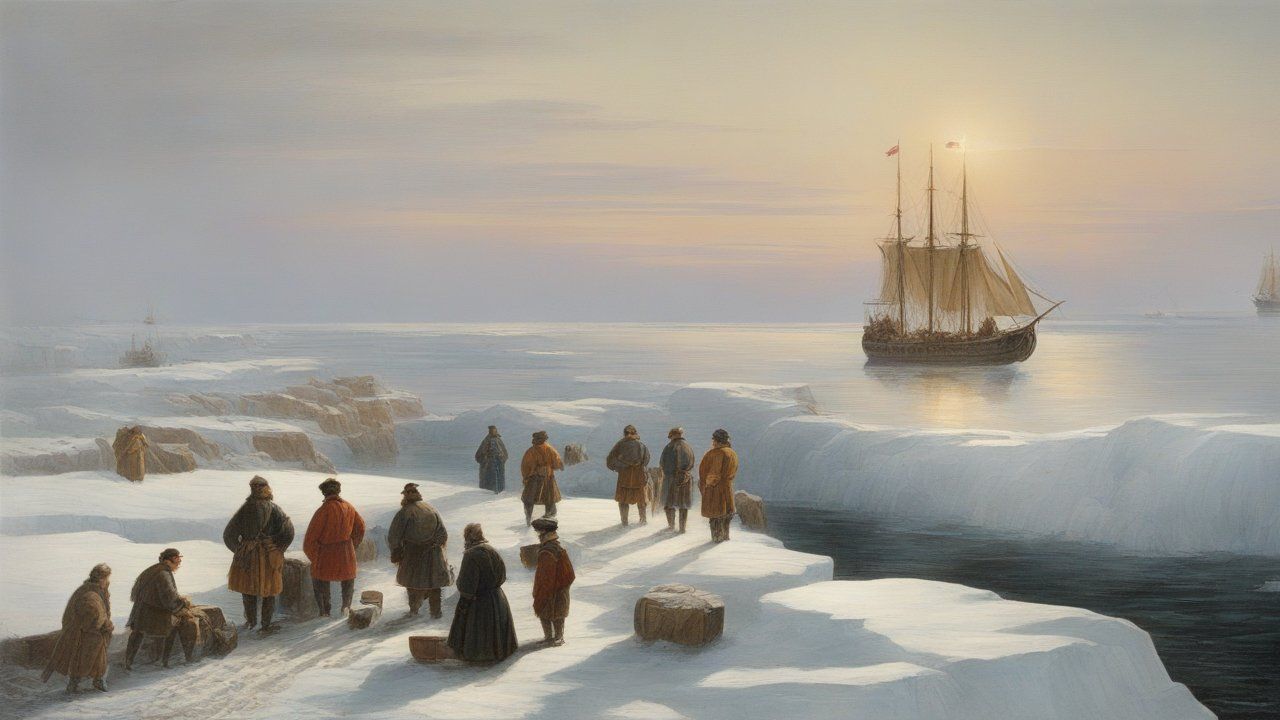
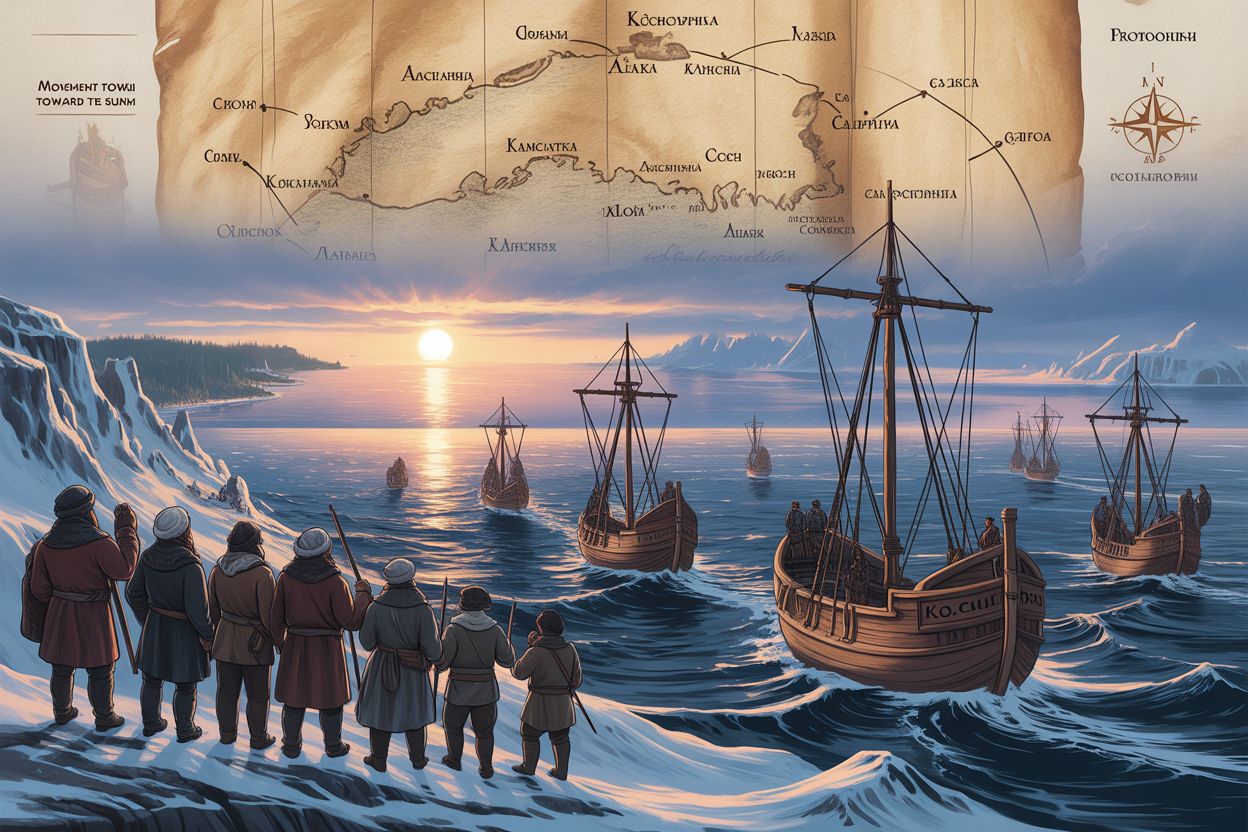
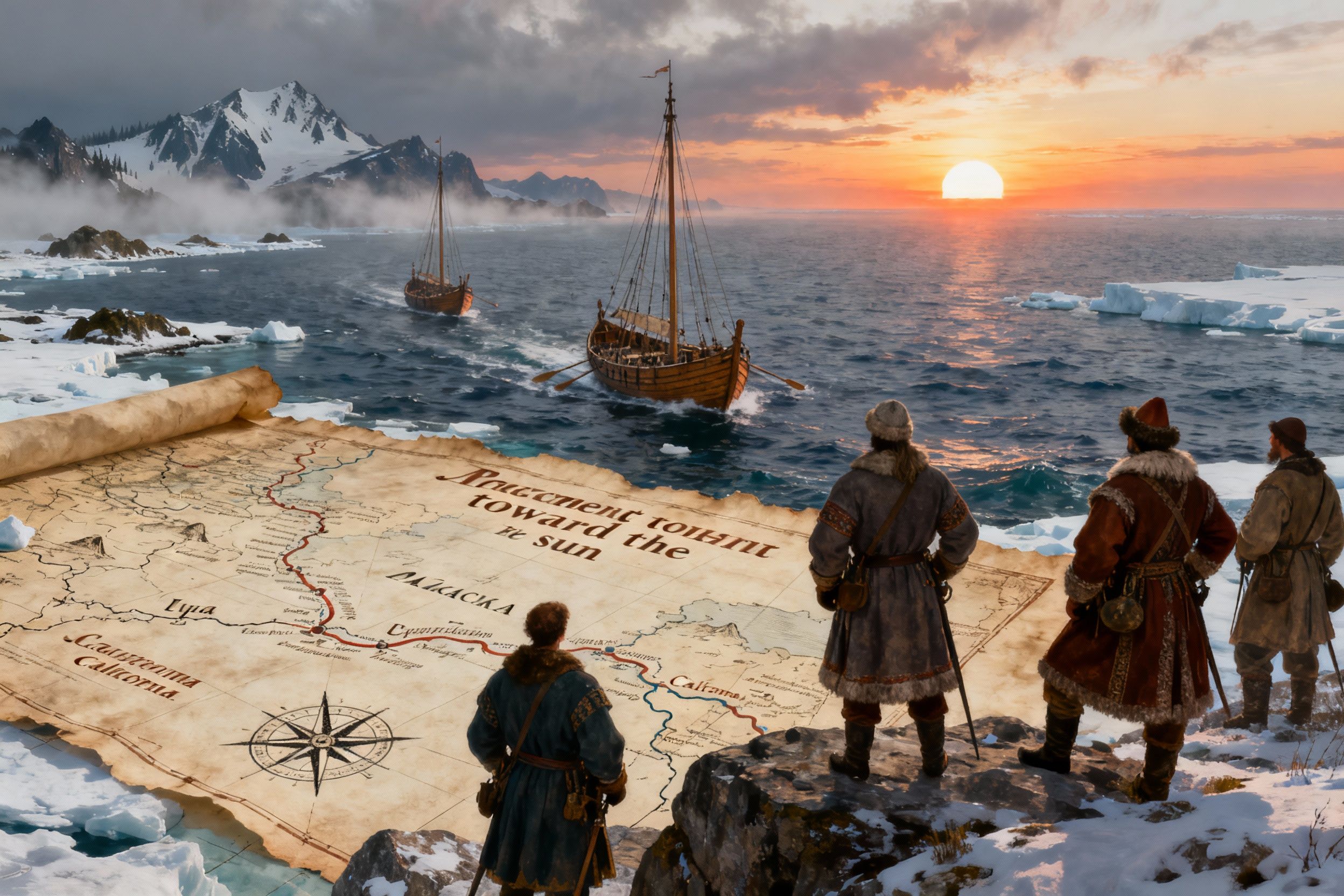
The discovery and subsequent development of Northwestern America was a major achievement of our people, the result of their persistent movement “toward the rising sun”—from the Urals to Kamchatka. By the end of the 17th century, courageous explorers had reached the Pacific Ocean along a vast stretch: from the Bering Strait to the Amur Estuary. And immediately, without any pause, further penetration by Russian pioneers began—to the Kuril Islands, the Commander and Aleutian Islands, to Alaska, and then all the way to California. All this testified to the growing power of the Russian state, which by that time had become a major maritime power.
Information about lands in the ocean east of the Asian continent became known in Yakutsk as early as the beginning of the 17th century. Cossacks who had been to the extreme northeast of Asia heard from Eskimos and Chukchi about islands and a Great Land lying beyond the Great Ocean. There was much confusion and contradiction in these accounts. The land was called either an island or a continent, and its location was indicated both opposite Cape Dezhnev and near the mouth of the Kolyma.
The Great Land was mentioned in the reports of Stadukhin (1647), Atlasov (1701), Malgin (1710), and others. At the beginning of the 18th century, Prokopy Nagibin (1725) and Afanasy Melnikov (1728–1730) attempted to reach the unknown continent but failed. It was precisely then that tales appeared claiming that Russian people lived on the Great Land. These were linked either to an ancient voyage (a hundred years before Dezhnev) by Novgorodians from the mouth of the Kolyma eastward around Chukotka, or to conjectures about the fate of Dezhnev’s lost companions. Indeed, of his seven koches (flat-bottomed single-masted vessels), two were carried to Kamchatka (the Nikol’ka River), one was wrecked at the mouth of the Anadyr, and three either perished or disappeared without trace—meaning they may have reached Alaska. Later, the first Russian settlers in the New World were considered to be the sailors who vanished without a trace in 1741 from the packet boat “St. Paul” commanded by Lieutenant A. Chirikov.
Rumors of an ancient Russian colony in America persisted throughout the 18th century. Indigenous inhabitants of Chukotka (Chukchi and Eskimos) spoke of it, as did servicemen who had visited them—Malgin (1710), Daurkin (1765), Kobelev (1773), and others. Scholars participating in Bering’s expedition—Müller, Steller, Lindenau—as well as employees of the Shelikhov Company (Bocharov, Izmalov—1788) asserted the same. Foreign seafarers (for example, Captain Gore—1789) were also convinced of this.
Thus, ancient Russian settlements in America appear to be an undeniable fact. In 1944, the foreign press published a copy of a letter from the first Russian missionary in Alaska—Herman. It fully confirms the vague rumors circulating in Chukotka about the existence of a Novgorodian colony on the Great Land, on the Kizilova River. In 1937, another piece of evidence was obtained: during boundary surveys in Alaska near the Kenai Peninsula, a Russian settlement was found. According to specialists, it was at least 300 years old.
Comparing Herman’s letter with the 1937 discovery, the American researcher Theodore Farrelly recognized the find as a Novgorodian colony. However, the Soviet historian A. V. Efimov considers only one thing certain: an ancient Russian settlement existed in Alaska, apparently arising in the 17th century. From which regions of the Russian state its inhabitants came remains unclear. It is hard not to agree with Efimov’s view.
“One may assume that there was not just one, but perhaps many other Russian settlements in Alaska, just as there is much evidence of ancient Russian settlements along the northern edge of the Asian continent…”
Indeed, it is difficult to assert unequivocally that this particular ancient settlement of 31 houses is the very Novgorodian colony founded in 1571 by fugitives. But it is possible to suppose that it likely was. And it is entirely certain that this was only one of the Russian settlements, of which there were probably several.
I would like to emphasize that even now, more than a century after the Russians left Alaska and the Aleutian Islands (and California was abandoned even earlier), traces of our ancestors’ presence have not completely disappeared there. In 1942, the author of these lines happened to visit Unalaska Island, at the Dutch Harbor naval base. On the shore of the bay stands the Aleut settlement of Illiuliuk—a former Russian village founded by hunters and traders in the 1760s–1770s.
Wooden houses resembling old log huts stretch along the only street; there is a white three-story bell tower and a small stone church with a copper cross atop an onion-shaped dome. And on the outskirts of the settlement, like ancient monuments, stand two cannons of Ural casting on wooden carriages.
The local inhabitants (Aleuts) had at that time been relocated to the Alexander Archipelago—we did not see them. But our guide, the American Lieutenant Chase, said that they had preserved Russian first names and surnames, partly the language, and the Orthodox faith once professed by the Russians who lived here.
During a stop in San Francisco, a group of Soviet submariners visited the former Fort Ross, located 30 miles from the city near the Russian River. A hundred years had passed since the Russians left, yet the former settlement still retained a log warehouse and a wooden church. Every year on July 4, Americans of Russian origin gather here for festivities and a prayer service.
It seemed as if our people had been here quite recently, and one could picture them leaving—packing their belongings, comforting their wives and children, and bidding a final farewell with a deep bow to the land made habitable by their labor.
The memory of the Russians’ presence on the Californian coast remains in toponyms—geographical names scattered around San Francisco: Russian River, Russian Hill, Russian Gulch, Slavyanka, and more than a dozen others…
On the whole, I agree with M. Chekurov’s point of view, but I would like to offer three small remarks of my own.
The settlement of the North by the Novgorodians should not be linked to the oppression of Ivan the Terrible. This process began much earlier—already in the 11th–12th centuries. It is known that by 1187 there were Novgorodian “tribute collectors” on the Pechora and in Yugra. Novgorod considered Yugra and the Pechora to be its “volosts.”
And on Rus’, those who moved “toward the rising sun” were not so much servicemen as, first and foremost, hunters and traders who themselves добывали “soft furs.” The same was true during the development of Russian America. Servicemen moved with them or after them, bringing the population “under the high sovereign hand.”
The main reason that forced the tsarist government to “cede” Russian America to the United States at a nominal price was the weakening of the serf-based state after defeat in the Crimean War (1853–1856), that is, the inability to hold a territory greedily coveted by the greatest colonial power of the time—England.
As for the influence on the Novgorodians of the Western heresy mentioned by the author, M. Chekurov’s conjecture is not without ingenuity. It was not without reason that settlers called the Yukon River Hebron, which, incidentally, is clearly visible on a map compiled by the Geographical Department of the Academy of Sciences, where the inscription “Хевувренъ” can be plainly read.