


On the calm and sunny day of August 6, 1930, the sunlight flooded the glacier, making the island seem transparent. Profound silence reigned all around. The sea was calm, and the motionless icebergs surrounding the island appeared dormant.
That morning, the sailors of the Norwegian schooner "Bratvåg," along with skipper Eliassen, headed to the shore to hunt walruses. Three scientists from the Polar Institute decided to take advantage of the brief stopover and visit the uninhabited island — the easternmost in the Spitsbergen archipelago, named by the Norwegian Hjelmsen as "White." The island was small, about 60 kilometers long, and entirely covered by an icy cap. Only in two places — in the southwest and northeast tips — could small strips of gently sloping rocky land be seen.
During the peak of the hunt, the skipper unexpectedly returned to the ship.
— "Mr. Horn," he addressed the expedition leader, "it seems my men have found André's camp." Eliassen handed over a wet and heavy notebook. Several words could be discerned on the first page: "...polar journey of 1897."
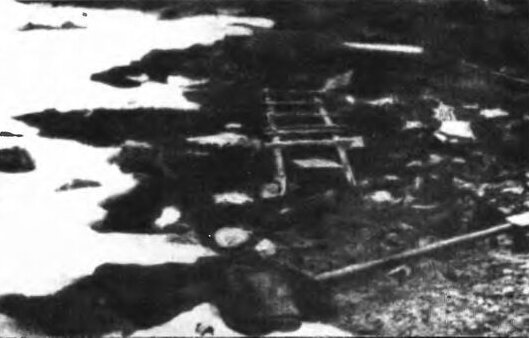
By chance, while searching for fresh water among the rocky tundra, two sailors stumbled upon a tarpaulin boat protruding from the snow. Inside, they found numerous items labeled "André Polar Expedition, 1896." Nearby, equipment lay scattered: a Swedish flag, crates and tins of provisions, empty sleds...
Ten meters from the boat, near a low rocky ridge, they found a corpse. A monogram in the shape of the letter "A" was preserved on the jacket. These were the remains of S. André — the leader of the ill-fated expedition. Nearby was a primus stove and a pot with remnants of food. Not far away lay another grave. The body was in a rock crevice, covered with stones. Initials on the clothing revealed it to be Nils Strindberg — the youngest member of the André expedition.
The sensational news of the discovery of the Swedish expedition, which disappeared without a trace 33 years ago, swiftly spread throughout the civilized world. A month later, journalist K. Stubbendorf aboard the "Polar Bear" completed the search initiated by the "Bratvåg." The snow melted, revealing the remnants of a tent. And within it lay the remains of André's third companion — Knut Frænkel...
What kind of expedition was this?
In the second half of the 19th century, many countries became interested in the Arctic, particularly in reaching the pole. Between 1848 and 1859 alone, forty expeditions explored the polar regions. They disappeared into the ice for months, endured shipwrecks, lost vessels, often suffered hunger, and perished from scurvy. Yet the North Pole remained inaccessible.
André's plan "came to light" on March 16, 1894. On this evening, the forty-year-old engineer of the Patent Office shared his cherished dream with the renowned polar explorer E. Nordenskiöld — to venture to the North Pole in a balloon. Many Swedes already knew André. Several years earlier, he had astonished his compatriots with his bold solo balloon flights aboard the "Svea."
— "Report this at the meeting of the Geographical Society. I will support you," advised Nordenskiöld.
...In his report, André pointed out the ineffectiveness of sled expeditions. "There is a means, as if specially created for such a purpose," he said. "It's a balloon. Such a balloon could fly across the icy deserts..." This idea was expressed over half a century ago, explained André, aviation enthusiasts sincerely believe that polar conditions are ideal for flights. Over the years, many similar projects have emerged, but all of them, for various reasons — mainly due to lack of funds — have remained on paper.
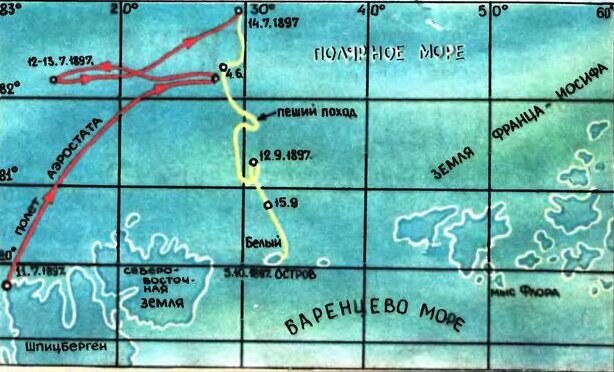 |
| Map of the expedition route of S. Andre. |
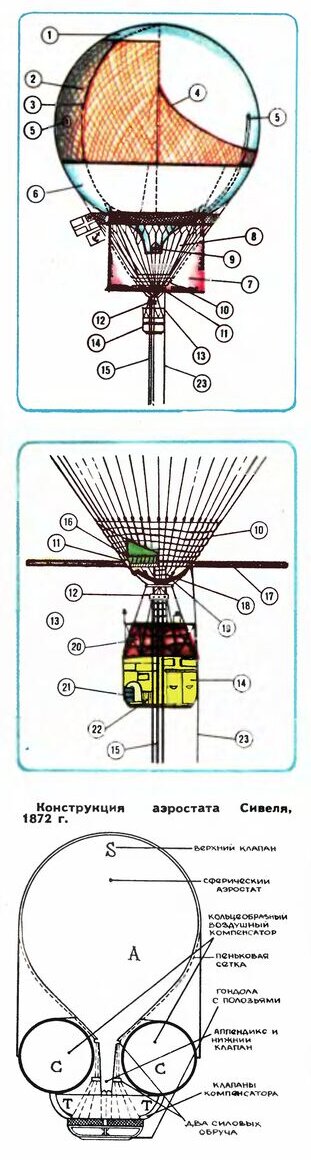
...American polar explorer Commander Cheyne wanted to travel to the pole on a set of three large balloons. The renowned French balloonist Sivel developed a balloon project in 1872 with a volume of 18,000 cubic meters and a diameter of 34 meters, which was supposed to lift 10 people with provisions and equipment. Since polar expeditions require economical use of every cubic meter of hydrogen, Sivel invented a special compensator to maintain the balloon at a certain height and reduce gas loss. It consisted of a hermetic ring filled with air. When the height changed, the volume of air in the compensator remained constant and acted as an automatic ballast device.
An interesting project was proposed in 1890 by the Frenchmen Bezanson and Hermit. A balloon with a volume of 16,000 cubic meters, named "Sivel" by them, was supposed to transport a whole polar house made of willow rods. The house had enough space for 5 people, 8 sled dogs, and provisions for 80 days. The house was equipped with runners and easily converted into a mobile structure.
In the Geographical Society, André's plan encountered no serious objections. It was approved. André proposed to build a small balloon capable of carrying three people and staying in the air for at least 30 days. Disagreements arose only regarding the possible direction of the winds in the near-polar region. Synoptic data on the central Arctic basin were extremely scarce. There were more guesses and assumptions. André hoped for favorable winds that would allow flying from Spitsbergen to the Bering Strait in six days, where it was expected to meet whaling ships. In addition, André suggested equipping the balloon with a system of sails and drogues, tested on the "Svea," allowing the balloon to deviate up to 30° from the wind direction.
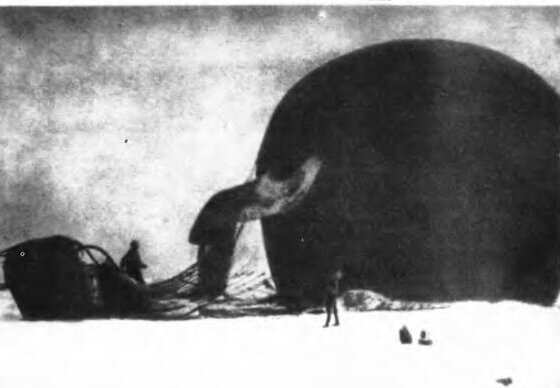 |
| Posthumous photographs of Andre, which were released 33 years after the death of the expedition. Above: the balloon disaster, below - the last stop on Bely Island. |
 |
The funds for the expedition were collected over several months. Large sums were donated by the "dynamite king" A. Nobel and Baron Dickson. A balloon with a volume of 4800 cubic meters was ordered from the French manufacturer Henri Lachambre - a prominent specialist in this field. The design was a typical Charlière balloon, modified by Andrée himself. He, in particular, decided to forgo the upper maneuvering valve, rightly believing that snow and ice would hinder its operation. Two small valves were located on the equator of the balloon. The upper part of the envelope consisted of three layers of lacquered silk. In the gondola, woven from Spanish reeds known for their exceptionally elastic properties, there was a sleeping compartment and a photo room. The explorer planned to engage in photographic mapping and develop materials directly during the flight. Most of the time, the aeronauts intended to spend on the roof of the gondola, protected from the wind by canvas sheets. Food and equipment supplies for four months were stored in the load-bearing ring. Three drogues of varying lengths were supposed to automatically maintain the balloon at a height of 150-200 meters; if it descended, they would lay on the ground, thereby lightening the load. Messages to the mainland were intended to be transmitted using carrier pigeons marked with special stamps and by dropping cork buoys. The problem of cooking during the flight was solved in an original way. The kitchen apparatus was suspended several meters below the gondola and operated remotely. Combustion was controlled using a mirror...
In the summer of 1896, the expedition set off for Danskøya, located northwest of Spitsbergen, approximately 1100 kilometers from the pole. There, a hangar for the balloon was built. Many wanted to fly with Andrée. He chose the twenty-five-year-old N. Strindberg - a skilled photographer and physicist. The third participant in the expedition was the meteorologist N. Ekholm.
But the flight did not take place that year. Without waiting for favorable winds, Andrée returned to Sweden. On the way back, he met Nansen, who had just returned from the legendary drift on the "Fram". F. Nansen stated that he had sufficiently studied the air currents in the polar regions to "doubt the success of an aerial expedition to the pole". In the autumn, N. Ekholm left the expedition. He concluded that the balloon did not meet the necessary requirements and the flight was doomed... Failures did not break Andrée. His conviction and persistence disarmed even the greatest skeptics. The next summer, Andrée set off for Spitsbergen again. Engineer Knut Frænkel took Ekholm's place.
At the end of June, the balloon was assembled and filled with hydrogen. On July 11, the long-awaited sharp southern wind blew. After consulting with his companions, Andrée decided to launch and ordered the dismantling of the northern wall of the hangar. For the last time, he inspects the balloon and ensures that everything is ready. Baskets with pigeons are suspended. Andrée sends the last telegrams. A brief farewell. The ropes holding the balloon are cut, and the "Eagle" slowly rises into the air. And suddenly, before the eyes of those around, it plunges down, touching the surface of the bay, then like a ball, it soars upward and soon disappears from view...
On July 15, the skipper of the Norwegian ship "Alken" shot down a carrier pigeon. The note, dated July 13, caused some concern. In two days, the balloon had moved north only 250 kilometers and was moving southeast. Several years later, five buoys were found in Iceland and Norway. Only two contained notes. On King Charles Land, near Spitsbergen, the largest "polar" buoy was found - Andrée dreamed of dropping it over the planet's summit. The press put forward the most fantastic assumptions about the whereabouts of the airship. There were reports that the balloon had allegedly been seen in various parts of the Arctic. The expedition became a source of mystification. But years passed, and it began to be forgotten. The aeronauts, it seemed, had forever disappeared into the white silence...
 |
But what really happened?
André kept his "big" diary especially carefully. He wrapped it in a wool sweater and always carried it under his jacket... The pencil entries were perfectly preserved. They reported what happened from the moment of takeoff to landing on White Island.
...After losing the ballast bags, which happened immediately after takeoff, the "Eagle" turned into an uncontrollable balloon. The wind changed direction. Ice accumulation on the shell was more significant than expected. The balloon flew very low, constantly hitting ice hummocks. The aeronauts had to part with some of their food and equipment. But even this was futile. On June 14th, André realized that further struggle was useless. The aeronauts activated the explosive device and landed on the ice in the area with coordinates 82°56' N and 29°52' E.
For a week, they prepared for the sled crossing. They decided to head southeast to the large food depot at Cape Flora on Franz Josef Land. They had to cover about 350 kilometers of difficult ice terrain.
In the Arctic, summer was in full swing. Pools and leads alternated with rough ice fields. Each person pulled sleds loaded with 120-130 kilograms of cargo. André's diary abounds with complaints about the difficult journey. The tiresome monotony of the crossings was occasionally broken by bear hunting.
In early August, they realized they hadn't progressed towards their goal and had drifted tens of kilometers southward. Ice drift carried them southward. The polar explorers changed direction. Now they were heading towards the small depot on the Seven Islands near Spitsbergen. The road remained awful. Frænkel and Strindberg had sore legs, but overall, their condition was good. The aeronauts increasingly remembered the quiet joys awaiting them at home. Strindberg wrote letters to his fiancée during breaks, whom he had become engaged to before departure, but soon abandoned this. He limited himself to brief remarks in his notebook. It was already late September. Each day became colder. But the worst thing was that the travelers realized they were inexorably drifting with the drifting ice between Severnaya Zemlya and Franz Josef Land. "We recognized the need to reconcile ourselves to wintering in the ice," André wrote on September 17th. They built an ice hut. In late September, they were driven to White Island. Suddenly, the ice floe split, and on October 5th, the aeronauts landed on the southwest tip of the island, now called "André Cape," and set up their final camp.
André began his second diary on the island. But only four pages were filled. On October 8th, the entries stopped... Strangely, N. Strindberg died mysteriously — the first victim. Some of his personal belongings were later found with André and Frænkel. They unloaded the third sled (later found empty), transported Strindberg to the crevice, and buried him under stones. And here's the strange part: André, who meticulously noted even the most insignificant events in his diary, doesn't mention his death at all! Perhaps he was shocked by what happened or... couldn't bring himself to confide his thoughts in the diary? And how many more days did André and Frænkel live? André didn't resume his entries, leaving us to assume that their mysterious death occurred shortly after Strindberg's death...
In late autumn 1930, the aviators' remains were transported to Sweden on the gunboat "Svenekkund" — the same one that had brought them to Danskøya 33 years ago — and solemnly buried as national heroes. Among the items found on the island were exposed films. They were developed, yielding 20 very clear photographs — after 33 years...
Why did the aviators perish?
The official version stated: "Death from cold during sleep." The inconsistency of this conclusion with the actual facts was so obvious that well-known polar explorers V. Stefansson and O. Sverdrup almost immediately took notice. Everything found on White Island indicates that the two main enemies of many polar expeditions — cold and hunger — were not the immediate cause of the aviators' deaths. And here's why. André and Frænkel's bodies were not found in their sleeping bags. In October, the air temperature on the island never dropped below -10°C. The primus stove was in perfect working order. There was a rudder and a hundred boxes of matches. Two bear skins were found in the camp. The aviators had enough clothing. Of course, its quality left much to be desired, but, for example, Nansen and Johansen during their wintering on Franz Josef Land were in much worse conditions. Among the belongings were untouched tin cans of food. The rifles were in perfect condition, with plenty of ammunition. And André himself noted in his diary that after successful hunting, the expedition was supplied with fresh meat until late spring...
And yet — their demise...
Pavel Novokshonov, Karaganda city