


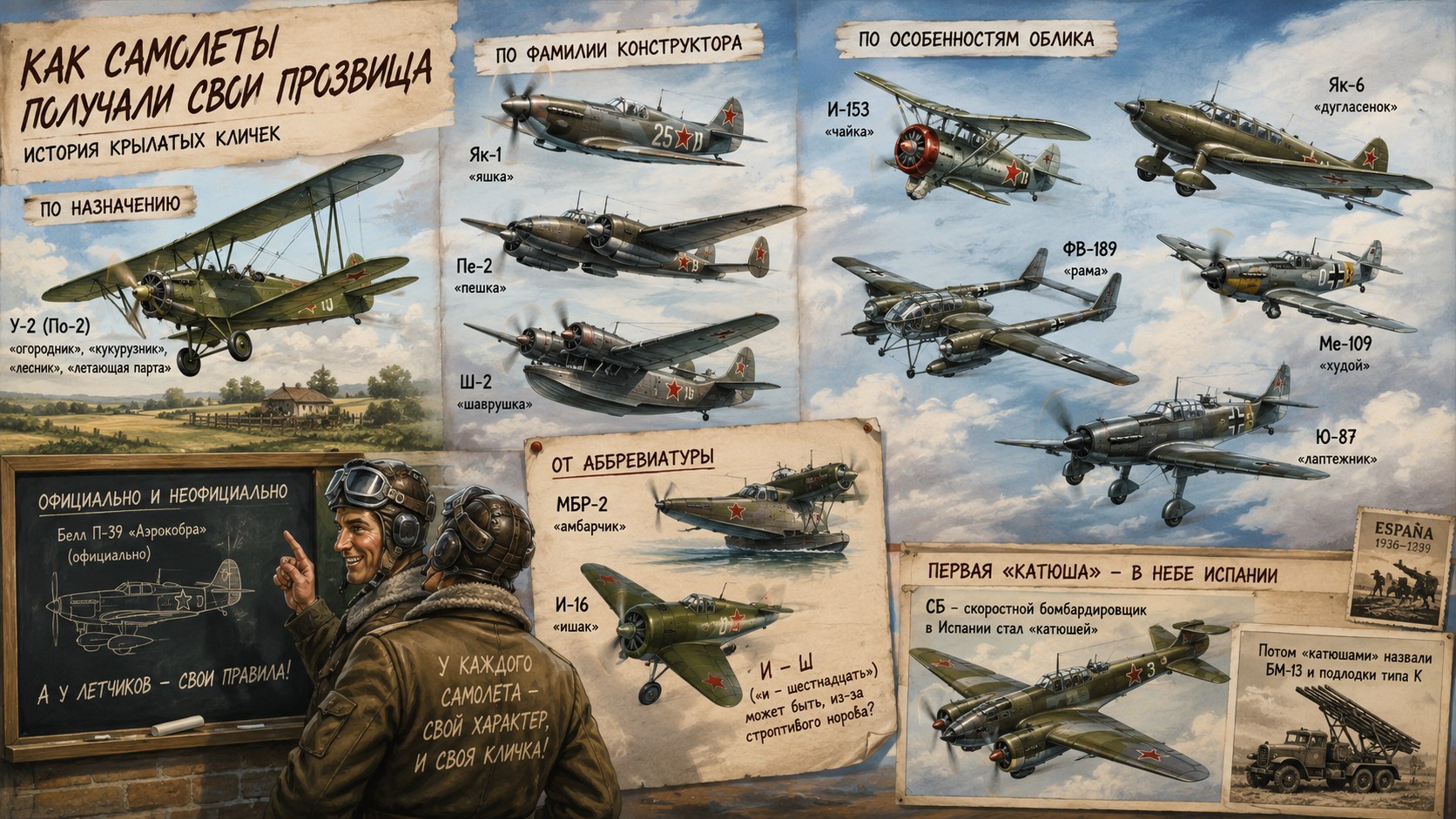
Usually, combat aircraft have a short and clear designation.
For example, upon seeing the alphanumeric designation I-5 or SB, it is not difficult to guess that in the first case we are talking about the 5th Soviet-built fighter, and in the second — about a pre-war Soviet high-speed bomber. True, there are also more complex designations. For instance, the 7th heavy bomber, created in A. N. Tupolev's design bureau by V. M. Petlyakov's team, was initially called TB-7 (ANT-42), and then Pe-8. In American aviation, it is customary to include the company name, coded class designation, the Air Force model number, and the machine's own name in the aircraft's designation. Therefore, the official title of one of the World War II fighters looked as follows: Bell P-39 "Airacobra".
However, the sharp-tongued pilots were never satisfied with the dry conciseness of documents, and from almost the first years of aviation's existence to this day, they take delight in inventing all sorts of nicknames for their own and others' aircraft. As for the reason, it was always to be found.
For example, the machine's purpose. Our multipurpose biplane U-2 (Po-2) was called many things: "gardener," "corn-crop worker," "forester," "flying desk" — in short, depending on where these unhurried heavenly all-rounders were employed.
In other cases, pilots jokingly twisted the names of aircraft designers. This is how the "yashki" (Yakovlev Yak-1 fighters), "peshki" (Petlyakov Pe-2 bombers), and "shavrushki" (Shavrov Sh-2 amphibians) appeared.
Sometimes the reason for the appearance of an unofficial name was the distinctive features of a particular aircraft's appearance. For example, Soviet pilots dubbed the I-153 biplane fighter, with its characteristic gull-wing upper wing, a "seagull"; the light transport aircraft Yak-6, which somewhat resembled the more massive Pi-2 (DS-3), was called "little Douglas." The twin-boom German spotter FW-189 was first nicknamed "frame" by Red Army soldiers and then by pilots, the Me-109 fighter was called "skinny" for its thin fuselage and narrow wings, and the Ju-87 dive bomber, whose fixed landing gear was covered by fairings, was dubbed "bast-shoe worker" (or "clog").
Sometimes a humorous name was born from the official abbreviation. This applied to the naval short-range reconnaissance aircraft MBR-2, nicknamed "little barn" by technicians and pilots, and the famous I-16 fighter. Probably, the combination of the letters I and Sh ("i — sixteen") led to pilots calling this machine "ishak" ("little donkey") — or perhaps its stubborn temperament was to blame. By the way, the I-16 had two other nicknames — during the Spanish Civil War, the Republicans called it "mosca" ("fly") as opposed to "chato" ("snub-nosed") for the I-15.
The history of another curious nickname is connected with the Spanish events. As is known, during the Great Patriotic War, "Katyushas" were the name given to the BM-13 multiple rocket launchers and the K-class cruiser submarines. But the very first "Katyusha" appeared in the skies over Spain — these were the already mentioned Soviet-built SB bombers. But why they turned into "Katyushas" is hard to say...
N. BOECHIN, historian