


In England, tankettes did not become widespread; they were used only as machine gun carriers and tractors. These vehicles received significantly greater development in countries that purchased licenses for their production.
Summing up the work of Soviet designers in the late 1920s and early 1930s, Chief Marshal of the Armored Forces P. A. Rotmistrov wrote in his book "Time and Tanks": "...the designers of these machines — enthusiasts of their craft who deserve the kindest words — were unable to solve the tasks facing our Motherland regarding the rearmament of the Red Army in accordance with the demands of the nature of a future war. The creation of tanks — designing, manufacturing prototypes, testing them, refinement, and setting up serial production — required considerable time... In order to create modern combat vehicles in the shortest possible time, technical achievements both in our country and abroad were studied."
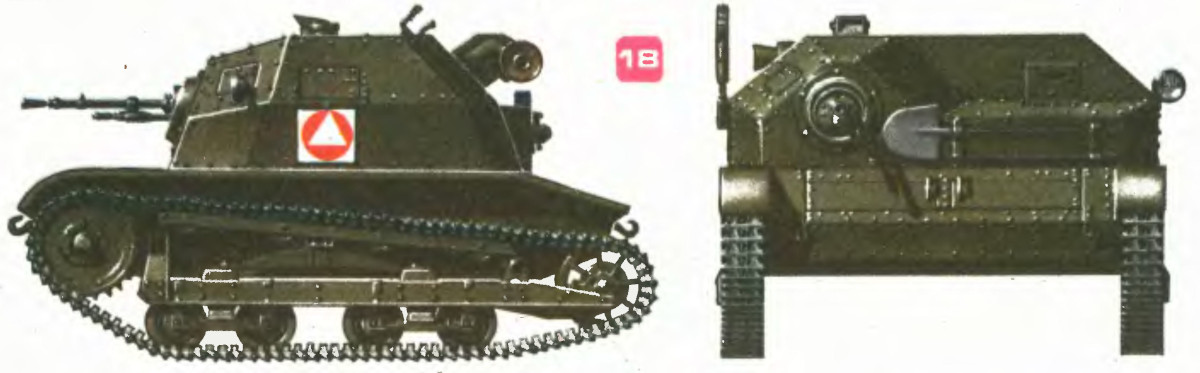 |
| Fig. 18. Polish tankette TKS. Combat weight — 2.65 tons. Crew — 2 men. Armament — 1 machine gun. Armor thickness — 8–10 mm front and sides of hull. Engine — Polish "Fiat" 42 hp. Road speed — 40 km/h. Road range — 180 km. |
In 1930, the Soviet Union purchased some samples of foreign military equipment, including the Carden-Loyd MkVI tankette. But before beginning serial production of the vehicle, it had to be refined and its shortcomings eliminated. This was undertaken by a team of designers led by N. N. Kozyrev. The improved model, designated T-27, was adopted for service by order of the Revolutionary Military Council of the USSR on February 13, 1931. However, production of the tankettes, which began at the end of the same year, was discontinued in 1933 (2,600 units were produced) due to the vehicle's unsuccessful design, which did not allow effective use of its armament.
A year earlier, the Polish government also purchased the same tankette and a license for its production. Work on its modernization began immediately: the suspension was reinforced with an additional leaf spring, a more powerful engine and a new gearbox were installed. The tankette received an armored cover and, under the designation TK-3, was adopted for service in July 1931.
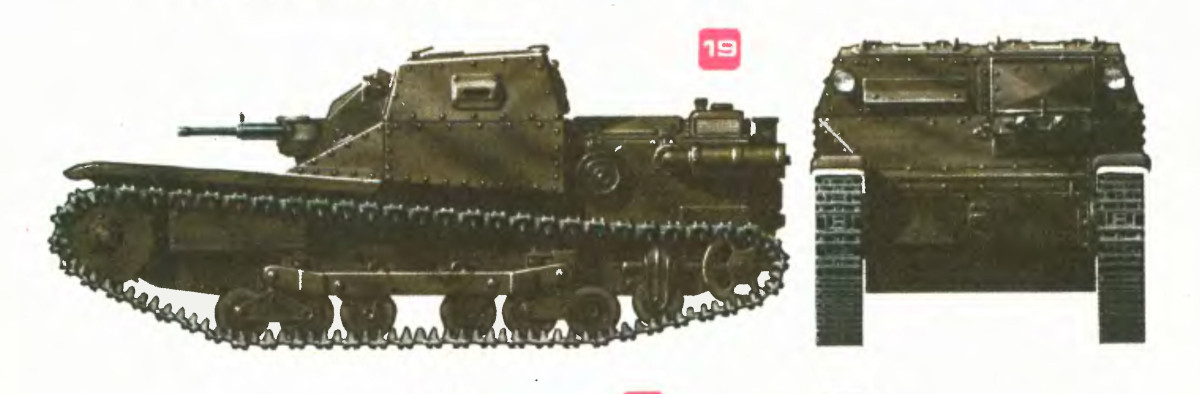 |
| Fig. 19. Italian tankette CV-3/35. Combat weight — 3.3 tons. Crew — 2 men. Armament — 2 machine guns. Armor thickness — 12 mm front of hull and 8 mm sides. Engine — "Fiat" 40 hp. Road speed — 42 km/h. Road range — 110 km. |
In 1931–1933, more than three hundred TK tankettes were built. Then, based on operational experience with these vehicles, designers developed a new model — the TKZ (TKS), with a more rational arrangement of thicker armor plates. The machine gun was placed in an improved ball mount. Suspension elements were also strengthened and the track width increased. The TKZ was equipped with a more powerful engine, portable tools, Gunzlak system suspension instruments, and an optical sight for the machine gun. The TK and TKZ served in independent companies within infantry divisions, cavalry brigades, and separate reconnaissance tank squadrons. By the beginning of the war, these vehicles formed the backbone of Poland's armored forces. In battles with German troops, they repeatedly supported desperate counterattacks by Polish forces, suffering heavy losses in the process. In total, 300 TKZ tankettes were produced in 1934–1936.
In 1930, the Italian War Ministry also purchased a license to produce the Carden-Loyd MkVI tankette, entrusting its construction to the well-known firm Fiat-Ansaldo. During the work, the tankette was improved, and in 1931 the first prototype appeared, which was adopted for service two years later as the "Fiat-Ansaldo CV-3/33 small tank." During modernization, the running gear was radically changed, armor thickness and vehicle dimensions were increased. All this led to an increase in weight and required the installation of a more powerful engine.
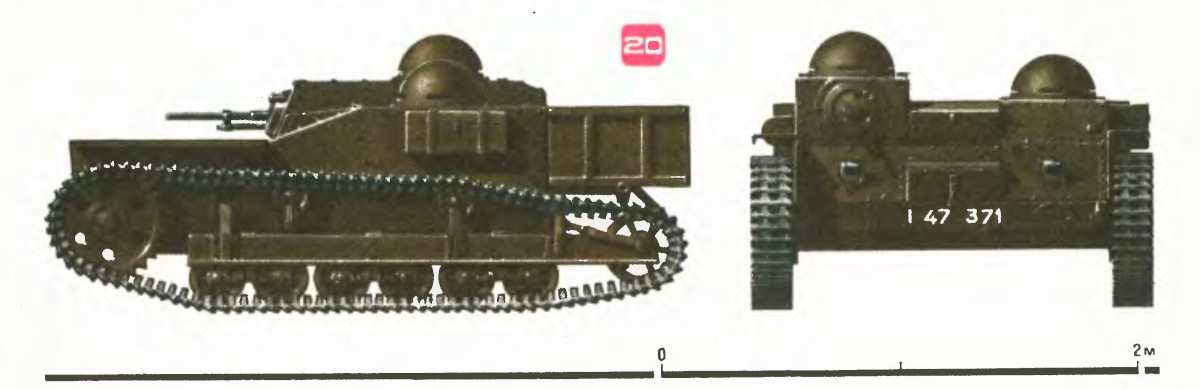 |
| Fig. 20. French Renault UE tankette. Combat weight — 2.8 tons. Crew — 2 men. Armament — 1 machine gun. Armor thickness — 7 mm front and sides of hull. Engine — "Renault" 35 hp. Road speed — 30 km/h. Road range — 180 km. |
1935 — a new modification of the "small tank" appeared — the CV-3/35, differing from its predecessor by the installation of twin machine guns. Based on the CV-3/33 tankette, a flamethrower vehicle was created with an armored trailer tank (for flame mixture). The flamethrower range was 45–60 m. The tankettes were used by the Italians in the war against Ethiopia in 1934–1935. However, during the battles in Spain (1936–1939), their complete unsuitability for fighting tanks was revealed, and it was also found that CV vehicles could even be penetrated by heavy machine gun bullets. Nevertheless, they were still used during World War II.
Production of these vehicles ceased in 1937 (more than 2,500 were produced, mainly CV-3/35). Many were sold abroad — to Austria, Brazil, Bulgaria, Hungary, and China. In the armies of the last two countries, they took part in combat operations.
The worldwide "fascination" with the tankette also found supporters in Czechoslovakia. The Ministry of National Defense commissioned the CKD firm to negotiate with the British concern Vickers-Armstrong for the purchase of a license to produce the same Carden-Loyd MkVI. It was decided to create an improved model of the tankette. It was built, and in 1933 the ministry ordered 70 tankettes, produced at CKD factories. The vehicle was called the "tankette" (tankovac). Simultaneously, another firm, Skoda, began producing the MU-4 tankette, designed for export.
In France, Renault created its own tankette in 1930. However, its design shows significant influence from the Carden-Loyd. Its main purpose was considered to be supplying mechanized infantry in combat. The vehicle was called the "infantry tractor UE." It was produced in series in the 1930s and, as a rule, had no armament. Tankettes captured by the Germans in 1940 were fitted with a fixed superstructure and equipped with machine guns.
Thus, we see that such vehicles were widespread in the armies of many countries. Their purpose was reconnaissance and guard duty, as well as cavalry escort. But even in these cases, the tankettes were required not only to provide protection for the crew from rifle and machine gun fire but also, if possible, to effectively use their armament, which was hindered by the absence of a rotating turret.
In general, these vehicles gave impetus to the development of light tanks, armored personnel carriers, and amphibious tanks. Armored tractors, command vehicles, and others were built on tankette bases.
The title page image shows the Soviet T-27 tankette.
Combat weight — 2.7 tons. Crew — 2 men. Armament — 1 machine gun. Armor thickness — 10 mm front and sides of hull. Engine — GAZ-AA 40 hp. Road speed — 40 km/h. Road range — 120 km.