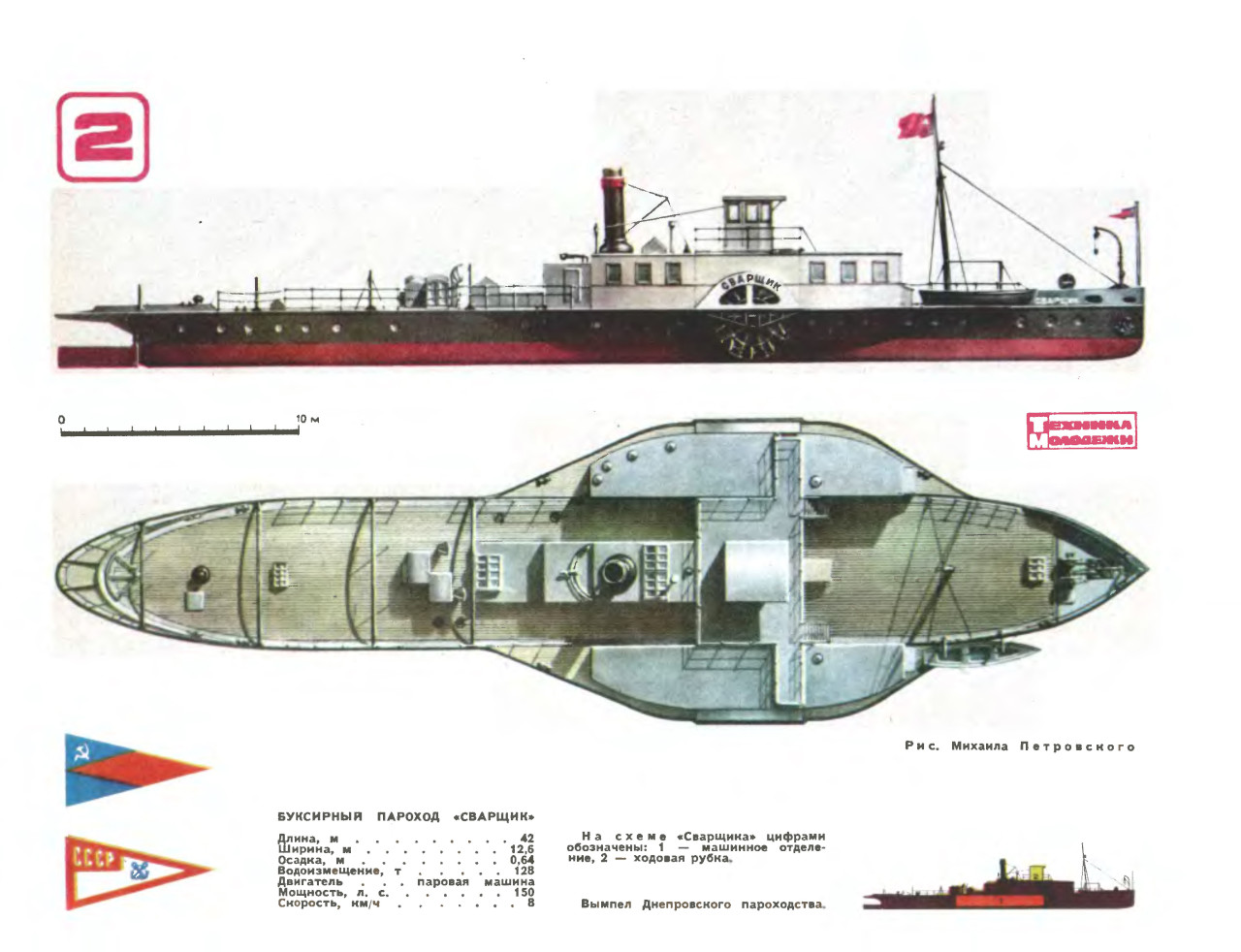
After the restoration of the river fleet was completed during the years of the First Five-Year Plan, a period of its reconstruction began. Shipbuilders were now faced with the task not only of replenishing shipping companies with vessels of Soviet construction, but also of boldly introducing advanced technologies that would shorten construction times, reduce the consumption of scarce metal, and thus lower costs. One of the progressive methods of those years was electric welding.
In fairness, it should be noted that it was invented as early as 1881 by the Russian engineer N. Benardos (see “TM,” No. 12 for 1981), and six years later improved by N. Slavyanov, who created the first welding shop in history at the Perm Steel and Cannon Works. However, for a number of reasons electric welding did not find wide application until the final years of the First World War. Its “second birth” was due to purely military factors—the need to save metal and to accelerate the production of military equipment by every possible means.
In the Soviet Union, electric welding began to be intensively introduced in many branches of industry during the First Five-Year Plan, when the entire nation enthusiastically responded to the call of the Bolshevik Party to catch up with and surpass the advanced capitalist countries in the shortest possible time. “In newspapers and magazines, notes and essays appeared more and more frequently about how the steel electrode in the hands of a welder helps to win days and weeks in the battle for speed,” recalled Academician E. Paton.
In shipbuilding, one of the initiators of the new technology was Professor V. Vologdin. It was he who, as early as 1926, successfully carried out the first experiments—first on welding barges, and then on individual assemblies and components of ships: machine foundations, fuel and ballast tanks, various casings, davits, and cargo booms. Subsequently, Vologdin’s group developed equipment intended for the manufacture of internal bulkheads. In 1929, staff of the Kyiv Mechanical Engineering Institute completed its testing, and at Sudoproekt—the centralized organization responsible for designing new vessels—a department was created whose employees undertook the development of welded ship structures, the introduction of electric welding at shipyards, and the training of skilled welder-workers.
The preparatory stage of research work was completed by the beginning of the 1930s, and the board of the All-Union Association of River Shipbuilding entrusted the construction of the country’s first all-welded vessel to the Kyiv shipyard (now the Lenin Forge Plant).
The Kyiv builders chose as the object of the experimental construction a tug already mastered by industry and well proven in service, with a steam engine rated at 150 hp. It had been designed by the engineers of the Nizhny Novgorod “Krasnoye Sormovo” plant for towing log rafts on northern rivers from logging areas to seaports.
Embarking on such an unusual experiment, the Ukrainian shipbuilders deliberately refrained from making any changes to the design—externally, the new tug differed in no way from its counterparts. It was the same flat-bottomed vessel, with a hull divided into five compartments by four watertight bulkheads, side paddle wheels, straight sides, and an angular superstructure crowned with a long smokestack.
There was no desire here to “get by with small forces” when solving a complex problem. This approach made it possible to quickly compare the welded vessel with riveted ones and, moreover, to achieve a substantial gain in construction time.
The working drawings of the tug—named “Belarus”—were prepared by August 1, 1931, and two weeks later the first bottom plates were laid on the slipway. Then began the assembly of the framing, shell plating, and superstructures. Everything seemed as before… except that for the first time there was no deafening hammering of riveters over the slipway; instead, the dazzling flame of the electric arc flickered ghostlike. For the first time, ready-made bollards, hawse pipes, portholes, and other fittings were installed on the vessel under construction at their designated places, rather than being assembled piece by piece as before. The work progressed at an unusually fast pace, and already on November 20 the brand-new tug was ceremoniously handed over to its owners—the Dnieper river workers. Thus began the working service of the steamship “Belarus.” And at the “Krasnoye Sormovo” plant, a sister tug named “Svarshchik” (“Welder”) was built using the same method.
The shipbuilders then set about summing up the results of the experiment. They turned out to be quite favorable. Suffice it to say that the hull of the “Belarus” was 27.5% lighter than that of riveted tugs—clear evidence of metal savings. Moreover, for the first time shipbuilders were able to dispense with a number of rather heavy and time-consuming operations: drilling holes in shell and hull plates, the riveting itself, and caulking; finally, the need to manufacture thousands of bolts and nuts of various sizes disappeared—the labor intensity of the work was reduced by 30%. The advantages of electric welding were obvious.
The new method of ship assembly was immediately extended to other enterprises in the industry, and the Kyiv Lenin Forge Plant embarked on an extensive program to design and build a large series of all-welded tugs with engines rated at 150 and 300 hp. Following the Ukrainians, electric welding was rapidly introduced at many shipbuilding and repair enterprises of the Volga basin.
By the beginning of 1932, the slipways of the All-Union Association of the Shipbuilding Industry, Soyuzverf, already counted 550 welding machines, and more than a thousand workers had mastered the new specialty.
Soon, electric welding began to be widely used in the construction of seagoing vessels as well—tankers, timber carriers, dry cargo ships, cargo-passenger liners, and warships. Suffice it to say that on new fishing trawlers, welding operations accounted for up to 45% of the hull work. Moreover, the success of the Kyiv shipbuilders enabled Soviet shipbuilding enterprises, ahead of well-known foreign firms and companies, to move to a new stage in the history of shipbuilding—high-speed sectional assembly of vessels. The application of this method alone in the construction of timber carriers saved the national economy more than 5 million rubles.
And it all began with the small paddle tugs “Svarshchik” and “Belarus.”
IGOR ALEKSEEV, engineer