Historians of the national river fleet have established that at the height of the 1913 navigation season, 4,600 steamships and motor ships of various classes and about 24,000 barge-type vessels were operating on the country’s rivers and lakes, accounting for 29% of Russia’s total freight turnover.
Approximately the same composition of shipping companies and individual owners remained until January 26 (February 8), 1918, when the Council of People’s Commissars adopted the Decree on the nationalization of water transport, signed by V. I. Lenin.
However, in the battles of the Civil War and in combat against foreign interventionists, the river fleet suffered enormous losses. From sinking alone, it lost 863 steamships and up to 12.5 thousand non-self-propelled vessels. And how many passenger liners, dry cargo ships, tankers, and tugs burned, were wrecked, or were thrown ashore! Immediately after the Civil War, river workers repaired and returned to service many vessels of various classes and began building first wooden barges with a carrying capacity from 340 to 1,900 tons, and then metal tank vessels, steamships, and motor ships started coming off the slipways. By 1927, as many as 2,775 self-propelled vessels alone were already operating on the country’s rivers.
However, most of them were significantly outdated; vessels built at the end of the previous century were still in service. Naturally, the technical condition of the fleet could not be considered satisfactory. Therefore, the Communist Party and the Soviet government set the river workers the task of renewing the river fleet in the shortest possible time. The Council of People’s Commissars developed a plan for the reconstruction of the river fleet, calculating that by 1931 the total power of the propulsion systems of steamships and motor ships of various classes would reach 477,000 hp, and the carrying capacity of the non-self-propelled fleet would increase to 4,361,000 tons.
When beginning to carry out this task, Soviet specialists sought to use the richest experience of Russian engineers who at the beginning of the century had created such masterpieces as the comfortable cargo-passenger motor ships of the “Borodino” and “Bayan” type, the first diesel-electric ships in history “Sarmat” and “Vandal,” and the most powerful tug motor ship “Redel, Prince Kossky.”
The list of remarkable creations of domestic shipbuilders should also include the world’s first dry-cargo motor ship Danilikha (later renamed “Karakalpakia”). Its hull was assembled by Sormovo workers in 1913–1914, and the propulsion system was installed by the Kolomna Plant, which at that time specialized in building very successful internal combustion engines running on heavy fuel.
This vessel was taken by engineers and river workers as a model when they began developing the project of motor ships of the “Abkhazia” type (or “small Danilikha”). Their series, consisting of ten units, was intended for transporting dry cargo between ports located on the Kama, Volga, and Oka rivers.
But before the last motor ship of this type had even been launched, Sormovo engineers began producing vessels of an improved design, dubbed by river workers “large Danilikhins.” In their design and initial construction, the experience accumulated by shipbuilders and operators on pre-revolutionary and Soviet-built vessels was taken into account. As a result, in terms of carrying capacity, the new vessels more than doubled their famous predecessor; their propulsion systems were far more powerful and advanced, and the living and working conditions of the crews were significantly improved.
These vessels, embodying the traditions of domestic shipbuilding and the latest (for their time) achievements of science and technology, open the historical series of 1932.
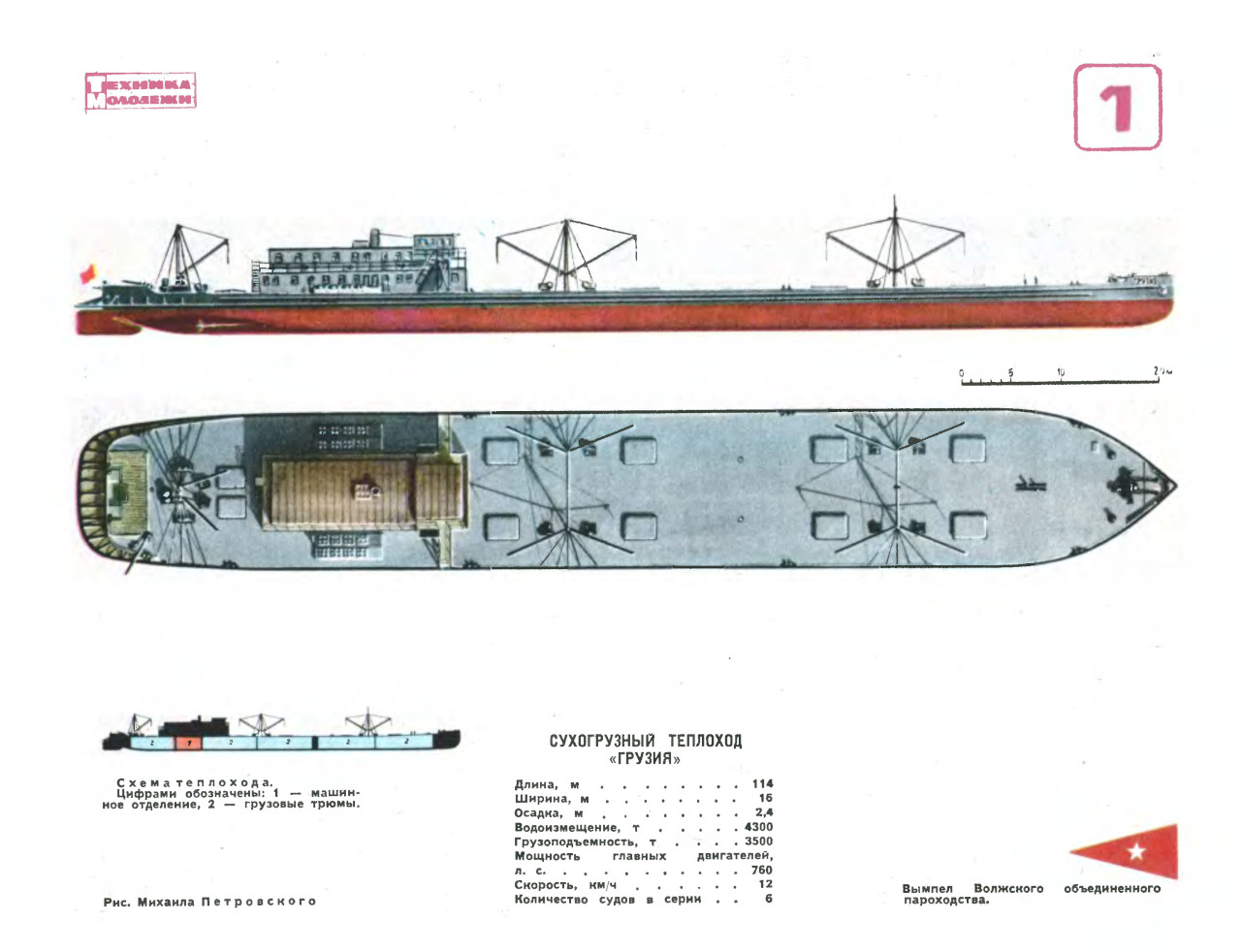
Each “Georgia”-type motor ship was a fairly large vessel for its time, with a flat bottom, straight sides, a spoon-shaped bow, and a cut-off stern. To ensure unsinkability, the hull was divided by ten transverse and one longitudinal watertight bulkheads.
Most of the vessel was occupied by five double cargo holds. Near their hatches on the upper deck rose ten derricks with a lifting capacity of 1,000 kg each, equipped with electric winches. This, of course, significantly облегчало the work of the deck crew during cargo operations in ports. In the stern section, beneath a two-tier superstructure housing the wheelhouse and bridge, as well as service and living quarters, was the engine room. It contained the main engines—two four-stroke, non-compressor, six-cylinder Kolomna diesel engines of the “50 GRS-6” type, providing the vessel with a speed of 12 km/h.
Electrical power was supplied by two 30-kilowatt diesel generators driven by two-cylinder, two-stroke units with a capacity of up to 50 hp, produced by the “Krasny Proletary” plant.
An example of the careful thought given to all ship systems is the fact that external and internal lighting on the “Georgia” did not depend on the main and auxiliary mechanisms, but was generated by a dynamo machine connected by a belt drive to an oil engine of the “Vozrozhdenie” brand. Incidentally, speaking of the high degree of mechanization characteristic of motor ships of this type, it is worth recalling that sailors did not have to strain their backs manually lifting the two bow Hall anchors weighing 800–920 kg each and the half-ton stern anchor—they were raised from the water by electric motors installed at the windlasses.
Perhaps the only tribute to the “steamship past” of the Volga remained the steam boilers, and even then the steam they produced was used only for heating.
The group of six “large Danilikhins”—“Georgia,” “Kalmykia,” “Karelia,” “Belorussia,” “Bashkiria,” and “Yakutia”—entered service in the early 1930s, marking in domestic shipbuilding the transition from a period of searching to the mass introduction of motor ships built according to the latest word of technology.
Dry cargo ships of the “Georgia” type, like many other vessels of the river fleet that came off the slipways of the country’s oldest shipbuilding enterprise—the Krasnoye Sormovo Plant named after A. A. Zhdanov—became lead ships in large series or prototypes of passenger liners, tankers, dry cargo ships, and tugs that sailed on many of the country’s lakes and rivers.
<