


In the 1980 navigation season, unusual structures were transported on barges along the Tura, Tobol, Irtysh, and Ob rivers — cluster and booster pumping stations for the Priobsk oil fields.
Objects that once took months and years to construct are now produced in a so-called superblock variant by the Komsomol Youth Experimental Plant of block units. These stations will inject water into the subsurface, thereby maintaining reservoir pressure and increasing oil production.
The modular method has drastically reduced the amount of work on the construction sites in the North by moving assembly and installation "under the roof" into factory workshops. In the block variant, a cluster pumping station was assembled from 8-10 boxes weighing from 18 to 50 tons. The boxes are universally transportable: their dimensions are dictated by railroads and the belly of the "Antey." However, there are currently no other ways to transport superblocks weighing 220-300 tons other than by river.
Why have oil workers become active customers of this heavy equipment? The fact is that the effectiveness of modular construction directly depends on the level of factory readiness of the object. A block station is 50-55% ready, whereas a superblock station is 90-95% ready, and on the oil field, it just needs to be placed on the foundation and connected to communications, which can be done by a team of 8-10 people. But all this is great under one condition: if the oil field is by the shore, and the superblock does not need to be transported overland for dozens or hundreds of kilometers. There is nothing to transport it with or on. AND AGAIN, we continue the discussion materials on airship construction that we started in the previous issue. Specialists,
Since the early years of oil and gas production in the Tyumen North, many newspapers and magazines (including "Technika — Molodezhi") have mentioned the airship when talking about transportation problems. Let’s accept this name as conditional — we are not talking about cigar-shaped Zeppelins. Siberians urgently need a lighter-than-air apparatus with a lifting capacity of 1200-1500 tons, capable of moving. Let it be a cube, a system of spheres, or a "donut" — the essence is not in the shape but in the capabilities.
A bag filled with helium can hold a person collecting pine cones in the air — this ingenuity was celebrated about seven years ago with a photograph in a Krasnoyarsk newspaper. Looking at the picture, we, builders, thought: what if the bag was a thousand times bigger! It would be a dream for any construction! It would hover over the site, securely tied, with a hook hanging from it to which you could attach anything you need! And if it lifts, we'll figure out how to drag it with the load from Tyumen to Yamburg.
Yamburg is a close matter. We have "unsealed" Urengoy, and the Yamburg gas field needs to be developed in the 11th five-year plan to take its gas in full in the 12th. But it is in the Arctic, on the shore of the Arctic Ocean. We will need to transport production installations, compressor stations, housing, dining rooms, and everything else there in superblock form. Because creating construction bases there, where they will become unnecessary in two to three years, is absurd. And transporting thousands of builders there, where the new development method can be managed with hundreds or even dozens of them, is wastefulness.
We cannot rely solely on river routes — the navigation season is too short, and the distances from the shores will be considerable. That is why without an airship, whose economic efficiency has been convincingly demonstrated many times since K. Tsiolkovsky by amateur enthusiasts, it is impossible to manage the development of the gas industry effectively. The time for discussions about the airship, in our opinion, has passed. The time has come to create this essential transport.
ALEKSANDR GULKO, director of the Komsomol Youth Experimental Plant of block units
VITALIY KLEPIKOV, senior engineer of the "Sibkomplektmontazh" association, Tyumen
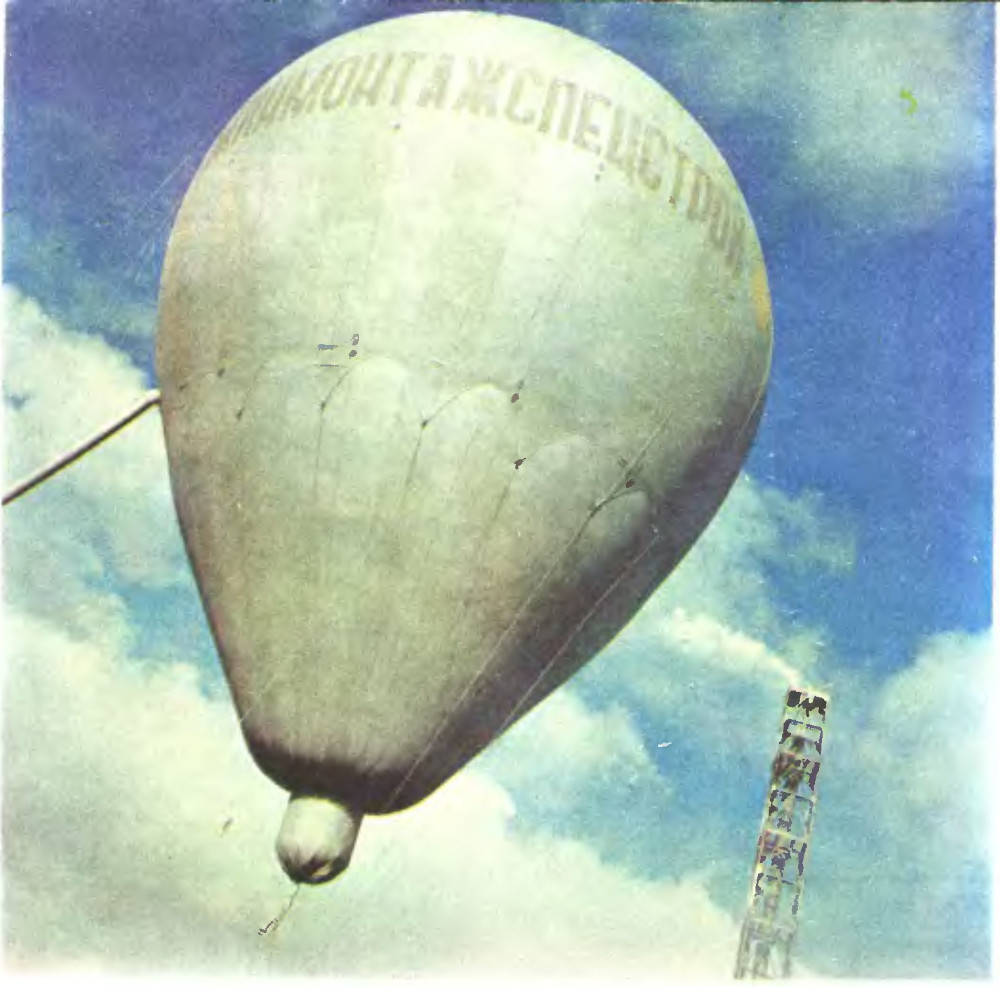
In the image above: EPAK-1 looks impressive, as the diameter of the aerocrane is 15 meters.