


"I owe you many new impressions, a wealth of information that cannot be found in books; the fact that I could enjoy complete freedom, forgetting about heavy concerns, new countries and places little known to me, people whom I understood better because I saw them up close..."
With these words, the French writer O. Mirbeau addresses the constructor of the machine that "has already brought about a revolution in social life" in his book "Journey by Automobile" (1907).
Mirbeau made one of the first long automobile journeys through European countries in a car of the “Charron” brand. And his book opened an endless series devoted to road rallies. So it became customary: every rally meant a book.
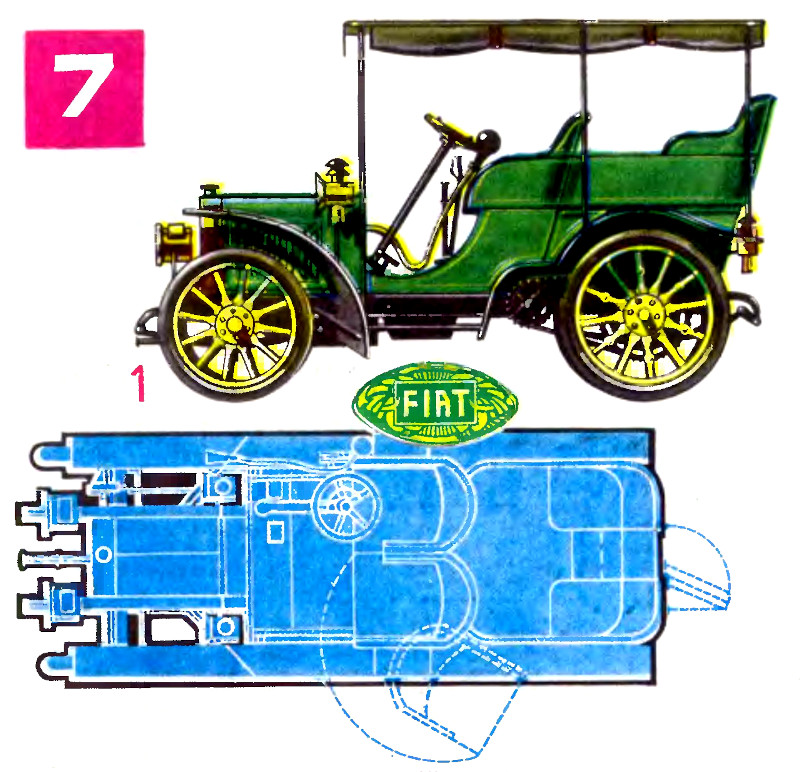 |
| 1. "Fiat" (Italy, 1902). 4–5-seat body; 4-cylinder engine, 12 hp, speed 70 km/h. The car successfully completed a run of 2141 km without breakdowns under the control of Giovanni Agnelli, the future director of the Fiat company. The diagram shows two versions of the swivel seats. |
Unfortunately, we know little about the “Charron”: too few materials have survived. But there is another, similar car from the same era that made long record-breaking journeys — the “Fiat.” Moreover, it has been established that this very car hides under the pseudonym “Lorraine-Dietrich” and the nickname “gnu antelope” in the novel "The Golden Calf". Anyone can imagine the appearance of the car based on the very precise “testimony” of the writers I. Ilf and E. Petrov. Large wheels (“Panikovsky leaned his back... against the wheel”), a “tonneau” type body without side doors (“...tumbled into the car like someone boarding a boat”), but with rear swivel seats-doors (“...Balaganov fell out...”). A high canopy (“...swaying like a funeral carriage...”); pale acetylene headlights, chain drive, pneumatic tires (“changed tubes and treads”). And so on, in all details. Adam Kozlevich supplied the car with a “Lorraine-Dietrich” badge, clearly trying to make it seem younger, since this brand appeared in 1910, when “tonneau” bodies were no longer produced.
Geographers, athletes, and journalists saw in the automobile not only a means of recreation and travel. “The greatest automobile race of all time,” “The mad motorists” — these books are dedicated to two historic long-distance races: Peking–Paris (1907) and New York–Paris (1908), which passed across all of Siberia and European Russia.
Light three- and four-wheeled cyclecars could not withstand the trials. Only the solid, uniform “Itala” and “Thomas-Flyer” cars successfully reached the finish line near the Eiffel Tower. The other vehicles fell behind.
The travelers crossed 1200 km of Mongolian steppes, navigating by the telegraph line. They had to refill the radiator with water at almost every well. Near the Russian border, the “Itala” sank into a bog up to its fuel tanks! A passing caravan rescued it.
To overcome soft ground, chains were put on the wheels. These chains also slowly cut into the wooden rims and spokes. Drying in the sun, the spokes began to wobble freely in their sockets. They were doused with water, but this helped only briefly. In Perm, one wheel was soaked in the bathhouse pool. Alas, the spokes again came out — this time irreversibly. A local cart-builder came to the rescue, making a new wheel that, according to the Italians, was even stronger than the original.
The “Itala” is now displayed in the largest automobile museum in Europe, in Turin. On the stand is a large photograph showing the moment the new wheel was accepted. Nearby stands the wheel itself — without which the race could not have been completed. This moment documents in automotive history the first collaboration between Italians and Russians — cooperation that continues to this day.
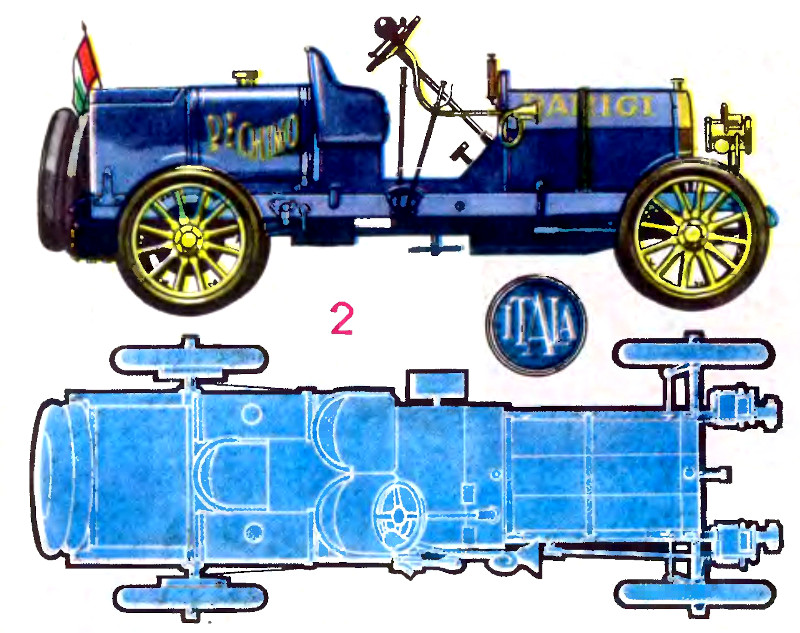 |
| 2. "Itala", model 29/50 (Italy, 1907). 4-cylinder engine, 50 hp, speed 75 km/h. |
The cheers for the winners of transcontinental rallies had already died down, the discussion about the advantages of automobiles over horses was finished, Ford was producing thousands of Model T cars on the assembly line. Yet Russian industrialists were still unsure about the need to start automobile production. True, by 1910 small-batch manufacturing had begun at the Russo-Baltic Wagon Factory.
The factory produced in seven years... 500 automobiles.
“Russo-Balts” participated in the 1911 rally from St. Petersburg to Sevastopol. Taking into account the poor roads and technical limitations, drivers carried spare springs, a dozen tires and tubes, a substantial tool kit, shovels, ropes, chains, buckets... Just before the trip, unreliable parts were removed from the cars — parts without which one could still drive, though with difficulty. Only a few segments of paved roads were found along the route. At every turn of the wheels, the drivers were met with ruts and potholes. Past Kharkov, the dirt road disappeared into deep sand all the way to Crimea. Springs, steering rods, and frames broke...
In this rally, the “Russo-Balt” won the first prize in its class. The car also successfully performed in European star rallies in 1912–1913 (first prizes for route length and endurance). It became the first car to reach the top of Mount Vesuvius under its own power, and later made a journey to North Africa (“In Pursuit of the Sun”), where it had to ford rivers, cross swamps, and drive through loose sand.
After the major sporting rallies of the early century came a lull. They were replaced by regularity rallies. Only in 1927–1929 was there a round-the-world journey in the “Adler” (“By Automobile Across Two Worlds”) and several scientific auto-expeditions, which also became material for books. In 1933, the famous run across the Karakum desert using Soviet-made cars was conducted — we will devote one of our historical series articles to it. Finally, not so long ago, in 1968, the old tradition revived in the London–Sydney marathon (16,000 km in 13 days) and the even grander Olympic marathon of 1970 — London–Mexico City (26,000 km in 400 hours of driving). In the first race, less than half the participants reached the finish line, but the “Moskvich” team arrived in Sydney in full. In the London–Mexico race, the Moskvich-412 cars took third place in the team standings.
Long ago, newspapers called the “Itala” and “Thomas-Flyer” rallies “a test of the automobile as such.” They were right. These rallies convincingly demonstrated what an automobile could do and helped identify weaknesses in its design. This significance of major long-distance rallies — as well as their sporting and promotional value — has not been lost even today.
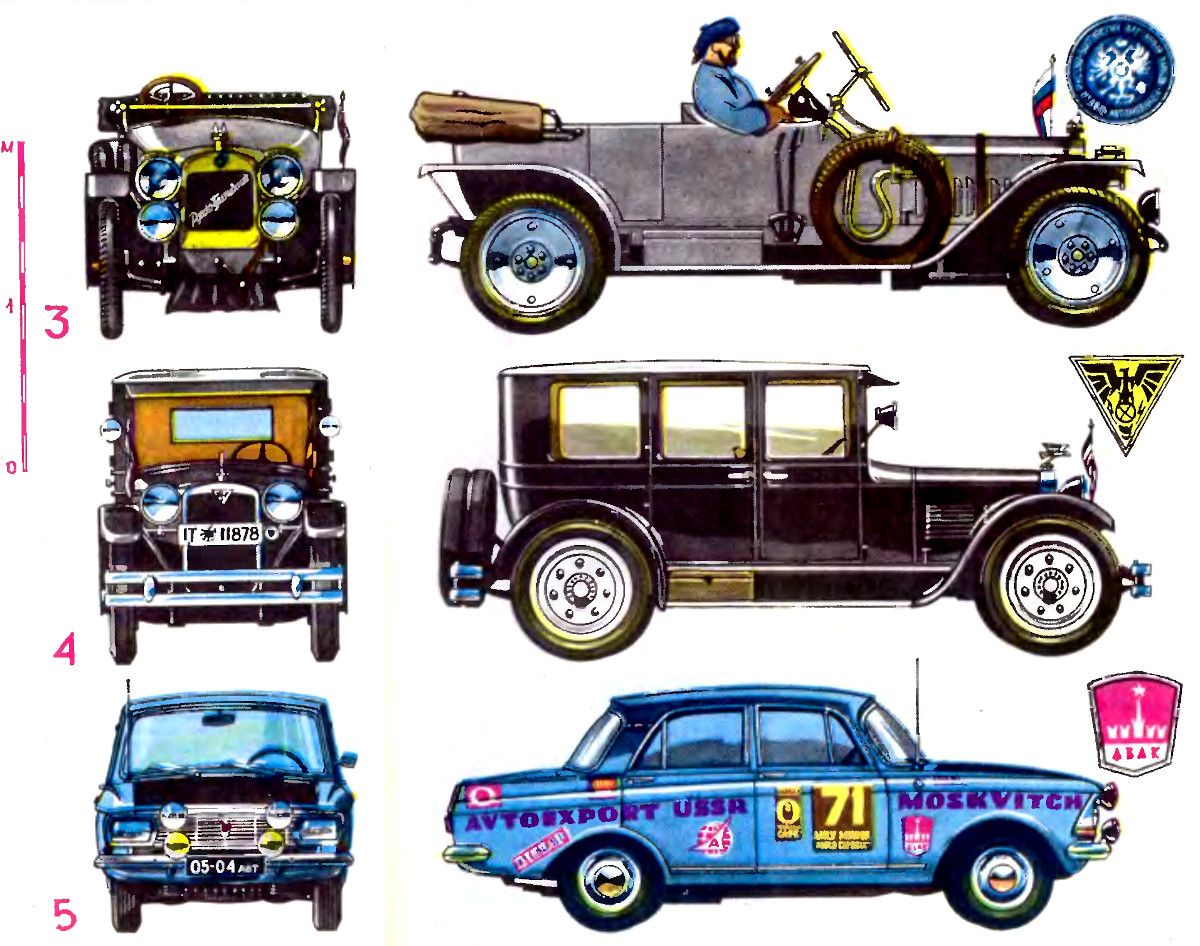 |
| 3. "Russo-Balt", model C (Russia, 1910). 5–7-seat “double-phaeton” body, 4-cylinder engine, 40 hp, speed 90 km/h. 4. "Adler", model “Standard-6” (Germany, 1927). 5-seat body type “limousine with internal control” (modern term: sedan); 6-cylinder engine, 60 hp, speed 100 km/h. 5. "Moskvich", model 412 (USSR, 1969–1972). 5-seat sedan body, 4-cylinder engine, 75 hp, speed 140 km/h. |