


"A new and undoubtedly very promising chapter has begun in the history of dynamic aeronautics: a new type of aeroplane — the hydro-aeroplane — has proven its viability and entered the path of development",
wrote in 1912 the Paris correspondent of the Russian journal "Aeronautical Engineering". The reason for such a conclusion was the contest of seaplanes in Monaco.
 |
| 12. Racing aircraft “Packard-Williams-Kirkham X” (USA, 1927). Engine: Packard X-24, 1250 hp. Wingspan — 9.10 m (upper wing); 7.40 m (lower wing). Wing area — 20.0 m². Takeoff weight — 2084 kg. Empty weight — 1810 kg. Maximum speed — 446 km/h. |
Among dozens of announcements establishing prizes for competitions in duration, altitude, and speed, the notice about the cup and cash award of Jacques Schneider — a wealthy sportsman and relative of the founder of the well-known “Schneider–Creusot” concern — went almost unnoticed. Nevertheless, it was precisely these competitions that largely determined the development of aviation technology between the two world wars. After all, in the pursuit of speed, the leaders were the swift seaplanes using the smooth surface of the water as their airfield.
The prize was promised to the country that would win the annual seaplane speed competitions at least three times in a row. The Schneider races were held for the first time on April 6, 1913, in Monaco. Only two machines — the “Déperdussin” and “Nieuport” monoplanes, both of French manufacture — took to the air. Victory went to Prévost, who had already taken first place many times in various competitions with the land version of his aeroplane. The float “Déperdussin” flew 28 ten-kilometre laps at a speed of 96.5 km/h. A year later, the Monaco waterfront again gathered crowds of spectators.
It was the English who initiated a new trend in world aircraft construction — they brought to Monaco a machine specially designed for speed racing. The other aircraft were slightly modified military machines. The “Sopwith” achieved a convincing victory, demonstrating an average speed of 139.7 km/h. Several months later, when World War I began, the winning aircraft became the basis for an entire family of famous Royal Air Force fighters.
In 1919–1922, in the Schneider races, now held not in Monaco but near other cities of the world, single-seat naval fighters with boosted engines took part. The speed of the aircraft did not exceed 236 km/h. Additional power was obtained by increasing compression ratio and engine revolutions. In 1923, racing aircraft with super-powerful engines, designed specifically for competitions, appeared. These machines were also distinguished by excellent aerodynamics.
|
| 13. Racing aircraft “Supermarine S-6B” (UK, 1931). Engine: Rolls-Royce R, 2600 hp. Wingspan — 9.15 m. Wing area — 13.5 m². Takeoff weight — 2400 kg. Empty weight — 2070 kg. Maximum speed — 658 km/h. On this aircraft, on December 30, 1931, a world speed record over a 3-km course was set. |
The 1926 races ended with an unexpected victory for Italy (396.6 km/h) and showed how much depends on the pilot’s skill and his training to handle racing machines.
The British immediately organized a training squadron for high-speed flights. Its sole task was to train pilots and test aircraft for the Schneider competitions. As in Italy, the pilots were recruited from the military air force.
Both countries spent enormous sums on building machines, engines, and preparing for the competitions. Fortune smiled upon the British team — in the 1927 races, pilot Webster showed an average speed of 453 km/h in the “Supermarine S-5”. His achievement surpassed the world speed record for land planes.
Success in the 1927 competition was only a step toward the Schneider Cup. Britain still had to prove its superiority two more times in a row. Preparing for the 11th race, the chief designer of Supermarine, R. Mitchell, developed a new machine — the S-6. Only an engine was lacking whose power and compactness would match the aerodynamic perfection of the aircraft.
Seven months before the start, the firm finally received financial support from the Air Ministry and accepted the offer of engine designer Royce to modernize the “Buzzard” engine and install it on the S-6. Thus the famous Rolls-Royce R appeared. Special fuel and a sophisticated supercharging system increased the output of the original engine to 1950 hp. On September 7, 1929, flying the course at 529 km/h, the Englishman Waghorn took the victory.
The 1931 Schneider races looked unusual. Only English machines participated — the swift seaplanes S-6B with gigantic floats. The Rolls-Royce (2600 hp) held out; the pilot flawlessly completed 5 laps of the 350-km course, and his achievement — a speed of 547 km/h — crowned the last, twelfth competition for the Schneider Prize. In the many-year rivalry among pilots, engineers, and scientists of the leading aviation powers, the British triumphed.
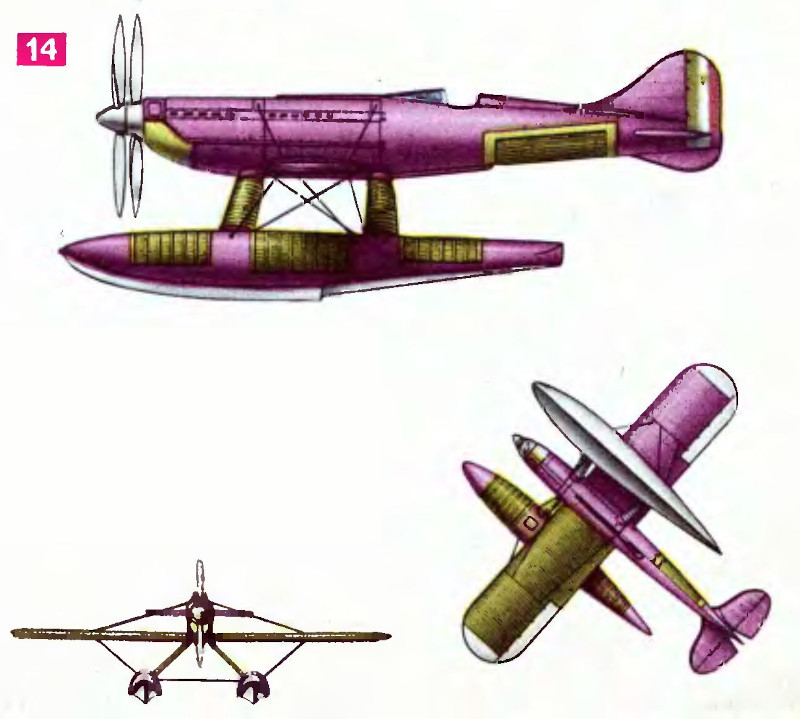 |
| 14. Racing aircraft “Macchi M.C.72”. Engine: Fiat AS-6, 24-cylinder, paired, 2650 hp. Wingspan — 9.6 m. Wing area — 15 m². Takeoff weight — 3028 kg. Empty weight — 2500 kg. Equipped in 1933 with a 2800-hp engine, this aircraft was used by Italian pilot Angelo to set, on October 23, 1934, the absolute world speed record (709.21 km/h), which stood until 1939. |
The reason for the high speed of racing seaplanes is their water landing. The smooth water surface allows them to land at a higher speed than on dirt or concrete runways. This remarkable property of hydro-aerodromes makes the contradiction between maximum flight speed and landing speed less severe — a problem that has always been difficult for designers. Seeking high speed for a land plane, they reduced wing area to decrease aerodynamic drag, but at the same time they always had to remember: the aircraft must land safely, and this requires a sufficiently large lifting surface.
Thus, the wings of racing seaplanes turned out to be of smaller area and therefore of lower drag. Even the gigantic floats — which simultaneously acted as radiators for cooling the engine water — did not worsen the aerodynamics enough for a land racing plane with relatively small landing gear to surpass them. The perfection of combat aircraft in the early 1940s was in many ways prepared by the intense sporting competitions. Not only the desire to win motivated the designers.
The ambitions of the aviation nations extended beyond winning the Schneider Cup. Success in a future war was at stake. The Italians sought revenge even after the triumph of the British team. On the “Macchi M.C.72”, which Italy had not managed to prepare for the decisive race, pilot Angelo set in 1934 the absolute world speed record.
The “Schneider-type” racing aircraft — powerful engine, perfect aerodynamics, sleek fuselage lines — continued to be developed in Britain as well. It is no coincidence that Supermarine designer Reginald Mitchell later created the famous “Spitfire” fighter.
At the core of the “Spitfire” lay the S-6B aircraft, which put an end to the 24-year Schneider marathon and was a decade ahead of its time.
Frontispiece:Racing aircraft “Macchi M.39” (Italy, 1926). Engine — Fiat AS-II, 800 hp. Wingspan — 9.26 m. Wing area — 14.5 m². Takeoff weight — 1610 kg. Empty weight — 1300 kg. Maximum speed — 396 km/h. This aircraft brought victory to the Italian team in the 1926 races.