


At the end of 1918, not far from Paris, where the Seine makes a bend reminiscent of the river’s curve in the French capital, a grand construction project unfolded.
Workers and soldiers were laying railway lines, erecting wooden structures, and painting the ground. Electricians fussed over some sparking mechanisms and installed lamps with a dim flickering light. A few more weeks — and next to the camouflaged, hidden Paris there would have risen a fake city, giving itself away by tram sparks and the seemingly dimmed lights of factories and stations. The armistice put an end to this hoax, by which the French intended to mislead German aviation pilots and save Paris from systematic raids by bombers.
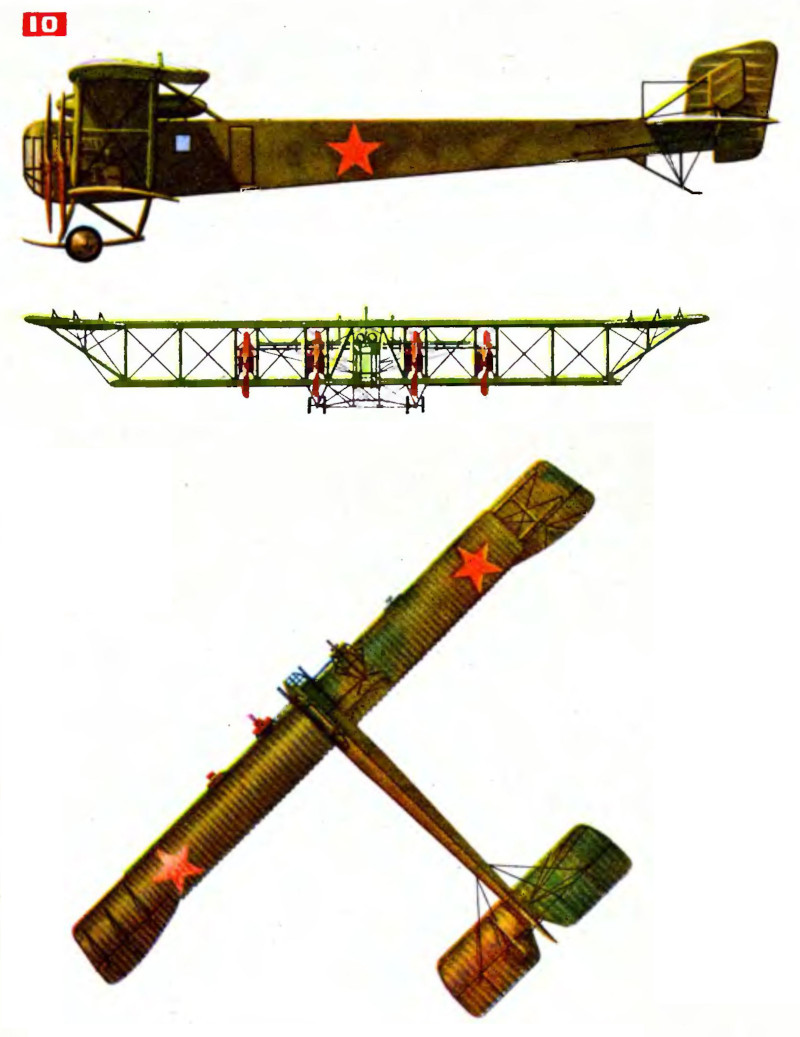 |
| 10. “Ilya Muromets”, series B (Russia, 1914). Crew — 4. Engines — “Argus” (2 x 140 hp and 2 x 125 hp). Takeoff weight — 4,400 kg. Wingspan — 29.8 m (upper wing), 21.0 m (lower). Length — 17.10 m. Wing area — 125 m². Total load — 1,500 kg. Maximum speed — 120 km/h. Armament — 3 machine guns, 500 kg of bombs. During the Civil War, Ilya Muromets aircraft were widely used in Red Army aviation units in battles against the Whites. In 1922, V. I. Lenin was enrolled as an honorary sailor of the “Ilya Muromets” airship squadron. |
However young combat aviation was, it had already become a formidable force: not only infantry and cavalry but entire cities feared it. And to turn into a never-before-seen means of delivering explosive shells hundreds of kilometers from the front line, airplanes had to become large and multi-engined. The progenitor of such aircraft was the “Russian Knight” by Igor Ivanovich Sikorsky...
Many designers attempted to build large multi-seat airplanes. Prejudice stood in the way, reinforced by the calculations of respected scholars and the warnings of practitioners. For example, the English scientist Lanchester published an aerodynamic study in which he argued that airplanes had already reached their maximum size and that further growth would render them unable to fly.
The largest airplane of those years weighed a ton. The “Knight” was four times heavier. Sikorsky knew perfectly well from his own experience what the scale effect was. His helicopter models flew excellently, but a full-size helicopter never got off the ground. “Intuition played a great role,” Sikorsky recalled 60 years later. “I made the wings of the ‘Knight’ with a very large span.”
With the same lift, a long wing has much less aerodynamic drag than a short one. Recall the outstretched wings of gliders or the famous ANT-25, on which Chkalov’s crew made a flight over the North Pole. In Sikorsky’s time, this was not known. Without pondering aerodynamic subtleties, Santos-Dumont cheerfully flew his squat, short-winged “Demoiselle.” The Russian designer conceived of turning the uncomfortable airplane into a machine with an enclosed, spacious cabin.
On May 13, 1913, with complete disregard for superstition, Sikorsky lifted a giant four-engined airplane into the air. In its very first flight, Sikorsky proved the skeptics wrong: the airplane flew excellently even on three engines. The foresight of the designer who equipped the machine with a long tail boom of the fuselage and four huge fins made itself felt. The “Russian Knight” completed 53 successful flights, setting in one of them a world endurance record — 1 h 54 min. Disaster awaited it... on the ground.
On the day when Sikorsky was preparing the machine for another flight, the famous pilot and aerobatics master Haber-Vlynsky took off. A few seconds before landing, the engine of his aircraft broke off (such things happened in those days!) and struck the “Knight” directly. Sikorsky did not waste time on the badly damaged airplane and began building a new, long-planned one. It was this aircraft — the “Ilya Muromets” — that was destined, in combat conditions, to realize the advantages of heavy multi-engined machines that began with the “Russian Knight.”
At first the squadron carried out reconnaissance operations, and then the machines, equipped with new sights, bomb racks, and bomb releases, turned into heavy bombers with very high flight-tactical qualities. The squadron became the world’s first formation of combat aircraft of this type.
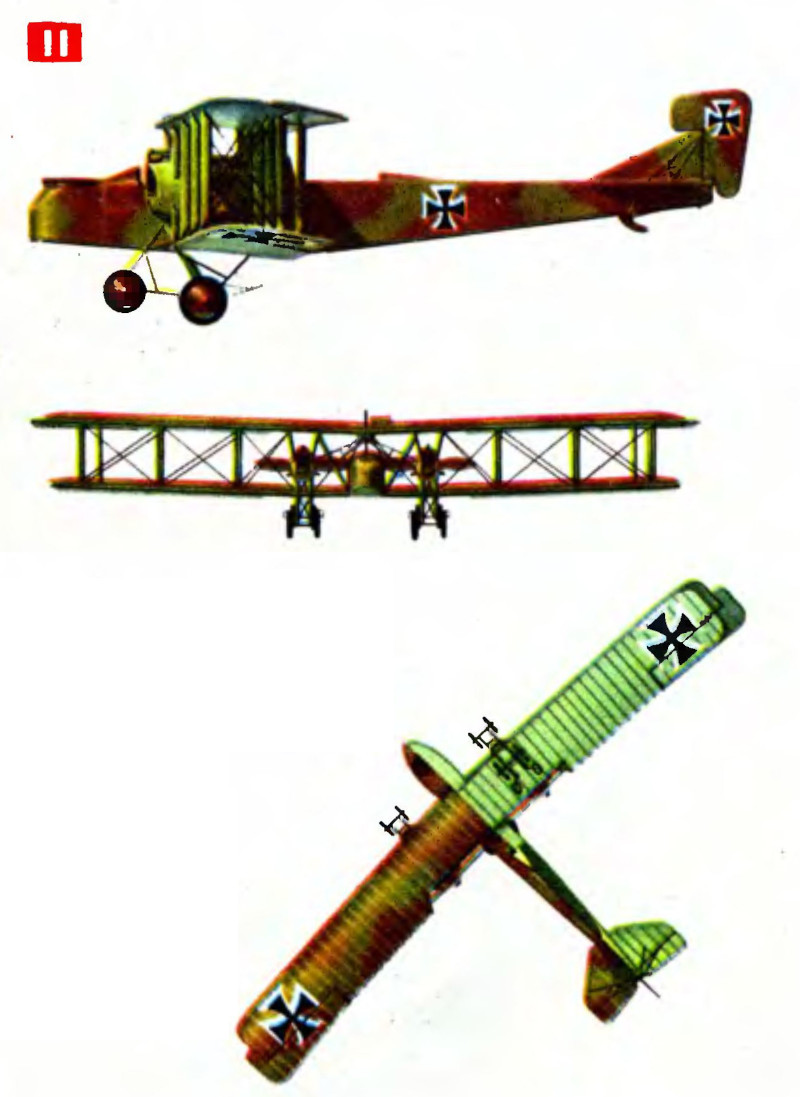 |
| 11. “Gotha G-IV” (Germany, 1916). Crew — 3. Engines — 2 × “Daimler-Mercedes D-IVa” at 260 hp each. Takeoff weight — 3,635 kg. Wingspan — 23.71 m (upper wing), 21.90 m (lower). Length — 12.36 m. Wing area — 89.5 m². Useful load — 734 kg. Maximum speed — 135 km/h. Maximum range — 700 km. Armament — 3 machine-gun mounts, 300 kg of bombs. |
Having become a bomber, the “Ilya Muromets” bristled with an entire battery of machine-gun mounts. Its defensive armament provided spherical coverage. The crew and the aircraft’s fuel tanks were protected by armor. Combined with the all-around action of its armament, the armor protection made the machine a very difficult target for enemy fighters and anti-aircraft guns. There were cases when the “Muromets” acted as a ground-attack aircraft and itself suppressed anti-aircraft batteries.
The basis of Germany’s heavy aviation consisted of relatively small twin-engined Gotha bombers.
Born of the First World War, heavy bomber aviation did not have time to fully demonstrate its power: fighter aviation, anti-aircraft artillery, and skillful camouflage greatly complicated bomber raids on major targets. Nevertheless, the “bombers” forced strategists to reckon with a new formidable weapon that even then promised to become an omnipresent means of attack.
Frontispiece: “Handley Page O/400” (England, 1917). Crew — 3. Engines — 2 × “Rolls-Royce Eagle VII” at 275 hp each. Takeoff weight — 6,375 kg. Wingspan — 30.50 m. Length — 18.90 m. Wing area — 153 m². Useful load — 2,525 kg. Maximum speed — 155 km/h. Armament — 2 twin machine guns, 820 kg of bombs.