


The American writer D. Runyon once called the automatic pistol an “equalizer of chances,” meaning that a person who possesses such a weapon and knows how to use it will almost certainly emerge victorious from a fight. One only has to manage to draw the pistol in time and send the bullet to its target without missing. In the worst case, a miss can be corrected with a second shot…
The first attempts to create rapid-fire weapons date back to the 15th–17th centuries. The State Hermitage Museum houses a four-barreled hand gun 755 mm long, made by Western European craftsmen in the second half of the 15th century. All its barrels are set into a wooden block tightened with iron hoops. In the breech part of the barrels, touch holes were drilled—to these the shooter would alternately apply a smoldering match in order to fire four shots with minimal intervals.
Of course, calling such a hand gun rapid-fire is something of a stretch; nevertheless, it was precisely such systems that gave rise to a large family of various multi-barreled weapons created for infantrymen over nearly two centuries.
From the 16th century onward, after the wheel lock had been invented, gunsmiths began to equip multi-barreled weapons with it as well. At first, the barrels were mounted one above another, and the locks, operating independently of each other, were likewise arranged in two tiers. The barrels were also laid horizontally on the stock; in this case, the locks were attached to the right and left of them.
Military historians are also familiar with a double-barreled gun with a two-tier priming pan equipped with a special partition. A single lock would first ignite the main charge in the upper barrel; a shot followed, then the soldier moved a shutter to open the other pan, cocked the lock again, and fired from the lower barrel.
A very ingenious technical solution was employed by Dutch craftsmen in 1710–1720. They produced pistols with seven barrels of different lengths. The central barrel reached 217 mm, while the others ranged from 190 to 214 mm. The main feature of these pistols was their elaborate ignition system. When fired, the spark struck by the flintlock ignited the powder charge in the right barrel; then the fire ran along a special channel to the touch hole of the central barrel, and then—almost instantly—to the remaining ones. Thus, the shooter discharged a volley of seven bullets.
True, reloading the Dutch “wonder weapon” took seven times longer than reloading a conventional pistol, and the design itself was far from simple; nevertheless, it could still be regarded as an “equalizer of chances.”
No less complex was the so-called “wender” system. It consisted of two or more barrels mounted on a polygonal (according to the number of barrels) plate. Inside it was a steel axle, one end of which fitted into a narrow slot in the stock that held the lock. After each shot, the plate had to be rotated, bringing the next loaded barrel up to the lock.
The “wender” weapon had plenty of shortcomings, the main one being that over time the axle and the socket in the stock loosened, and the barrels ceased to align properly with the lock. Nevertheless, relatively rapid-firing and convenient “wenders” were produced for quite a long time in Holland, France, the German principalities, and Russia. In particular, the craftsmen of the Armory Chamber of the Moscow Kremlin made many such guns, known as “rotating” ones.
One of the masters, Pervusha Isaev, in the first half of the 17th century devised his own version of a rotating weapon by placing the bullets and powder charge in a rotating cylinder. Thus appeared the first examples of the ancestors of revolvers and, more broadly, breech-loading weapons.
Let us recall that Russian craftsmen also produced arquebuses whose breech sections accepted a chamber containing the bullet and powder, with the chamber itself held quite securely by a transverse wedge. In a number of countries, rifles and pistols were made with vertical, screw-type breeches, which soldiers unscrewed during reloading and lowered so that a bullet and the main charge could be inserted into the barrel. In the Armory Chamber of the Moscow Kremlin one can see a pair of superbly finished hunting rifles with such breeches, made in 1740–1760 in Karlsbad (now Karlovy Vary) by the renowned gunsmith Johann Adam Kondt.
However, the problem of rate of fire was addressed not only by increasing the number of barrels and locks. At the beginning of the 17th century, the first multi-charge rifles also appeared. In their barrels, from six to ten touch holes were drilled. Initially, the shooter applied the match (or shifted the wheel or flintlock) to the hole closest to the muzzle; after the shot, he moved it back to the next charge. Such weapons proved far from safe for the shooter himself. At times, burning particles of powder ignited not one but several charges at once, causing the barrel to burst. Therefore, soldiers had to carefully measure powder charges, compact them, and reliably separate one from another. Only then did the smoothbore multi-charge rifle operate reliably and discharge bullets much like a modern automatic rifle.
There has also survived to our day an example of a single-barrel rifle loaded with three bullets. Before firing, the right lock was cocked first; then, after the shot, a shutter on it was closed, opening another touch hole, another bullet was fired, and the left lock was brought into action to make the third shot.
As we can see, the improvement of handheld firearms proceeded along different paths, but often masters, working by trial and error, arrived at similar technical solutions. Thus, almost simultaneously, similar rifles with separated ammunition supplies appeared in a number of European countries. The ammunition was arranged in various ways: some gunsmiths embedded magazines for bullets and powder in the stock, while others preferred to mount them alongside the barrels.
In particular, the Armory Chamber of the Moscow Kremlin houses a piece made by Caspar Kalthoff in Moscow in 1665. Kalthoff placed two tubes in the stock: the upper one was intended to hold 15 bullets stacked one after another, and the lower one powder charges. Before firing, it was necessary to move the trigger guard located under the breech forward and to the right. In this way, a bullet and powder were fed into the barrel, the hammer was cocked, and powder from a special magazine was sprinkled onto the priming pan. Why not an automatic weapon?
It should be noted that the very first attempts to manufacture rapid-fire handheld weapons date to the era of the first industrial revolution. It was then that mechanisms were developed which later became widespread in the 19th century, naturally at a different technical level.
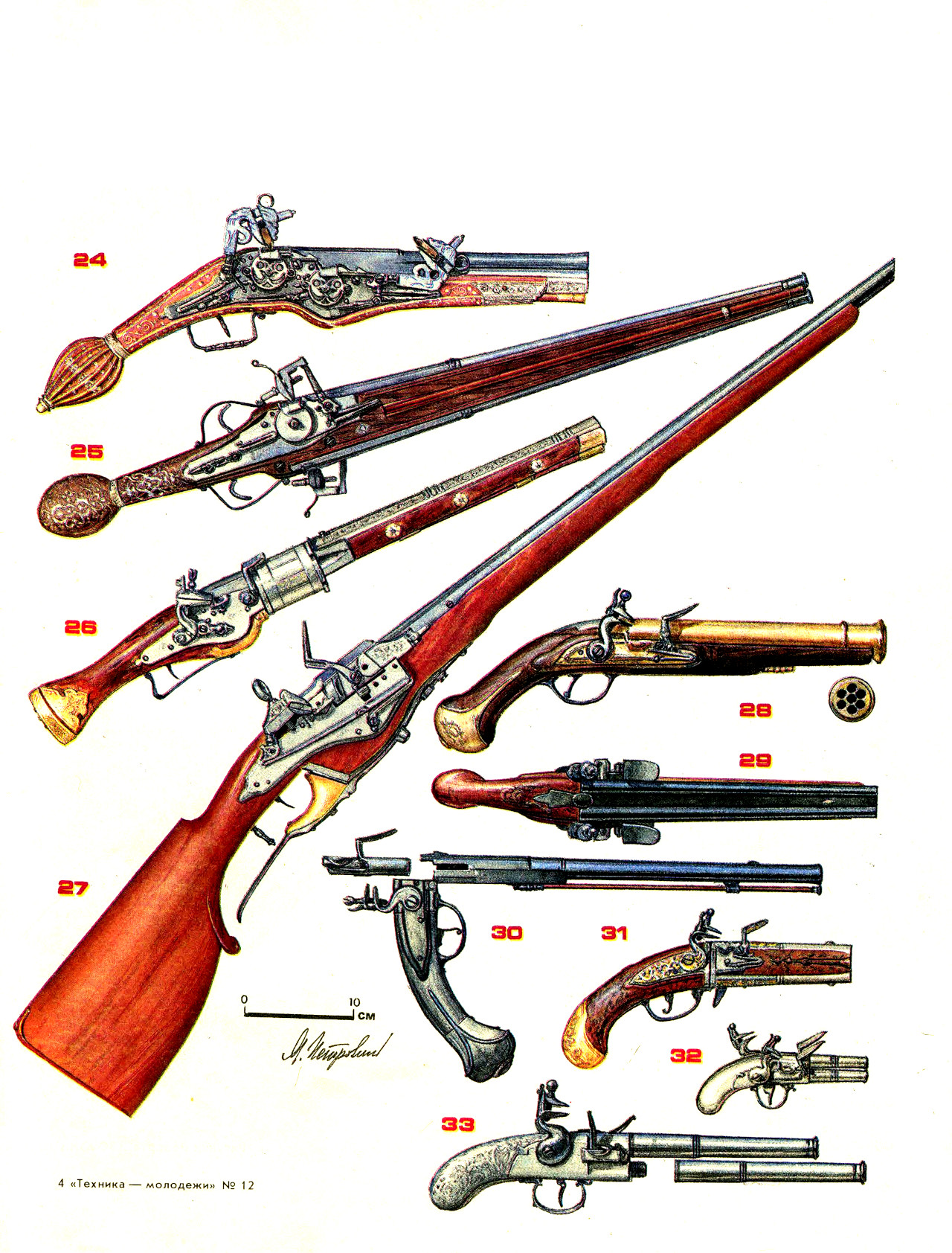
24. Double-barreled saddle pistol with a double wheel lock. Pistol length—511 mm, barrel length 308 mm, caliber 10.3 mm. Germany, 1590–1600.
25. Double-barreled saddle pistol with a wheel lock. Pistol length—730 mm, barrel length 497 mm, caliber 8.6 mm. Germany, 1610–1620 (side view).
26. Pistol with a revolver cylinder. Made by the master P. Isaev in the 17th century. Pistol length 577 mm, barrel length—292 mm, caliber 11 mm.
27. Magazine rifle with a flintlock, made in Moscow by C. Kalthoff in 1665. Rifle length—1175 mm, barrel length—720 mm, caliber 12 mm.
28. Dutch seven-barreled pistol of 1710–1720. Pistol length 406 mm, barrel length 235 mm, caliber—8.3 mm.
29. French breech-loading, double-barreled pistol of 1750–1760. Pistol length 398 mm, barrel length—244 mm, caliber 14 mm (top view).
30. Western European breech-loading pistol with interchangeable chambers. Pistol length 544 mm, barrel length—355 mm, caliber 15.4 mm. 1710–1720.
31. Russian double-barreled pistol with rotating barrels. Pistol length—265 mm, barrel length 116 mm, caliber 11 mm, mid-18th century.
32. Russian pistol of 1757 with vertically arranged barrels. Pistol length—155 mm, barrel length 80 mm, caliber—7 mm.
33. Belgian double-barreled, breech-loading pistol, 1740–1750. Pistol length—348 mm, length of screw-out barrels—170 mm, caliber—12.9 mm.