


The next step in the development of handheld firearms was the creation in the second half of the 16th century of a new system for igniting the charge. We are talking about the flintlock.
Unlike the earlier wheel-lock, in which fire was produced by the contact of flint with a rotating (spring-driven) wheel, in the flintlock sparks were produced by the impact of flint against a steel frizzen. This lock was simpler and more reliable than the wheel-lock.
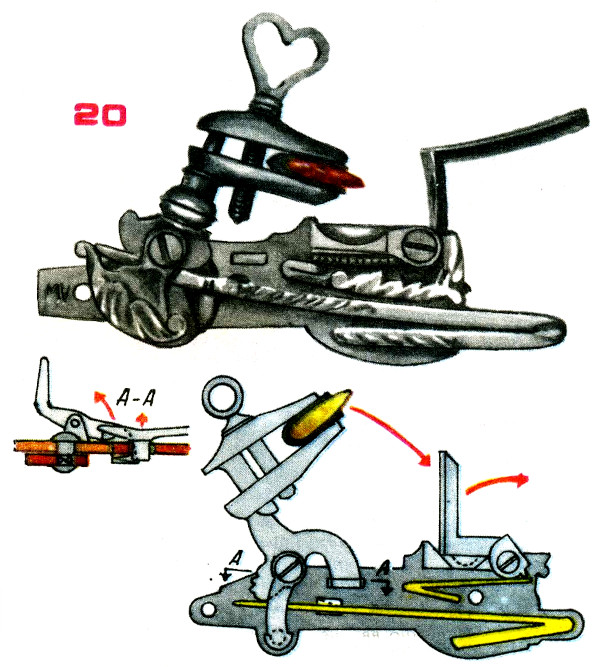 |
| 20. Flintlock of the Spanish type. 17th century. |
According to some researchers, the flintlock was developed by Spanish or Portuguese gunsmiths — specifically Simon Macquarte, who worked in the workshops at the court of King Charles V of Spain in the 1560s. Others maintain that the flintlock was invented in the same years by German craftsmen.
However, these assumptions have been refuted by more recent data. The oldest surviving flintlock was, it has been established, made in Sweden in the 1550s. Comparatively recently, a decree of the city authorities of Florence dated 1547 was discovered — townspeople were forbidden to appear in the streets with firearms, in particular flintlocks.
Most likely, similar mechanisms were invented independently by different gunsmiths, and they quickly spread throughout Europe. Dutch, Spanish, Russian, Karelian, Mediterranean, Baltic, Swedish and other types of flintlocks and their variants are known, differing in the arrangement of parts, shape, finish and the interaction principles of certain components.
For example, in the Russian type of flintlock some parts — the cock, the priming pan cover, the mainspring and the bridle spring — were located on the outer side of the lockplate.
The flint was clamped in the jaws, the upper jaw being adjustable and equipped with a ring by which the cock was set to the full-cock position. The trigger mechanism was on the inner side of the lockplate and consisted of a straight spring with a sear and a trigger pull. When the shooter pulled the trigger, the sear dropped and the flint struck the frizzen. In another variant, instead of separate mainspring and bridle spring a single two-lobed spring was used.
In northern Europe the Karelian type of lock, close to the Baltic and Swedish types, became widespread, featuring a characteristic shape of the cock. At first the mainspring was placed on the outer side of the lock, then on the inner side.
In the Dutch type of lock the springs were located on the inner side of the lockplate, which protected them from dirt and damage; the cock was shaped like the letter S. At the moment of firing the mainspring acted on the lower edge of the steel block (the “heel”) mounted on the cock’s axis, while a rod attached to the upper part pushed the lever of the priming-pan cover, causing it to open automatically.
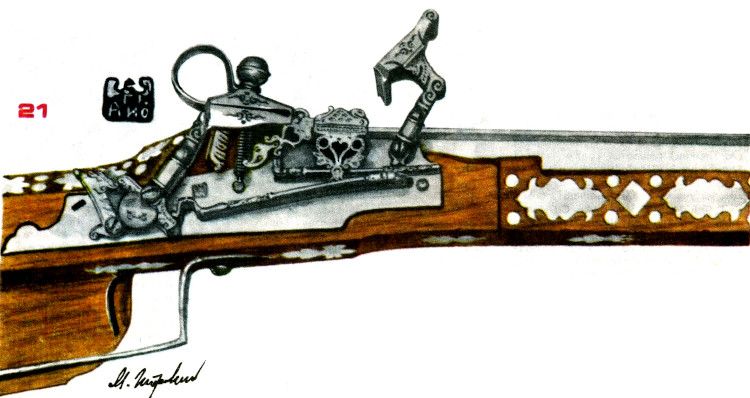 |
| 21. Flintlock of the Russian type, made by the master of the Armory of the Moscow Kremlin, Dementyev, in the 1670s. |
A feature of the Spanish-type lock was that the priming-pan cover was combined with the frizzen. When the flint struck it, the cover flipped up and the powder in the pan ignited, firing the main charge in the barrel through the priming touch-hole. When loading, the lock was set on safe.
At the beginning of the 17th century in France an improved variant of the lock appeared, credited to the royal gunsmith Marin le Bourge. He combined the sliding pan cover with the frizzen (this assembly was called the “battery”) and created a sear that moved not horizontally but vertically, which noticeably simplified the trigger action.
By the end of the century battery locks were produced in almost all European countries. At the same time so-called French stocks with an elongated neck gained popularity; with some modifications these have survived to the present day in rifles, submachine guns and hunting guns.
The next innovation that had a significant impact on the development of handheld firearms was the cartridge. Initially these were a waterproof-paper case containing powder and a round lead ball. For a time shooters made such cartridges themselves, following certain norms. For example, by decree of the French King Louis XV published in 1738, a cartridge case was to contain 9 g of powder and a bullet weighing 28 g. The size and shape of the paper and the procedure for making the cartridge case from it were similarly strictly regulated.
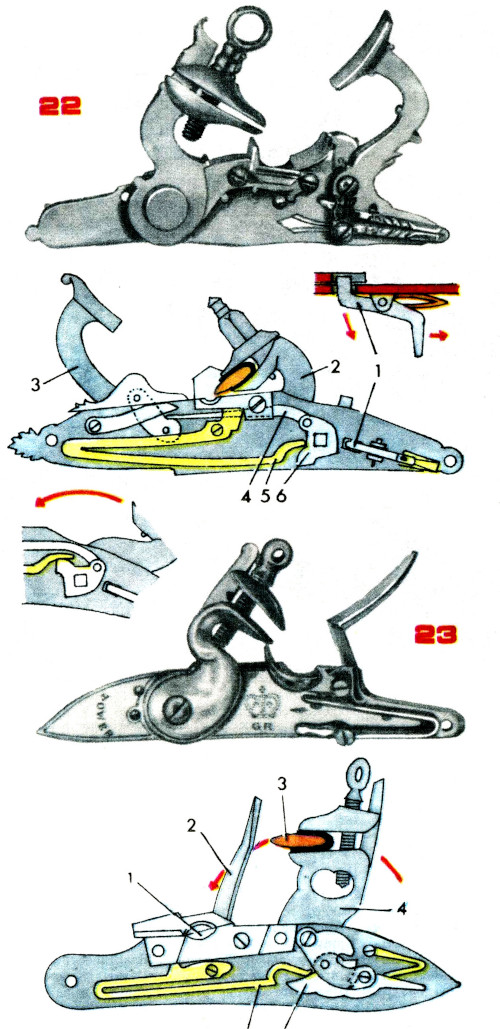 |
| 22. Dutch-type flintlock. 17th century: I — sear, 2 — cock, 3 — frizzen, 4 — rod, 5 — spring leaf, 6 — sear. 23. French-type flintlock, late 17th — early 18th century. So-called “battery”: 1 — pan, 2 — frizzen, 3 — flint, 4 — cock, 5 — sear, 6 — spring. |
Before firing the soldier bit off the lower edge of the cartridge, poured some powder into the priming pan and the rest into the barrel. He then dropped in the lead ball, the wad, rammed the charge with the ramrod and only after that cocked the lock.
Loading the earliest rifled weapons was much more difficult, because it was necessary to force a bullet slightly larger than the bore down the barrel. Shooters used a wooden mallet, and later bullets with a jacket of oiled linen, baize or leather were used, so as not to clog the rifling with lead particles. The loading process of a flintlock rifled pistol is vividly described by A. S. Pushkin in Eugene Onegin —
The pistols already glimmered.
The mallet raps on the ramrod.
Into the faceted barrel go the bullets,
And the cock clicked for the first time.
Now grayish powder
Pours onto the pan. Tooth-edged,
Tightly screwed-in flint
Is cocked...
What were the characteristics of flintlock arms? Domestic archives preserve data showing that in tests a 33 g bullet fired from an 18th-century musket charged with 11 g of black powder at a distance of 43 m penetrated 12 cuirasses and left substantial dents in five more. However, the rate of fire did not exceed one shot per minute...
Thus in battle a soldier had time to deliver two or three volleys at the attacking enemy, after which hand-to-hand combat began. It is no accident that in the 16th century musketeers were armed with daggers or knives with elongated handles which were inserted into the barrel. True, this turned the firearm into a cold weapon. Therefore, after some time a socket with a spring catch began to be installed near the muzzle, on the top or the side, which securely held the bayonet without interfering with firing. This system in general lasted until the beginning of the 20th century.
The flintlock guns themselves proved to be reliable. In 1806 the French tested examples made in 1777 that had already withstood a thousand shots each. One burst on the 14,443rd shot, another endured another 15,000 without damage.
However, flintlock weapons had serious drawbacks. We have already mentioned the low rate of fire; moreover, accuracy was unsatisfactory — a shooter of average skill hit the target at 100 paces with only half his shots. Misfires were common for infantry. Austrian weapons produced a misfire every 62nd shot, Russian — every 22nd, French — every 15th. And that was under range conditions. On campaign, in bad weather, or in strong wind, the infantryman could count only on the bayonet...