


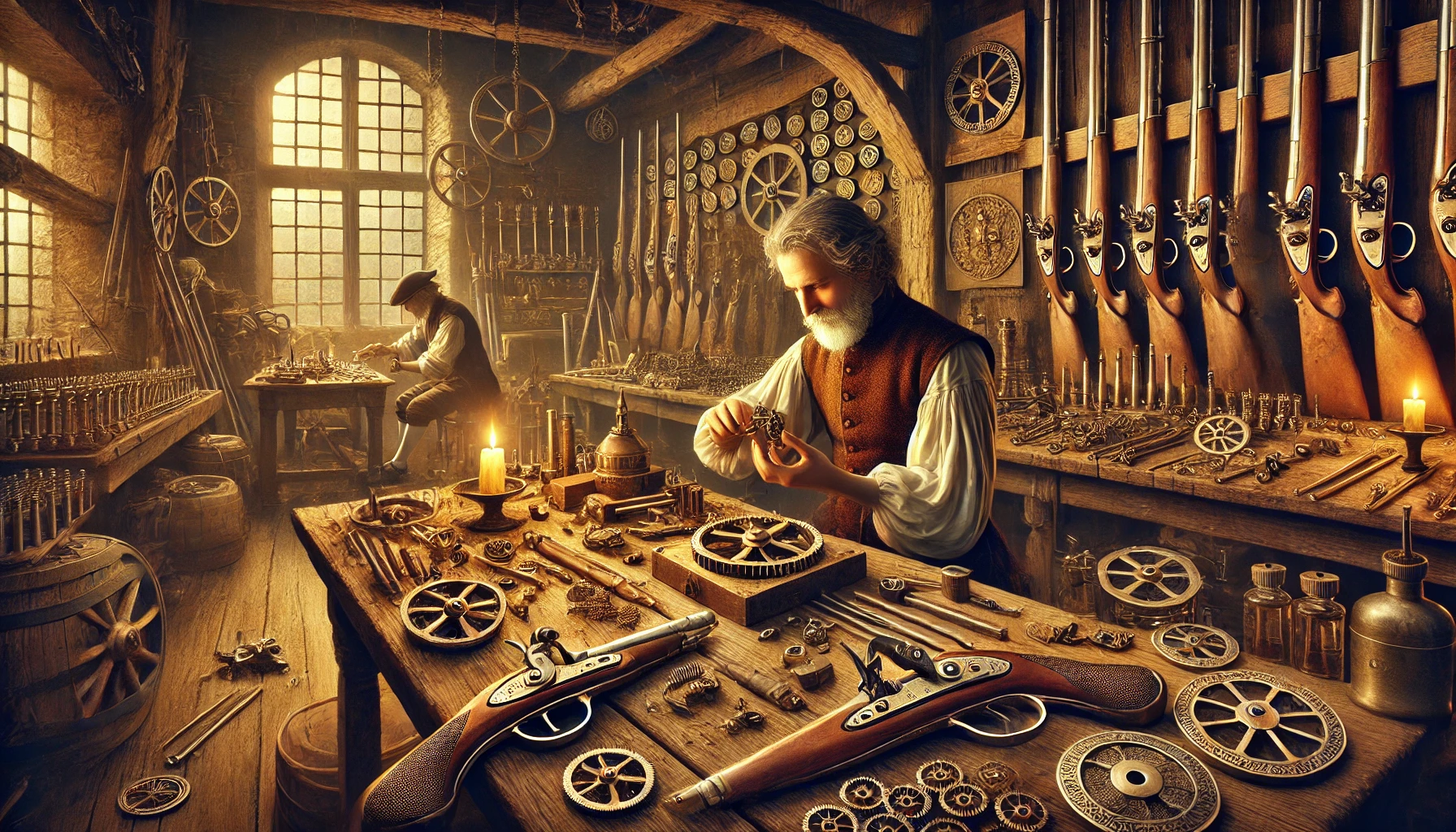
No matter how much gunsmiths tried to improve the matchlock, they could not achieve significant qualitative changes.
The match itself was an obstacle, as the shooter had to constantly keep it smoldering. But what could replace it to ignite the propellant charge in the barrel? Someone had a brilliant idea—to equip handheld firearms with flint and steel. The flintlock wheel (wheellock) mechanism marked a new era in the history of rifles and pistols.
Historians have debated for years about who exactly invented it. They agree on only one thing—the wheellock mechanism could not have been conceived without the availability of clockwork mechanisms, with their numerous wheels, springs, and winding keys.
Some researchers believe that the first wheellock was made by a clockmaker from Nuremberg, Johann Kiefuss, in 1517. However, no reliable historical records about this craftsman from the 16th century have yet been found.
Other historians argue that the inventor of the wheellock was Leonardo da Vinci. In the well-known collection "Codex Atlanticus," there is a drawing of such a mechanism, a schematic of a fire ignition device, and several sketches of chain transmission variants from a spring to the wheel's axis. It is possible that Leonardo refined an existing mechanism, or he may have indeed been its inventor.
The wheellock mechanism itself consisted of 35–50 parts. The most important of these was a steel wheel with serrations. Its axle was connected by a chain to a powerful mainspring. The shooter wound it with a special key, and when the trigger was pulled, the wheel spun, striking its serrations against the flint fixed on the priming pan. The resulting sparks ignited the priming powder, which then set off the main charge.
As the mechanism was refined, gunsmiths added a stop to hold the wheel in the cocked position and later devised a sliding cover for the priming pan. In the 17th century, a new lock design emerged, in which the main spring could be cocked not only with a key (which took time) but also by simply turning the hammer—achieved by introducing an additional linkage into the lock mechanism.
To improve shooting accuracy, in the second third of the 16th century, gunsmiths developed a set trigger, a device that simultaneously sped up and softened the trigger pull. Additionally, since the late 15th century, rifled barrels had begun to be produced, with straight rifling later giving way to spiral rifling in the following century.
Later, all the parts of the flintlock wheellock were relocated to the internal part of the lock plate.
Despite its complex mechanism, firearms with the new locks proved to be quite practical. First, the shooter wound the wheel with a key, then poured gunpowder (as in matchlock firearms) onto the priming pan and into the barrel, placing a bullet inside. After that, all that remained was to slide the pan cover shut and pull the trigger—now the weapon could be kept battle-ready for as long as needed. That is, until the gunpowder became damp...
The emergence of wheellock firearms had a significant impact on both tactics and customs. For example, rifles with such locks became indispensable for guard duty—a sentry could open fire on suspicious individuals at any moment, especially since wind and rain had little effect on the weapon. Cavalrymen particularly appreciated small rifle-pistols, which became a primary component of their armament by the mid-16th century. Early pistols also featured short barrels and heavy grips ending in rounded pommels. Later, gunsmiths lengthened pistol barrels while striving to make them as lightweight as possible.
Swedish King Gustavus Adolphus, having adopted such rifle-pistols into service, ordered his cavalrymen to first fire at a unit of pikemen from a distance “when the whites of the enemy's eyes could be seen” before engaging in melee combat.
Among city dwellers, wheellock firearms caused alarm. Small, short-barreled pistols (most importantly, always ready for action) were easy to conceal in clothing. They struck from a distance, quickly replacing the swords commonly used in the 15th–16th centuries and beginning to compete with rapiers and daggers. It is no coincidence that in Hamburg and several Italian cities, laws were passed banning the carrying of this “devilish weapon” without special permission, with severe punishment for violators—“public amputation of the hand.”
The wheellock flintlock mechanism also gained widespread use in hunting firearms, which were valued not only for their combat capabilities but also for their decoration. The large surface area of the lock plate and hammer allowed artisans to embellish them with engravings, intricate compositions featuring human figures, animals, landscapes, and genre scenes from hunters' lives.
Many gunsmiths were masters of engraving, etching, carving, inlay, damascening, and gilding, often transforming rifles and pistols into true works of art.
A considerable number of wheellock firearms have survived to this day. For example, a wheellock arquebus is on display at the State Armoury Chamber of the Moscow Kremlin. The date of manufacture—1588—is clearly visible on its lock and barrel (notably, the earliest dated firearm in the museum). The lock also bears the mark of a Saxon gunsmith— the letters SK.
By the way, it was in the 16th century that gunsmiths began regularly marking their products not only with personal stamps and their names but also with municipal proof marks on the barrels. Typically, the signature on the lock or barrel belonged to the person who assembled the rifle or pistol from pre-made parts. However, the true gunsmith was the specialist responsible for crafting the lock, barrel, and stock.
Creating a complex wheellock flintlock mechanism, consisting of dozens of parts, was no easy task, making mass production impossible. Only select infantry units in Western European armies could afford the luxury of such weapons. The difficulties in manufacturing wheellock mechanisms, as well as repairing them in field conditions, meant that even in the 16th century, matchlock muskets remained the primary firearms of soldiers. Nevertheless, wheellock arquebuses, carbines, and pistols were successfully used up until the 18th century, and their hunting versions continued to be produced even at the end of that century.
Article by — Head of the Sector of the State Museums of the Moscow Kremlin, Elena Tikhomirova.
Illustrator — Mikhail Petrovsky.
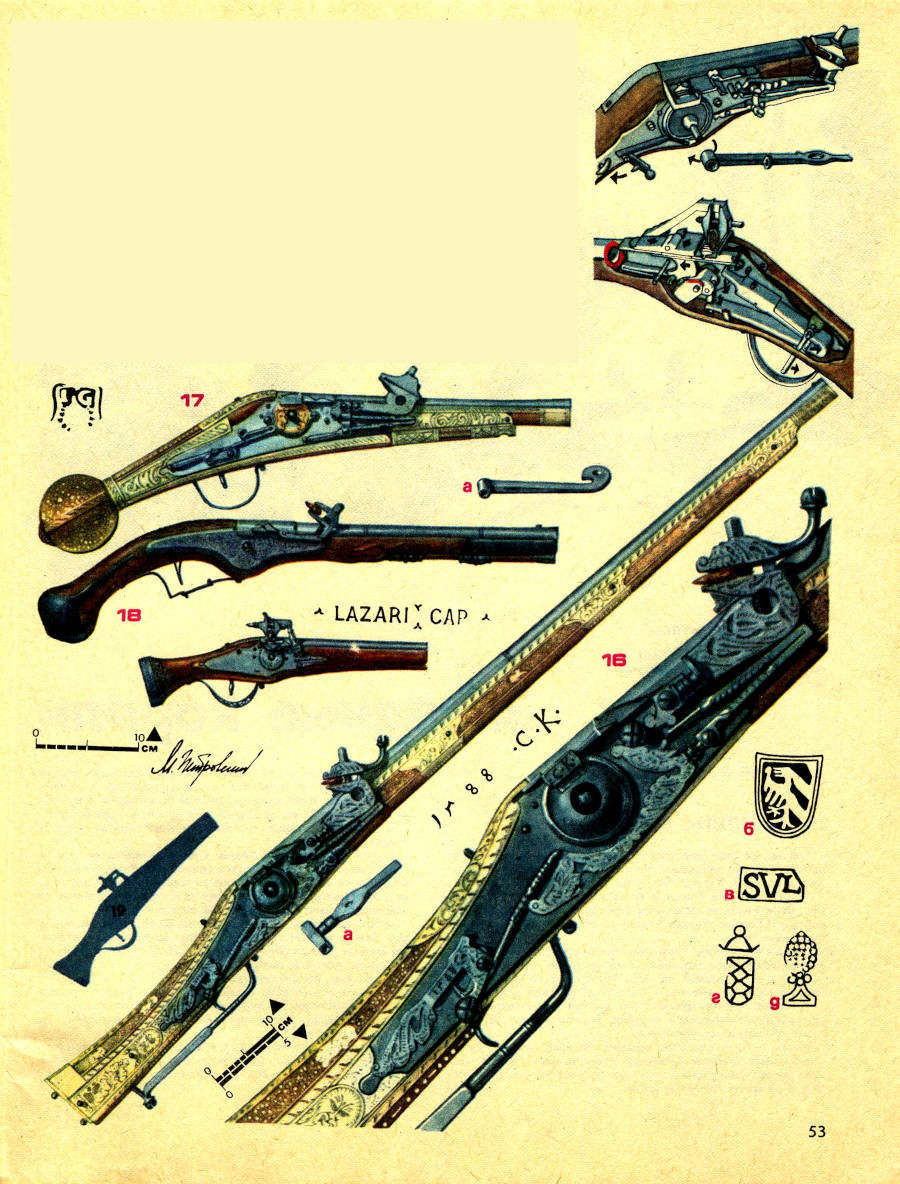
16. A wheellock arquebus made in 1588 in Saxony. Wheellock mechanism and proof mark engraved on it. From the collection of the State Museums of the Moscow Kremlin.
17. A saddle pistol with a wheellock mechanism, made by a Saxon gunsmith in the 16th century, and its proof mark. From the collection of the State Museums of the Moscow Kremlin.
18. An Italian pocket pistol from the 17th century with a wheellock mechanism. Inscription on the barrel of the pistol. From the collection of the State Museums of the Moscow Kremlin.
A. Western European keys for wheellock pistols of the 17th century.
B. Nuremberg municipal proof mark. 1500.
C. Suhl municipal proof mark. 1600.
D. Amsterdam municipal proof mark. 1610.
E. Utrecht municipal proof mark. 1600.
Diagram of the wheellock mechanism.